
Southern Carmine Bee-eater Identification Guide
A dazzling, colony-nesting bee-eater of south-central Africa, unmistakable for its vivid carmine-pink plumage, turquoise head, and long tail streamers.
Read the full Southern Carmine Bee-eater encyclopedia entry →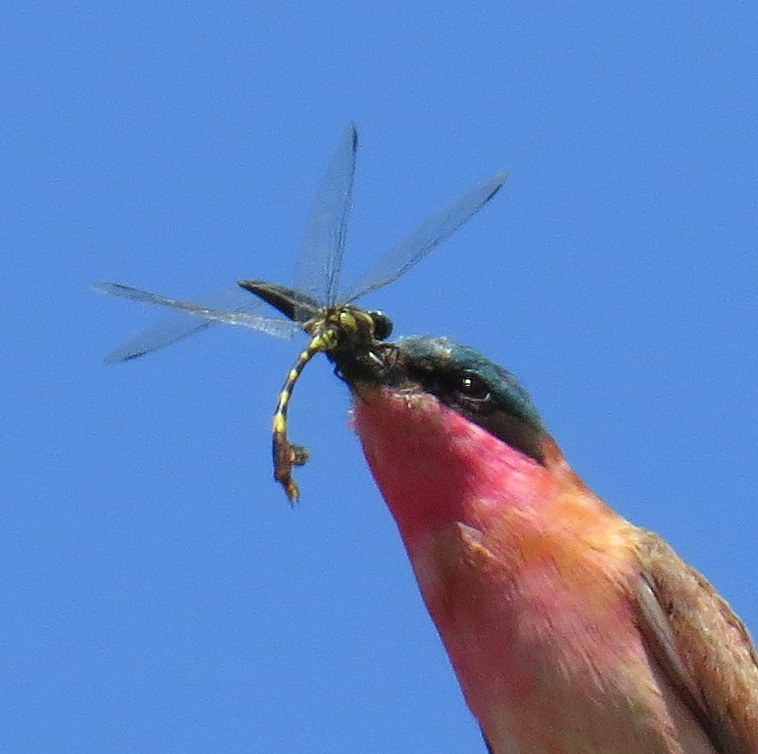
Key Field Marks
- Size & shape: A slender, aerodynamic bee-eater about 25–27 cm long including elongated central tail feathers that add several more centimetres.
- Plumage: Overwhelmingly carmine-pink body plumage, with a turquoise-blue crown, throat, and rump/undertail contrasting sharply against the pink.
- Bill: Long, black, slightly downcurved, typical bee-eater shape for snatching flying insects.
- Tail: Long, pointed central tail streamers extend well beyond the rest of the tail, visible even in flight.
- In flight: Pointed wings and streamlined body give a fast, swallow-like silhouette; flocks wheel and glide together while hawking insects.
Separating It From Similar Species
- Northern Carmine Bee-eater is extremely similar but has a blue crown and forehead with a green (not turquoise) throat, and its range is centered on the Sahel and East Africa; the two species' breeding ranges barely overlap, with Southern Carmine found from Angola/Zambia south to South Africa (mainly as an intra-African migrant).
- European Bee-eater and other bee-eaters lack the all-pink body and instead show yellow, chestnut, or green tones.
- No other widespread African bird combines an entirely carmine-pink body with a turquoise head, so a good look eliminates confusion quickly.
Where and When to See It
Southern Carmine Bee-eaters breed colonially in large numbers, excavating nest tunnels in vertical sandy riverbanks and road cuttings — colonies of hundreds to over a thousand pairs occur along rivers such as the Luangwa, Zambezi, and Okavango. They are intra-African migrants: birds arrive at southern breeding colonies (Zambia, Zimbabwe, Botswana, northern South Africa, Namibia) around August–September, breed through the austral spring, and move north again after breeding, with non-breeding birds ranging as far as the Democratic Republic of Congo and East Africa. Look for them near river cliffs and sandbanks, and watch for their habit of riding on the backs of large animals (kori bustards, antelope) or vehicles to snatch insects flushed from the grass.
Voice
A distinctive guttural, rolling "terrk terrk" or "quirt-quirt" flight call, often given in chattering flocks as they wheel over rivers and grassland; colonies are noisy with overlapping calls from many birds at once.
Frequently asked questions
How do I tell Southern Carmine Bee-eater from Northern Carmine Bee-eater?
Look at the head: Southern Carmine has a turquoise crown and throat, while Northern Carmine has a blue crown with a green throat. Range also helps — Southern Carmine breeds in south-central Africa, Northern Carmine in the Sahel and East Africa.
Why do Carmine Bee-eaters sit on the backs of animals?
They use large animals such as kori bustards, antelope, or even vehicles as mobile perches, snapping up insects that are flushed from the grass as the animal moves.
Where is the best place to see a Southern Carmine Bee-eater colony?
Large breeding colonies form in sandy riverbanks along rivers like the Luangwa (Zambia) and Zambezi, typically visible from August through the austral spring/early summer.
Is the Southern Carmine Bee-eater migratory?
Yes, it is an intra-African migrant, moving to southern breeding grounds for the austral spring and dispersing north after breeding, sometimes reaching Central and East Africa.