
Southern Brown Kiwi Identification Guide
A flightless, nocturnal New Zealand icon best identified by its shaggy brown feathers, long probing bill, and eerie whistling calls heard after dark.
Read the full Southern Brown Kiwi encyclopedia entry →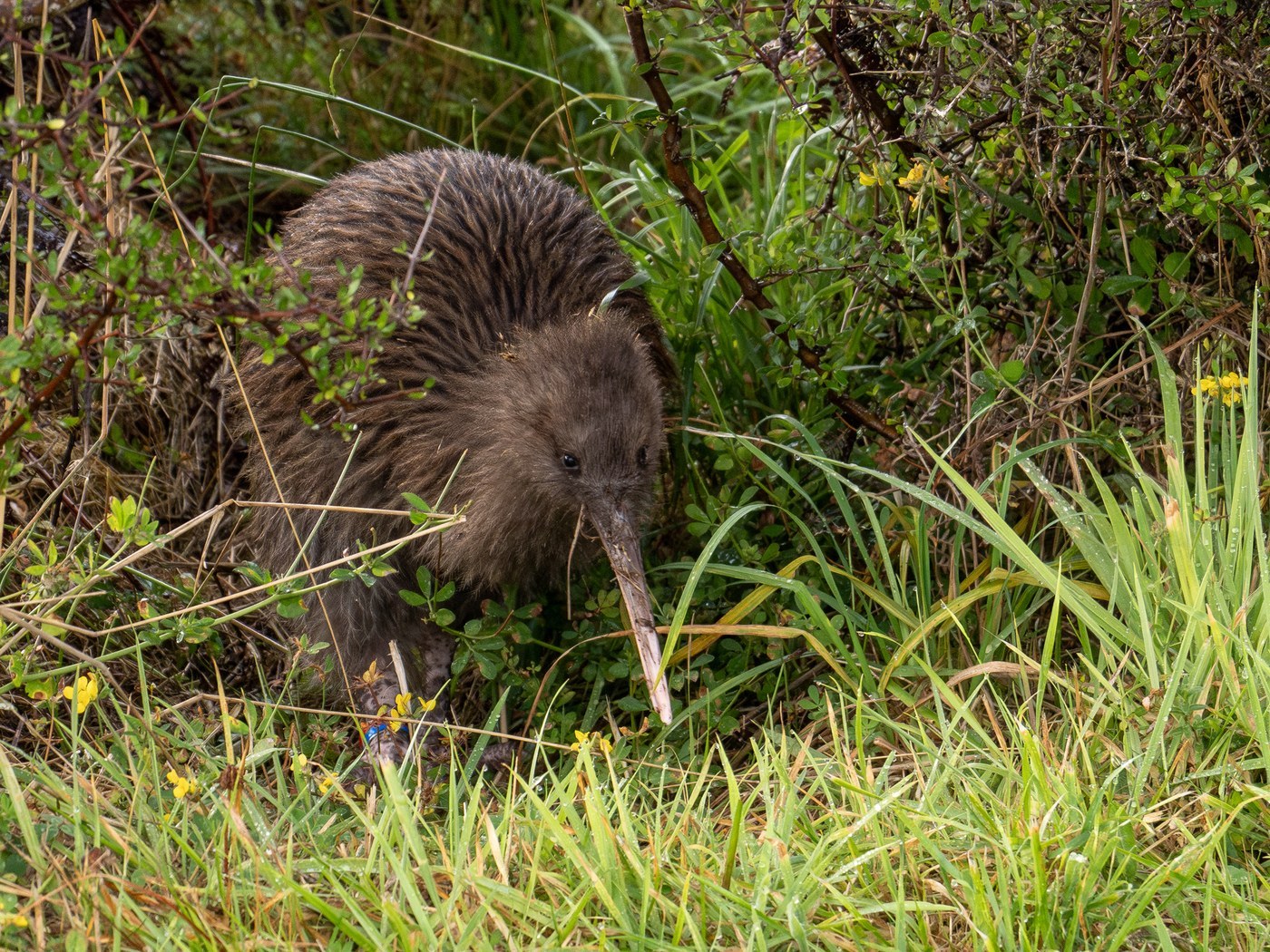
Key Field Marks
- Size & shape: A stocky, tailless, wingless-looking bird roughly the size of a domestic chicken, standing about 40 cm tall. The body is pear-shaped and hunched, with no visible neck.
- Plumage: Shaggy, hair-like grey-brown to reddish-brown feathers cover the entire body, giving it a mammal-like appearance rather than a typical bird silhouette.
- Bill: Long (up to 12 cm in females), slightly downcurved, ivory-pale at the tip, with nostrils located at the very end of the bill — unique among birds and used to smell prey underground.
- Legs & feet: Thick, powerful, scaly grey legs with strong claws, built for digging and running rather than flying.
- Eyes: Small and dark; vision is poor, and the bird relies primarily on smell and touch (facial whiskers) to navigate.
Separating It From Similar Species
Southern Brown Kiwi (Apteryx australis) is one of five recognized kiwi species/taxa in New Zealand, and range is the most reliable way to separate them:
- North Island Brown Kiwi occupies the North Island only; Southern Brown Kiwi is restricted to the South Island (Fiordland and Haast) and Stewart Island (where it is known as Tokoeka).
- Great Spotted Kiwi is larger and shows fine grey-and-white barring/mottling rather than the more uniform streaky brown of the Southern Brown Kiwi.
- Little Spotted Kiwi is noticeably smaller and paler grey with fine mottling.
- Rowi (Okarito Brown Kiwi) is confined to a small area near Okarito and tends to show a slightly greyer tone and can have white facial feathers. Because kiwi are almost never seen well in the field, range/locality plus call is usually more useful for confirming identity than plumage alone.
Where and When to See It
Southern Brown Kiwi inhabit native forest, scrubland, subalpine tussock grassland, and even rough pasture on Stewart Island, where predator numbers are lower and kiwi sometimes forage in daylight. On the South Island mainland they are almost strictly nocturnal and best detected at dusk or after dark using their calls; guided night walks in Fiordland and on Stewart Island (Ulva Island and Rakiura) offer the best realistic chances of a sighting. They do not migrate and are present year-round, though calling activity often peaks in the breeding season (winter months, roughly June to March depending on region).
Voice
- Males give a shrill, ascending series of whistled notes, often repeated many times and carrying long distances through forest.
- Females give a lower, hoarser, more guttural cough or growling call.
- Both sexes may snort or grunt while foraging, and rustling/snuffling sounds in leaf litter at night are a good clue to a nearby bird.
Frequently asked questions
How can I tell a Southern Brown Kiwi apart from a North Island Brown Kiwi?
Plumage is very similar, so range is the key: Southern Brown Kiwi occurs only on the South Island and Stewart Island, while North Island Brown Kiwi is restricted to the North Island. The two do not overlap.
Is the Southern Brown Kiwi active during the day?
Almost never on the mainland — it is strictly nocturnal there. On predator-reduced Stewart Island, however, kiwi are sometimes seen foraging in daylight, especially in overcast conditions.
What is the easiest way to detect a kiwi without seeing one?
Listen at dusk or after dark for the male's shrill, rising whistle or the female's harsher, lower call, and listen for snuffling and rustling in leaf litter as it probes for invertebrates.
Do Southern Brown Kiwi fly at all?
No. Like all kiwi they are completely flightless, with only vestigial wings hidden under their feathers.
What is a 'Tokoeka'?
Tokoeka is the Māori name commonly used for the Stewart Island and Fiordland populations of Southern Brown Kiwi.