
Southern Boobook Identification Guide
Australia's most widespread small owl, identified by its dark, spectacled facial pattern and its distinctive repeated two-note "boo-book" call.
Read the full Southern Boobook encyclopedia entry →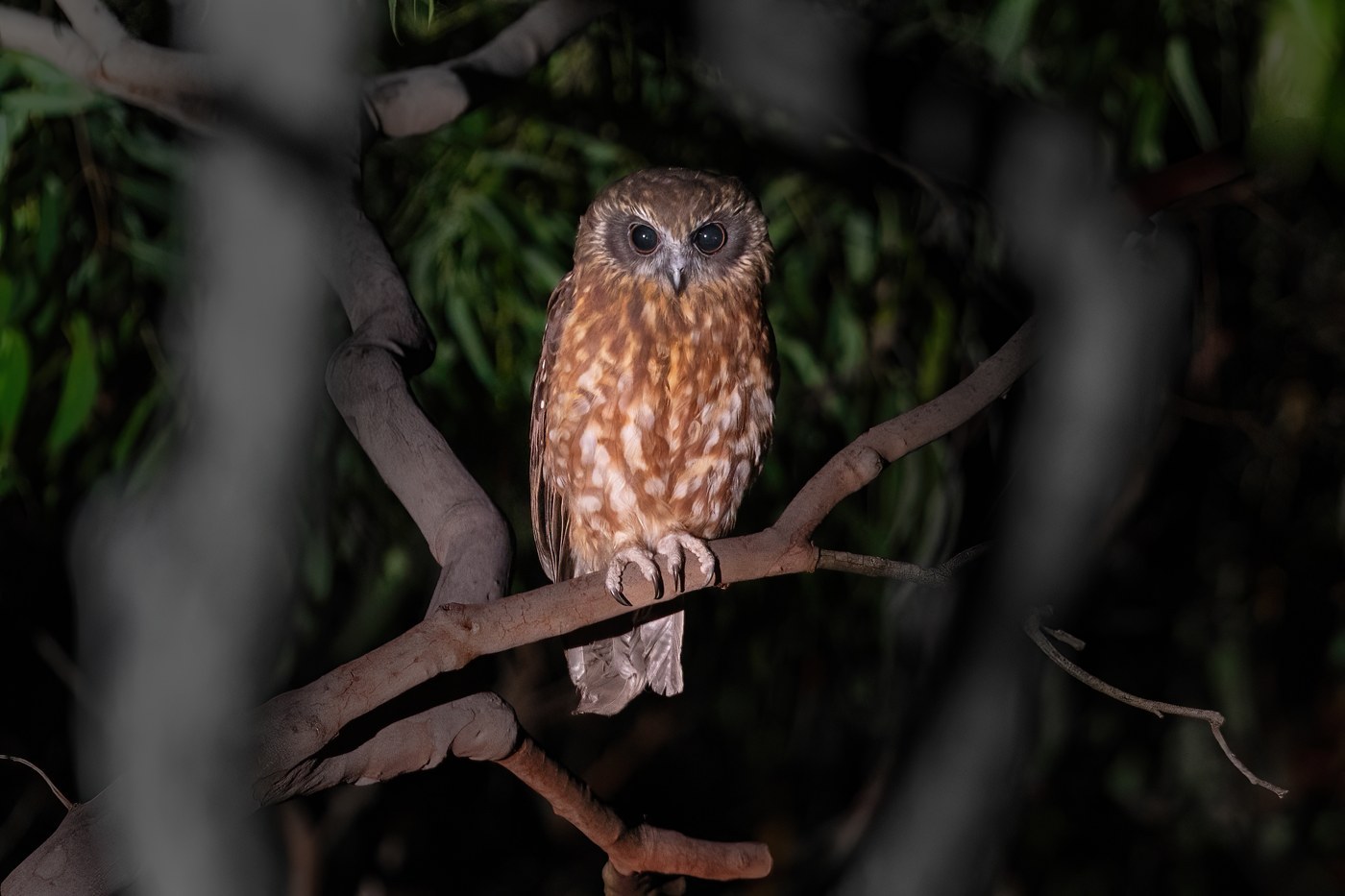
Key Field Marks
- Size & shape: Small owl, about 27–36 cm, with a rounded head, no ear tufts, and a compact body.
- Plumage: Dark brown above with pale buff spotting on the wings and back; paler underparts streaked with brown. The face shows a distinctive "spectacled" look, with dark patches around the eyes bordered by paler eyebrows and facial disc edges.
- Eyes: Yellow-green to greenish, giving an intense stare within the dark facial mask.
- Behavior: Strictly nocturnal, roosting quietly in dense foliage during the day (where it is frequently mobbed by small birds if discovered) and becoming active and vocal after dusk.
Separating It From Similar Species
- Barking Owl: Considerably larger and paler, with a more staring yellow-eyed expression and a very different call — a harsh, dog-like bark rather than the boobook's clear two-note hoot.
- Powerful Owl: Much larger still, with a heavier build and different vocalizations, unlikely to be confused at a good look.
- Morepork (New Zealand): A very close relative, now usually treated as a separate species from Southern Boobook, sharing a similar appearance and call type but occurring in New Zealand rather than mainland Australia.
Where & When to See One
- Habitat: Highly adaptable, found in eucalypt forests, woodlands, and increasingly in urban parks and leafy suburban gardens across its range.
- Range: Widespread and common across mainland Australia and Tasmania; resident year-round.
- Season: Present all year; most easily detected on calm nights when territorial calling is frequent, especially in the breeding season.
Voice
- A far-carrying, repeated two-note call, often rendered as "boo-book" or "mo-poke," which gives the species both its common name and its familiar Australian nickname.
Frequently asked questions
How do you recognize the Southern Boobook's call?
Listen for a clear, repeated two-note call often written as "boo-book" or "mo-poke," typically given steadily through the night, which is how the species got its name.
What does a Southern Boobook look like up close?
A small, tuftless owl with dark brown upperparts spotted buff, streaked pale underparts, and a distinctive dark "spectacled" pattern around the yellow-green eyes.
How is Southern Boobook different from Barking Owl?
Barking Owl is much larger and paler with a harsh, dog-like barking call, while Southern Boobook is smaller, darker, and gives a clear two-note hooting call.
Is the Morepork the same species as the Southern Boobook?
They are very close relatives that were once considered the same species, but the New Zealand Morepork is now generally treated as a separate species from the Australian Southern Boobook.
What habitat is best for finding Southern Boobooks?
They occupy a wide range of wooded habitats across Australia, from eucalypt forest and woodland to leafy urban parks and gardens, and are best located at night by their call.