
Sooty Tern Identification Guide
A pantropical, deeply forked-tailed tern with a blackish-sooty back and cap contrasting sharply with a crisp white forehead and underparts, nesting in enormous noisy island colonies.
Read the full Sooty Tern encyclopedia entry →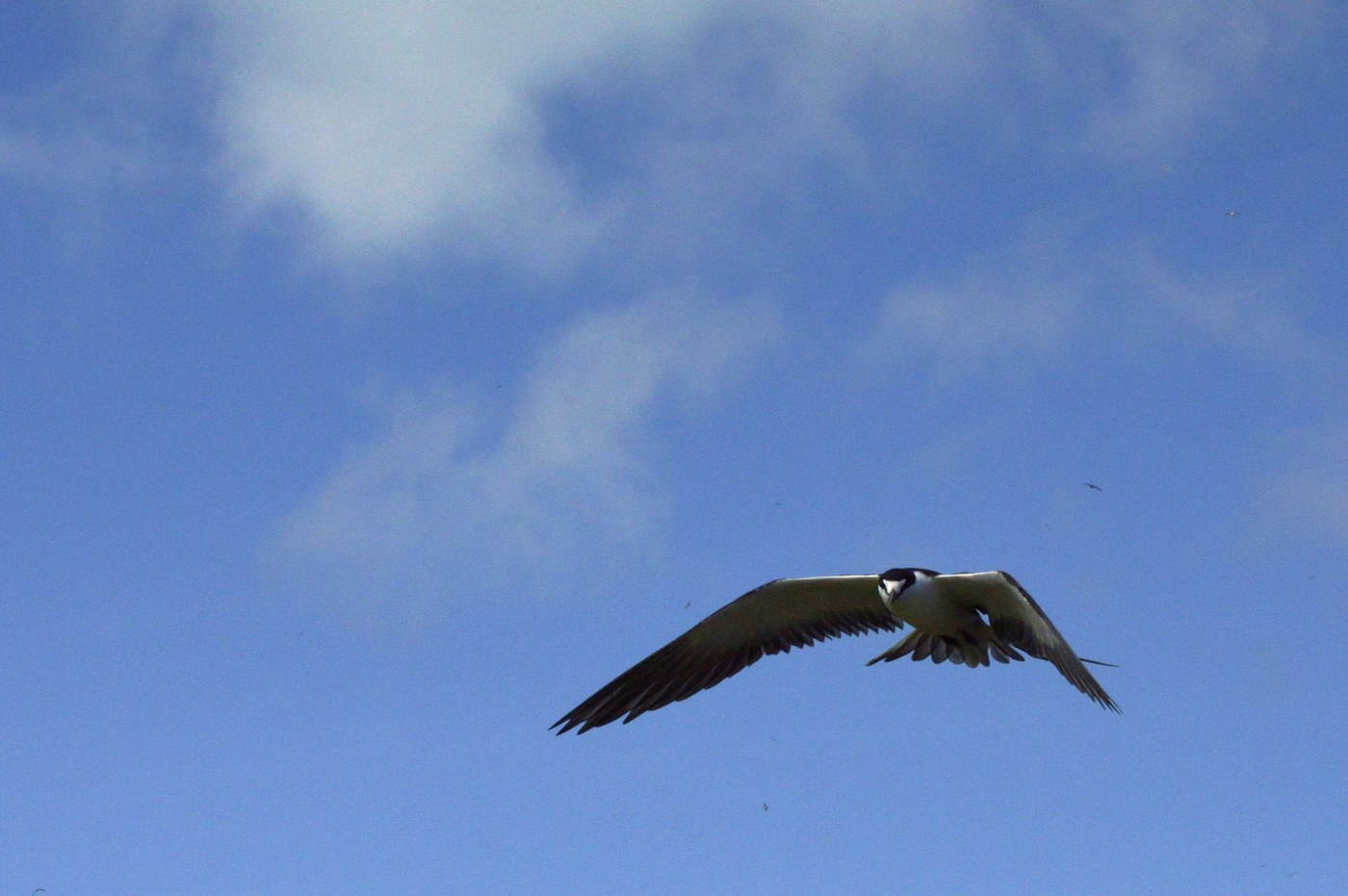
Key Field Marks
- Size & shape: Medium-sized tern, about 36–45 cm, with long, pointed wings and a long, deeply forked tail.
- Plumage: Blackish-sooty upperparts and cap contrast sharply with clean white underparts; a crisp white patch on the forehead is bordered by a black line running through the eye and connecting to the black cap.
- Bill: Black, straight, and fairly slender.
- Behavior: Extremely pelagic — after fledging, young birds may stay continuously at sea for years without ever landing, until they return to breed. Forms enormous, densely packed, very noisy colonies on tropical islands.
Separating It From Similar Species
- Bridled Tern: Paler grayish-brown (not blackish) upperparts, and the white forehead patch extends back as a thin pale line (supercilium) above and behind the eye, giving a less sharply contrasting, more "washed" look than Sooty Tern's crisp black-and-white pattern.
- Common Tern / Sandwich Tern: Both are much paler gray above and lack the strong blackish-and-white contrast and deep tail fork typical of Sooty Tern.
- Overall impression: Sooty Tern shows the boldest black-and-white contrast of the dark-backed terns, with a shorter white forehead patch that stops at the eye rather than extending behind it.
Where & When to See One
- Habitat: Open tropical and subtropical oceans; comes to land essentially only to breed, nesting in dense colonies on remote islands and atolls, often on bare sand or coral rubble.
- Range: Pantropical, found across tropical oceans worldwide. In the United States, the primary breeding colony is at the Dry Tortugas off the Florida Keys; birds can occasionally be displaced well inland or northward by hurricanes and tropical storms.
- Season: Present at breeding colonies mainly in the warmer months; otherwise ranges widely and unpredictably over open ocean.
Voice
- A harsh, nasal, two- or three-syllable call often rendered as "wide-awake," which earned the species the old nickname "wideawake tern" at some breeding colonies; colonies are extremely noisy around the clock.
Frequently asked questions
How do you tell Sooty Tern from Bridled Tern?
Sooty Tern has blackish upperparts with a white forehead patch that stops near the eye, giving a bold, sharply contrasting look, while Bridled Tern is paler grayish-brown with a white forehead patch extending back as a thin pale line above and behind the eye.
Why are Sooty Terns sometimes seen far inland?
Strong hurricanes and tropical storms can displace this highly pelagic species well inland or far north of its normal tropical ocean range, resulting in unusual inland sightings after major storms.
Where does the Sooty Tern breed in the United States?
Its main US breeding colony is at the Dry Tortugas National Park off the Florida Keys.
How long can Sooty Terns stay at sea without landing?
Fledged young are thought to remain continuously at sea for a year or more, sometimes several years, before returning to land to breed for the first time.