
Sooty Shearwater Identification Guide
An entirely dark, fast-flying ocean seabird recognized by its uniformly sooty-brown body contrasted with pale silvery underwing linings, often seen in huge migrating flocks.
Read the full Sooty Shearwater encyclopedia entry →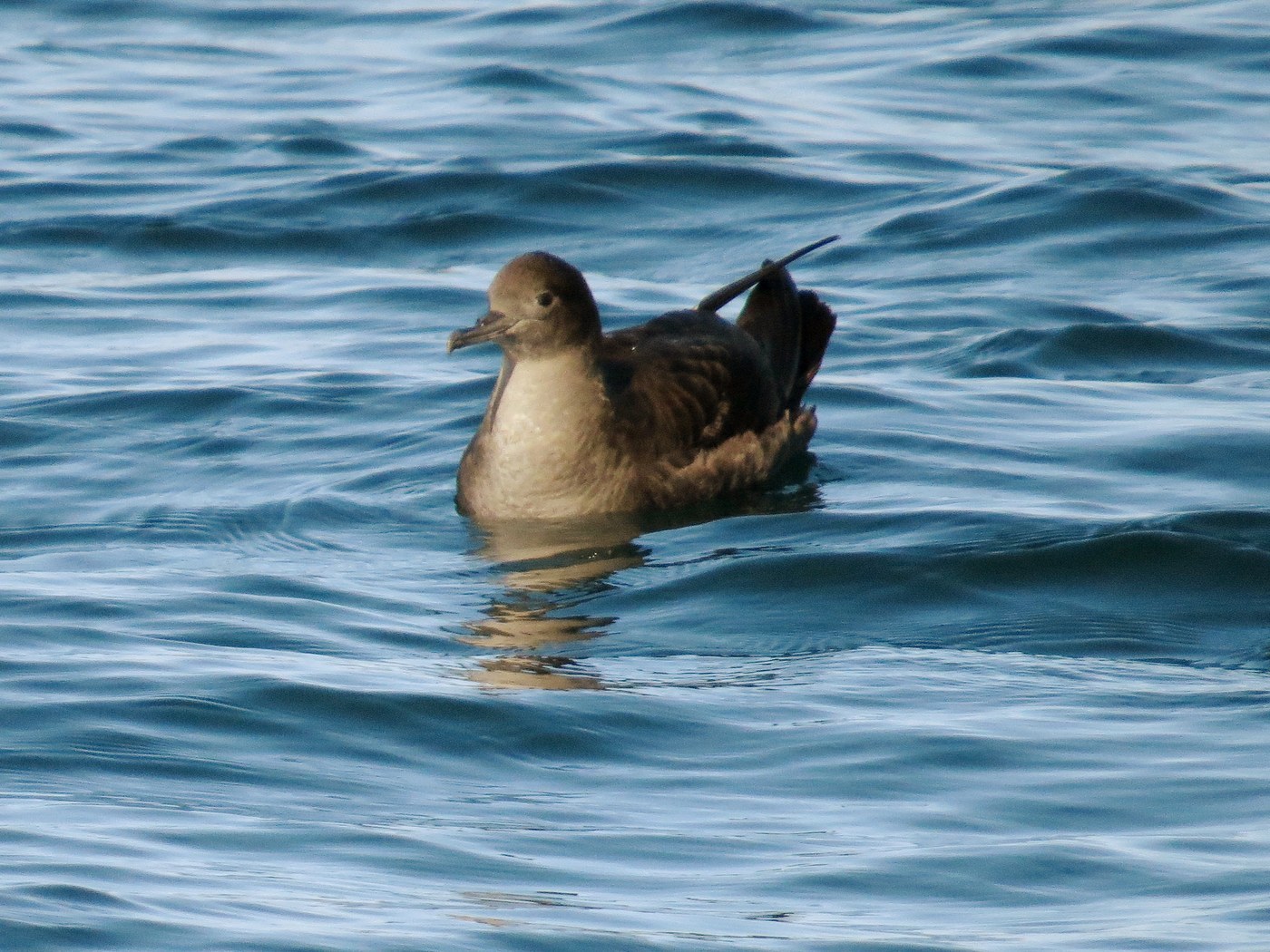
Key Field Marks
- Size & shape: Medium-large shearwater, roughly 40–51 cm long with a wingspan near 94–109 cm; slim-bodied with fairly narrow, pointed wings held stiffly.
- Plumage: Entirely sooty dark brown to blackish overall, with no pale collar, cap contrast, or white belly. The key mark is the underwing: pale silvery-white wing linings flash noticeably against the dark body in good light and at the right angle.
- Bill: Slender, dark, with a hooked tip typical of tubenoses.
- Flight: Fast, stiff-winged flapping alternating with long, low glides that arc close to the water's surface, typical shearwater "shearing" flight; often in large, dense flocks that can number in the thousands.
Separating It From Similar Species
- Short-tailed Shearwater: Extremely similar; Short-tailed is slightly smaller with a shorter, more delicate bill, a steeper, rounder forehead, and generally shows less contrastingly pale underwings — most reliably separated by range, season, and structure rather than a single field mark.
- Flesh-footed Shearwater: Shows a pale pinkish bill and pink feet, unlike the all-dark bill and feet of Sooty Shearwater.
- Other dark shearwaters: The combination of entirely sooty plumage with strongly contrasting pale underwing linings is the best quick separator from most other dark tubenoses.
Where & When to See One
- Habitat: Highly pelagic, spending virtually all its time over open ocean far from shore except when breeding.
- Breeding range: Colonies on islands off New Zealand, southeastern Australia, and southern South America, nesting in burrows during the austral summer.
- Non-breeding range: An impressive trans-equatorial migrant — after breeding, huge numbers migrate north into the North Pacific and North Atlantic during the northern summer, making it visible in enormous numbers from shore in places like California (e.g., Monterey Bay) and other productive coastal waters.
- Season: In North American waters, most common from late spring through summer and into fall during its non-breeding migration.
Voice
- Essentially silent at sea; at nesting colonies, gives harsh, guttural cackling and crooning calls, mainly after dark at the burrow.
Frequently asked questions
What is the best field mark for Sooty Shearwater?
An entirely sooty dark-brown body combined with pale, silvery-white underwing linings that flash visibly in flight — a strong contrast on an otherwise all-dark bird.
How do you separate Sooty Shearwater from Short-tailed Shearwater?
They are very similar; Short-tailed is slightly smaller with a shorter, more delicate bill, a steeper rounded forehead, and typically less contrastingly pale underwings, so range, season, and overall structure are often needed to confirm identification.
Why are Sooty Shearwaters sometimes seen in huge numbers from shore?
They are trans-equatorial migrants that travel in massive flocks from southern hemisphere breeding islands to rich northern hemisphere feeding waters during the northern summer, sometimes producing spectacular shoreline concentrations in places like coastal California.
Where does the Sooty Shearwater breed?
It nests in burrows on islands off New Zealand, southeastern Australia, and southern South America during the austral summer.