
Solitary Sandpiper Identification Guide
A dark, white-spotted sandpiper with a bold white eye-ring that lives up to its name by foraging alone at small woodland ponds and ditches rather than on open shorelines with other shorebirds.
Read the full Solitary Sandpiper encyclopedia entry →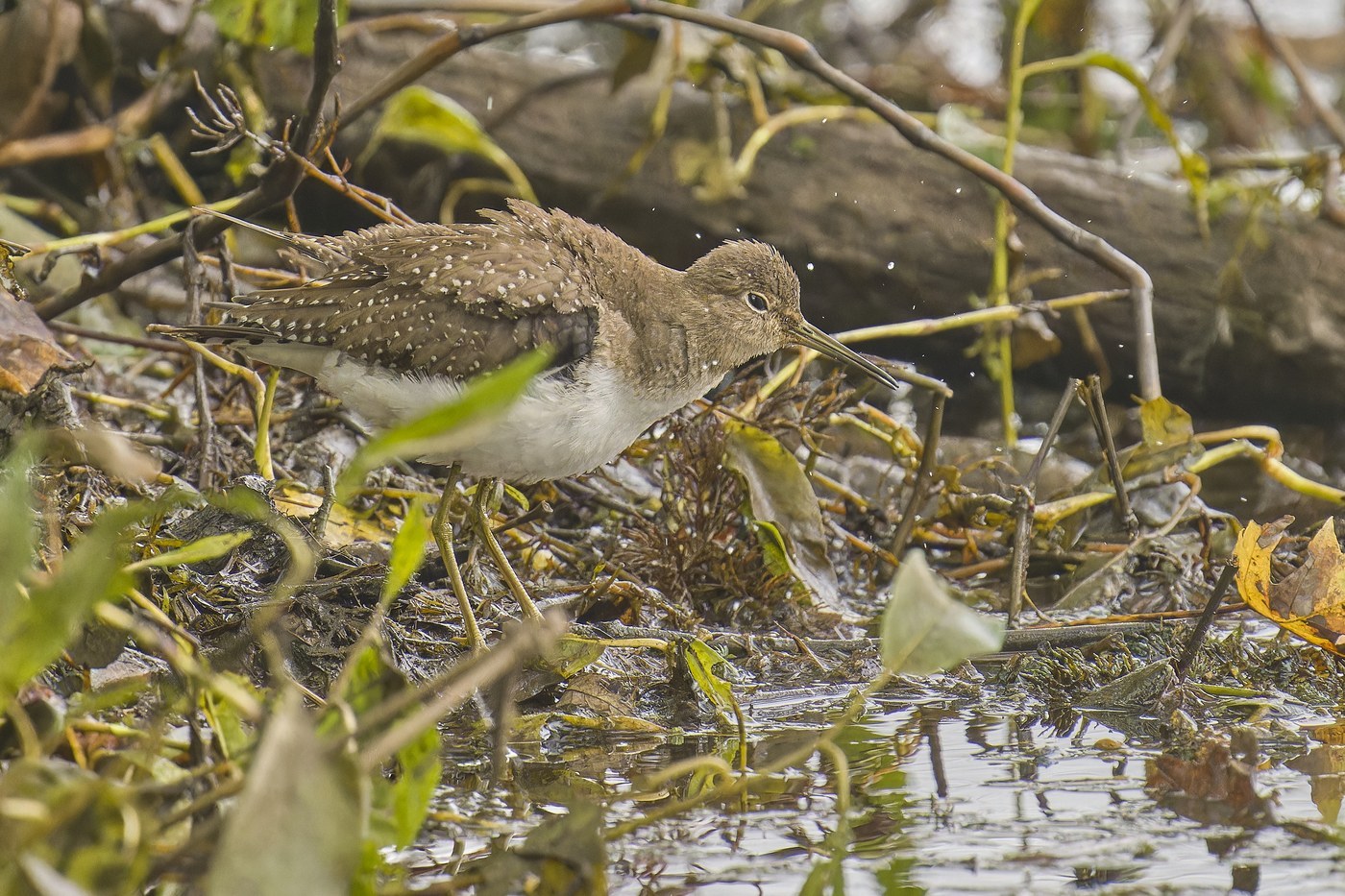
Key Field Marks
- Size & shape: Medium-sized sandpiper, about 7.5–9 inches, slim and elegant with a straight, medium-length dark bill.
- Plumage: Dark olive-brown to blackish upperparts finely spangled with small white spots; white underparts; a distinct, bold white eye-ring gives the face an alert, wide-eyed look.
- Legs: Olive-green to dull yellowish-green, medium length.
- Behavior: True to its name, usually found alone or in loose twos rather than in flocks. Bobs its rear end gently but far less constantly than a Spotted Sandpiper. When flushed, gives a sharp call and often towers up steeply in an erratic, swallow-like flight before dropping back down.
Separating It From Similar Species
- Spotted Sandpiper: Constantly teeters its whole body, has bold black spots on the breast in breeding plumage, and flies low over water with stiff, shallow, fluttery wingbeats rather than towering into the air.
- Lesser Yellowlegs: Larger, longer-necked, with bright yellow legs and typically found in more open, social flocks on mudflats rather than alone at wooded pools.
- Spotted vs. Solitary in flight: Solitary Sandpiper shows dark underwings and a dark rump/tail with barred outer tail feathers and no white wing stripe, aiding separation from other Tringa sandpipers.
Where & When to See One
- Habitat: Small freshwater wetlands — wooded pond edges, forest pools, flooded ditches, muddy stream margins, and puddles in fields; generally avoids large open shorelines and mudflats favored by flocking shorebirds.
- Breeding range: Boreal forest of Canada and Alaska, where uniquely among North American shorebirds it lays eggs in old songbird nests in trees rather than on the ground.
- Migration/winter: Migrates in small numbers or singly through the United States to winter from Mexico south through Central and South America.
- Season: Look for it during spring (April–May) and fall (July–September) migration at small, quiet wetland edges.
Voice
- A sharp, high-pitched "peet-weet" or "weet-weet-weet," higher and thinner than the similar call of Spotted Sandpiper, often given as the bird flushes and towers upward.
Frequently asked questions
Why is it called the Solitary Sandpiper?
Because unlike most shorebirds, it is usually seen alone or in very small, loose groups rather than in large flocks, and it favors small, quiet, often wooded wetlands over open flocking habitat.
How do you tell Solitary Sandpiper from Spotted Sandpiper?
Solitary Sandpiper has a bold white eye-ring, finely white-spotted dark upperparts, and towers up in flight when flushed, while Spotted Sandpiper constantly teeters, shows dark breast spots when breeding, and flies low with stiff, fluttery wingbeats.
Where does the Solitary Sandpiper nest?
Uniquely among North American sandpipers, it nests in trees, using old nests built by songbirds such as robins or jays in the boreal forest of Canada and Alaska.
What habitat should I check to find one?
Small, quiet freshwater spots such as wooded pond edges, flooded ditches, forest pools, and muddy puddles — not large open mudflats or beaches.