
Society Finch Identification Guide
A domesticated aviary finch, bred over centuries from the wild White-rumped Munia, recognized by its variable pied brown-and-white or fawn-and-white plumage rather than any wild field marks.
Read the full Society Finch encyclopedia entry →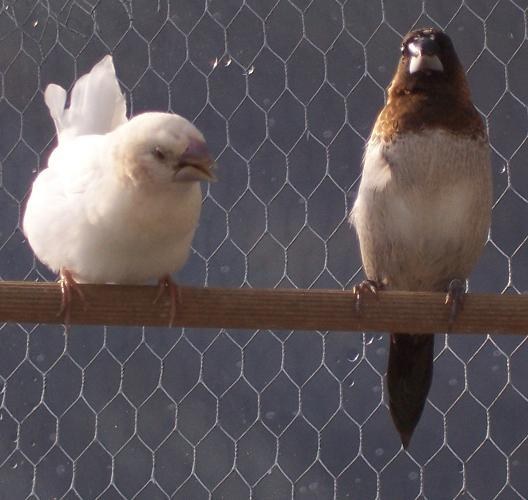
Key Field Marks
- Origin: The Society Finch (also called the Bengalese Finch) is not a wild species — it is a domesticated form developed over several centuries of selective breeding in China and Japan from the wild White-rumped Munia (Lonchura striata). There is no natural wild population or range to search for this bird in the field.
- Size & shape: Small, stocky finch, roughly 10–11 cm, with a short, stout, conical bill typical of munias/mannikins.
- Plumage: Highly variable due to generations of selective breeding. Common forms include "chocolate and white" pied birds (patches of dark brown and white), solid fawn, solid chocolate/brown, and pure white; crested forms also exist. No two color patterns are guaranteed to look alike.
- Bill: Stout, conical, pale gray to horn-colored.
- Behavior: Highly social and tame; kept in aviaries and cages, often in small flocks, and used historically as foster parents for other finch species' eggs.
Separating It From Similar Species
- White-rumped Munia (its wild ancestor): Uniformly dark brown above with a clean white rump and scaly buff underparts — much more uniform and "wild-plumaged" than the patchy pied colors typical of Society Finches.
- Other domesticated munias/mannikins: Society Finches are best recognized by the combination of variable pied or solid pastel coloring plus captive/aviary context, since true wild munias show consistent, unbroken natural plumage patterns.
- Because Society Finches are not established in the wild in most regions, encountering one outdoors typically means it is an escaped or released aviary bird rather than a naturally occurring population.
Where & When to See One
- Habitat: Exclusively an aviculture (cage and aviary) bird; not tied to any natural habitat, range, or season.
- Range: Kept worldwide in captivity; escapees are occasionally reported but do not typically form self-sustaining wild populations in most regions.
Voice
- Soft chirps and chattering contact calls; males produce a quiet, warbling courtship song accompanied by bill-wiping and bobbing displays, typical of estrildid finches.
Frequently asked questions
Is the Society Finch a wild bird?
No. It is a fully domesticated finch developed through centuries of selective breeding from the wild White-rumped Munia, and it has no natural wild range.
How do you tell a Society Finch from its wild ancestor?
The wild White-rumped Munia has uniform dark brown plumage with a clean white rump, while Society Finches show variable pied, fawn, chocolate, or white patterns from selective breeding.
Why might you see a Society Finch outdoors?
Any Society Finch seen outside a cage or aviary is almost certainly an escapee or release, since the breed does not maintain self-sustaining wild populations in most areas.
What colors do Society Finches come in?
Common varieties include chocolate-and-white pied, solid fawn, solid chocolate, and pure white, with crested and non-crested forms also bred.