
Snow Petrel Identification Guide
A small, entirely pure white seabird of Antarctic and subantarctic waters, unmistakable in flight against dark ocean or ice thanks to its snowy plumage, black bill, and dark eyes.
Read the full Snow Petrel encyclopedia entry →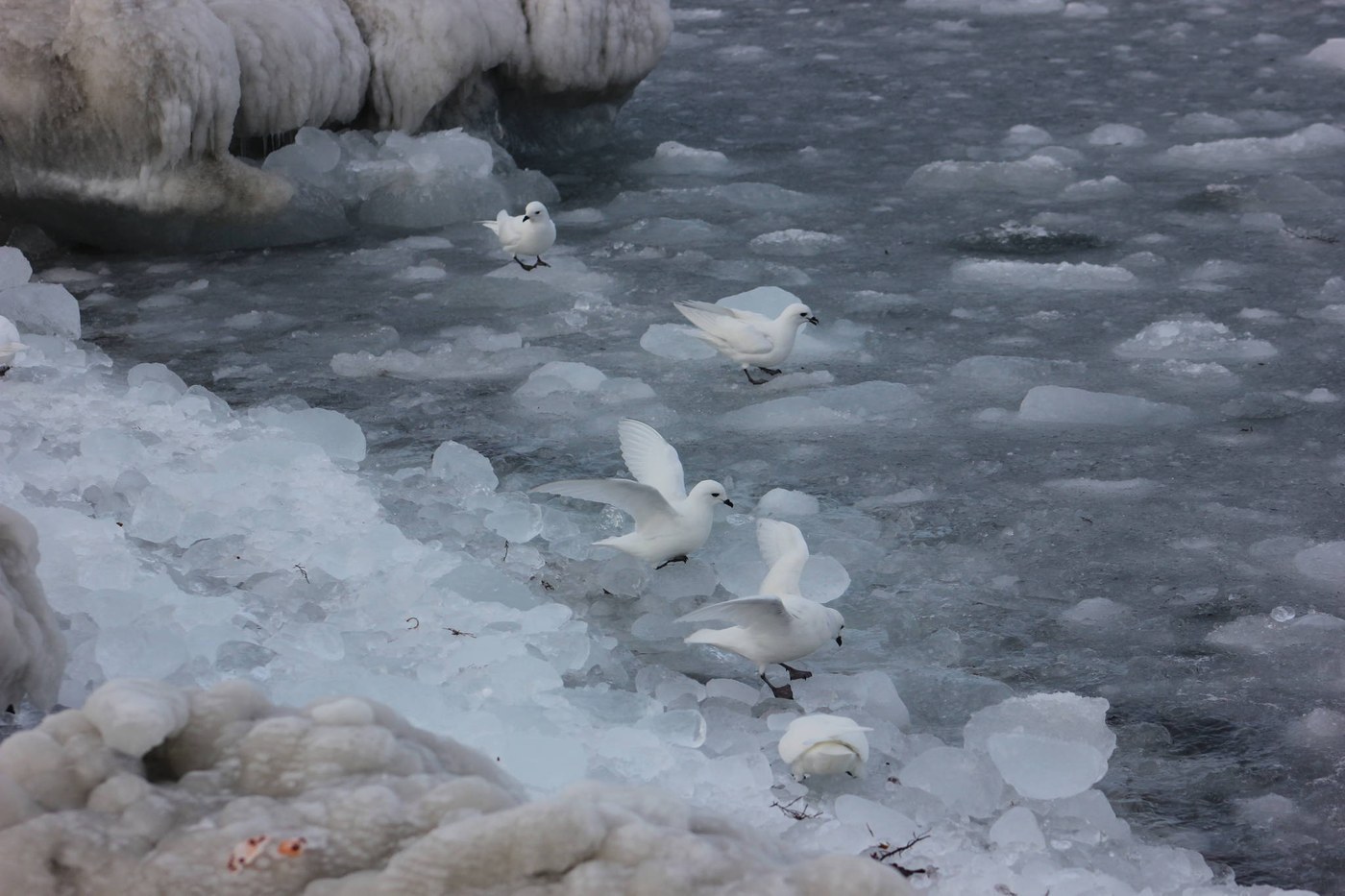
Overview
The Snow Petrel (Pagodroma nivea) is one of only a very small number of bird species that breed exclusively within the Antarctic continent, and it is unmistakable among Southern Ocean seabirds due to its entirely white plumage. It is closely tied to pack ice and cold Antarctic and subantarctic waters throughout its range, rarely straying into warmer seas, and is often seen fluttering low over ice floes and dark open water in a distinctive erratic, batlike flight.
Key Field Marks
- Plumage: Entirely pure white body, head, and wings with no other coloring in the plumage — the only Southern Ocean seabird with this completely white appearance.
- Bare parts: Small black bill and dark brown-black eyes, both standing out sharply against the white plumage and face.
- Size and shape: Small for a petrel, about 30-40 cm long, with a compact body, rounded head, and relatively short, rounded wings compared to larger albatrosses and shearwaters.
- Flight: Distinctive fluttering, erratic, batlike flight low over the water or ice, alternating rapid wingbeats with short glides, quite different from the stiff, gliding flight of larger tubenoses.
- Legs: Dark bluish-gray to black legs and feet, generally only visible at close range or when the bird is on ice or at the nest.
- Behavior: Closely associated with pack ice, icebergs, and open leads in the ice; feeds by picking prey items such as small fish, krill, and squid from the surface, and is often seen resting on ice floes, where its white plumage provides excellent camouflage.
Separating It From Similar Species
- White-morph fulmars, prions, and other Antarctic seabirds: No other Southern Ocean seabird is entirely white; Antarctic Petrel, Cape Petrel, and various prions all show substantial dark patterning on the upperwings, back, or head, immediately ruling out confusion with an all-white Snow Petrel.
- Sheathbills: Also entirely white and found in Antarctic/subantarctic regions, but sheathbills are non-flying-fish-eating shorebird relatives with a stout pale bill and fleshy facial wattles, a stocky pigeon-like body shape, and a terrestrial, scavenging lifestyle rather than the petrel's oceanic, fluttering flight — the two are not easily confused once seen well.
- Dove/Antarctic Prion: Shows a distinct dark "M" pattern across the upperwings and a blue-gray back, clearly different from the uniformly white Snow Petrel.
- General tip: In the harsh, high-latitude environment where it occurs, an entirely white, small, fast-fluttering seabird can essentially only be a Snow Petrel.
Habitat and Range
One of the most southerly distributed of all birds, breeding on rock outcrops and cliffs within Antarctica itself (including sites far inland from the coast) as well as on some subantarctic islands. It forages over open water within and at the edge of pack ice, and its at-sea range rarely extends much beyond the Antarctic Convergence, making it a true polar specialist among seabirds.
Voice
At breeding colonies gives a range of chattering, cackling, and harsh croaking calls during social interactions and nest defense, along with softer purring notes; largely silent away from colonies while foraging at sea, so voice is not typically a field identification tool for birders viewing this species offshore.
When to Look
Best encountered on Antarctic cruises and expeditions, particularly around pack ice edges and near breeding colonies, from the austral spring through summer breeding season (roughly October through March), when birds are most concentrated near the continent and its nearby islands.
Frequently asked questions
How do you identify a Snow Petrel?
Look for a small seabird that is entirely pure white with a black bill and dark eyes, flying with a distinctive fluttering, erratic flight low over pack ice or dark Antarctic water — no other Southern Ocean seabird shares this all-white plumage.
Where does the Snow Petrel live?
It is one of the most southerly distributed of all birds, breeding on rock outcrops within Antarctica and on some subantarctic islands, and foraging over open water at the edge of pack ice.
What does a Snow Petrel eat?
Small fish, krill, and squid, picked from the surface of open water near pack ice and ice edges.
How is a Snow Petrel different from a sheathbill?
Both are white Antarctic birds, but the sheathbill is a stocky, ground-dwelling scavenger with a stout pale bill and facial wattles, while the Snow Petrel is an oceanic tubenose seabird with a small black bill and fluttering flight.
When is the best time to see a Snow Petrel?
During the austral spring and summer (roughly October through March), on Antarctic cruises near pack ice edges and breeding colonies.