
Snow Goose Identification Guide
A widespread North American goose occurring in a bright white morph and a dark 'Blue Goose' morph, both showing black wingtips and a pink bill with a distinctive dark 'grinning patch' along the cutting edge.
Read the full Snow Goose encyclopedia entry →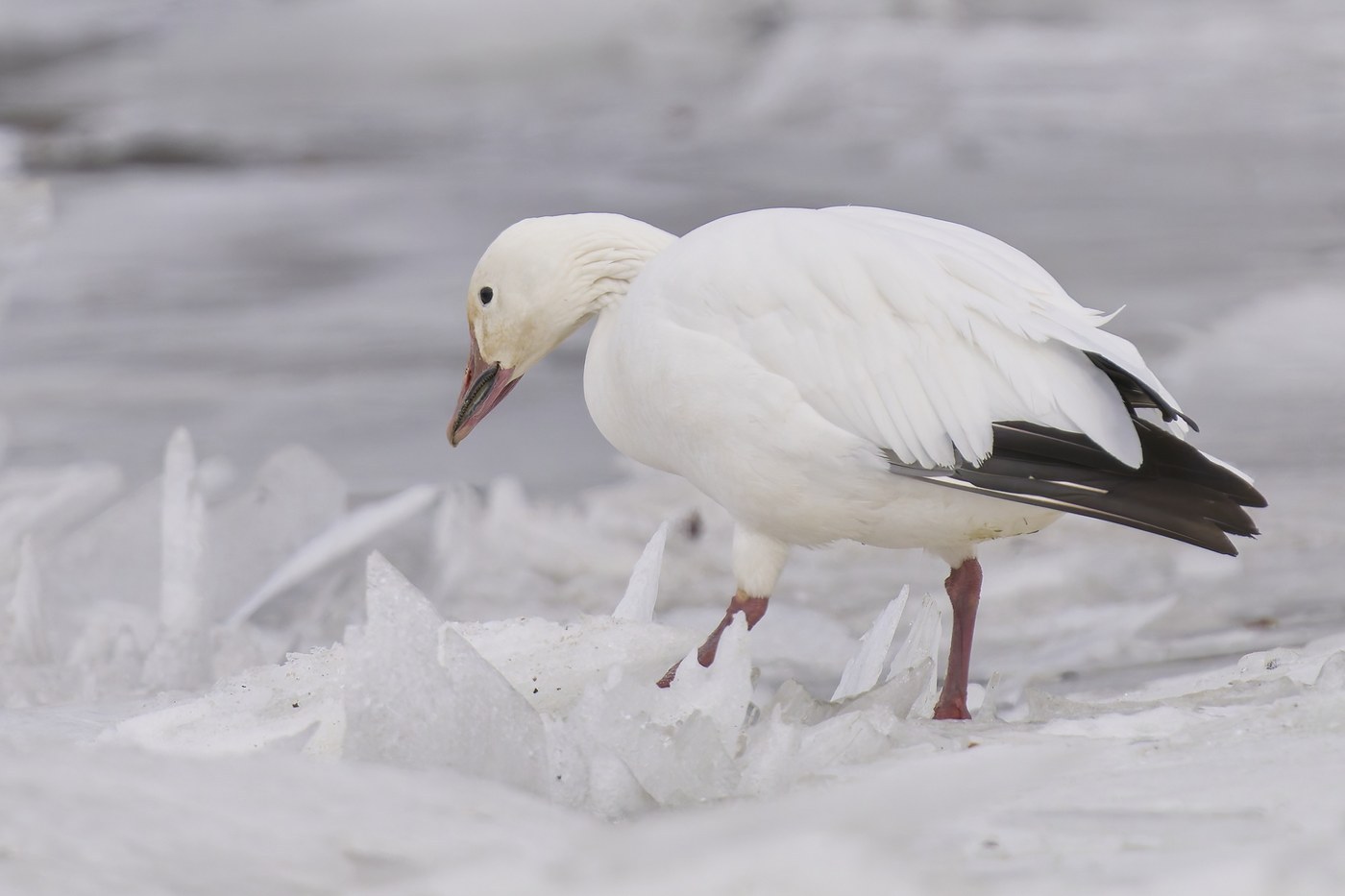
Overview
The Snow Goose (Anser caerulescens) is one of the most abundant and familiar geese in North America, breeding in vast colonies across Arctic tundra and wintering in huge, often spectacular flocks across much of the continental United States and Mexico. It occurs in two color morphs — a white morph and a dark "Blue Goose" morph — that were once considered separate species before being recognized as color forms of the same bird.
Key Field Marks
- Size and shape: A medium-large goose, about 60-79 cm long, with a fairly short neck, rounded head, and a distinctly triangular, deep-based bill.
- White morph: Almost entirely white body plumage with black primary (wingtip) feathers, visible mainly in flight and giving a striking white-bodied, black-tipped-wing appearance.
- Blue (dark) morph: Dark grayish-brown body with a white head and upper neck, contrasting sharply with the dark body; wings show varying amounts of pale gray and black. This morph is most common in the mid-continent population and much less frequent in western and Wrangel Island-breeding populations.
- Bill: Pink to reddish-pink, with a distinctive dark line along the cutting edge known as the "grinning patch" — visible at close range and useful for separating Snow Goose from the similar Ross's Goose.
- Legs: Pink to reddish-pink.
- Juveniles: White-morph juveniles show a dingy grayish wash overall rather than clean white, with a duller, grayish bill and legs; Blue-morph juveniles are darker and duskier than adults.
- Behavior: Highly gregarious, forming enormous flocks, often numbering in the tens of thousands to hundreds of thousands at major wintering and staging sites, feeding by grazing on grasses, waste grain, and grubbing for roots and tubers in marshes and fields.
Separating It From Similar Species
- Ross's Goose: Smaller and more compact, with a proportionately shorter, more rounded head, a stubbier bill lacking (or showing only a faint) grinning patch, and often a bluish-gray warty base to the bill in adults — Snow Goose is larger with a longer, more sloped bill profile and a bolder grinning patch.
- White morph Snow Goose vs. domestic/farm geese or swans: Swans are much larger with longer necks and lack black wingtips; white domestic geese lack the clean black primaries and grinning patch pattern.
- Blue morph vs. immature/dark geese: The clean white head and neck contrasting with a uniformly dark body is distinctive; no other regularly occurring North American goose shows this exact combination.
- Greater White-fronted Goose: Grayish-brown overall with orange legs and a pink bill, but lacks the white body (or white head/dark body) pattern and grinning patch of Snow Goose, and shows a white band around the base of the bill instead.
Habitat and Range
Breeds in vast colonies on Arctic tundra across northern Canada, Alaska, Greenland, and Wrangel Island (Russia), nesting on the ground near water. It winters in enormous flocks across much of the continental United States and into Mexico, favoring agricultural fields, marshes, and wetland refuges, with especially famous concentrations at sites such as the Bosque del Apache in New Mexico, the Skagit Valley in Washington, and various points along both coasts and the Mississippi Flyway.
Voice
Gives a loud, nasal, high-pitched "houk" or "whouk" call, often uttered incessantly by large flocks in flight, creating a distinctive cacophony audible from great distances, especially at dawn and dusk staging flights.
When to Look
Best observed during migration (spring and fall) and in winter, when huge flocks gather at traditional staging and wintering areas across the U.S. and Mexico; breeding-ground encounters require travel to remote Arctic tundra colonies in the brief summer season.
Frequently asked questions
How do you tell a Snow Goose from a Ross's Goose?
Snow Goose is larger with a longer, more sloped bill showing a bold dark 'grinning patch' along the cutting edge, while Ross's Goose is smaller and more compact with a stubbier bill that lacks or only faintly shows the grinning patch.
What is the Blue Goose?
The 'Blue Goose' is simply the dark color morph of the Snow Goose, showing a dark brownish-gray body with a contrasting white head and neck; it was once considered a separate species but is now recognized as a plumage variant.
Where can I see large flocks of Snow Geese?
Major wintering and staging sites include Bosque del Apache in New Mexico, the Skagit Valley in Washington, and numerous refuges along the Mississippi Flyway and both U.S. coasts, especially during fall and spring migration and in winter.
What does a Snow Goose eat?
Mainly grasses, sedges, waste grain in agricultural fields, and roots and tubers, which flocks obtain by grazing and grubbing in marshes and fields.
Where does the Snow Goose breed?
It breeds in large colonies on Arctic tundra across northern Canada, Alaska, Greenland, and Wrangel Island in Russia.