
Snow Bunting Identification Guide
A high-Arctic breeding songbird that turns up on windswept beaches, farm fields, and shorelines in winter, appearing as one of the whitest passerines in the Northern Hemisphere with bold black-and-white wings.
Read the full Snow Bunting encyclopedia entry →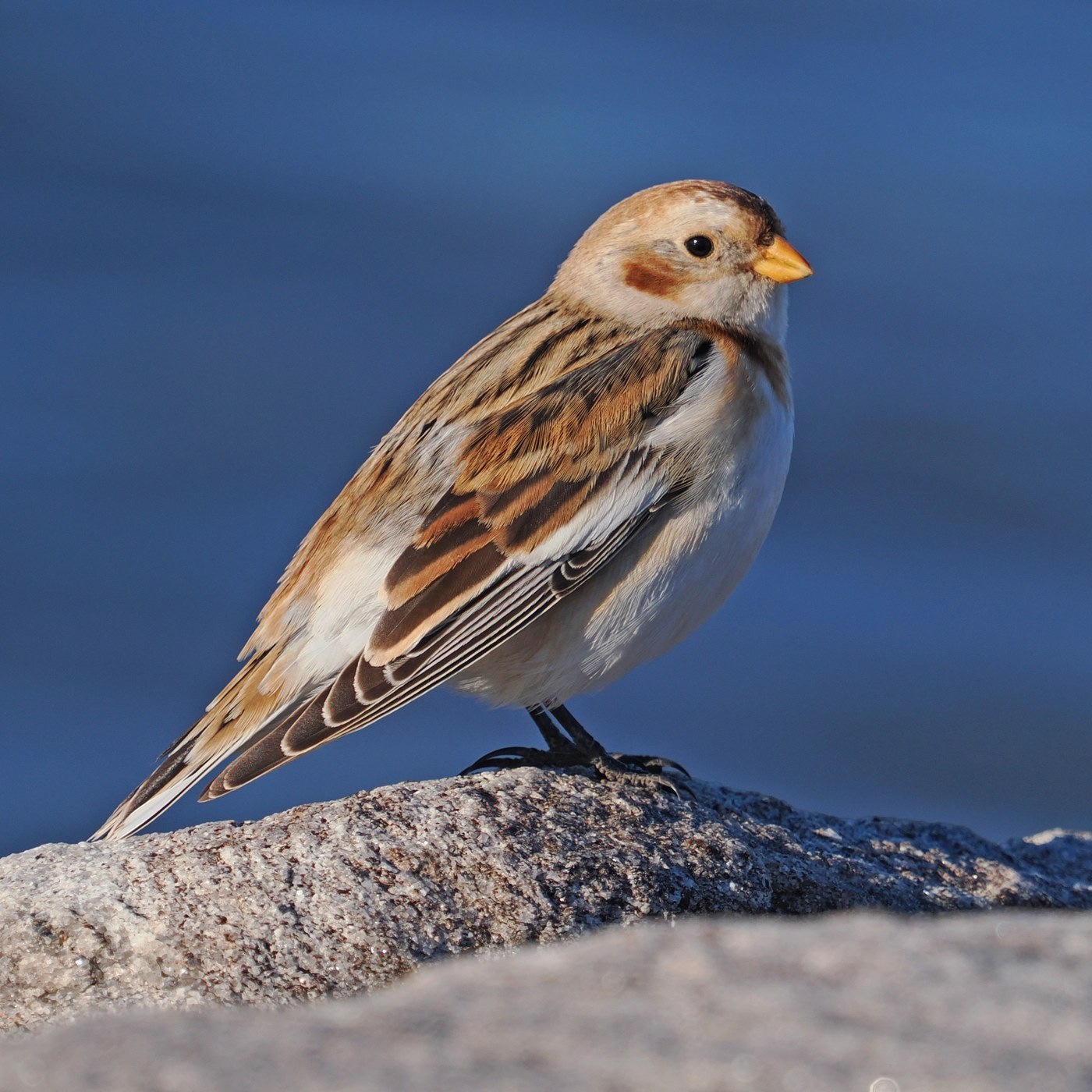
Overview
The Snow Bunting (Plectrophenax nivalis) is a hardy songbird of the high Arctic, breeding farther north than almost any other passerine and wintering in flocks across open, exposed habitats of the northern temperate zone. Its largely white plumage, especially striking in breeding males, makes it one of the most visually distinctive winter finches/buntings encountered in fields, beaches, and coastal dunes across much of North America, Europe, and Asia.
Key Field Marks
- Size and shape: A stocky, compact bunting about 15-19 cm long, with a short, conical bill, fairly short legs, and a habit of walking or running on the ground rather than hopping.
- Breeding male: Strikingly pure white body with a black back, black-and-white wings, and a black bill; among the whitest of all passerines in this plumage.
- Breeding female: Similar pattern but with more brown-black streaking on the crown, back, and cheek, and generally less pure white than the male.
- Nonbreeding/winter plumage (both sexes): Much more subdued, with warm rusty-brown wash on the crown, cheek, and back, a pale buffy-white underside, and retained bold black-and-white wing pattern; bill often yellowish with a dark tip in winter.
- Wings in flight: Show extensive white patches in the wing combined with black wingtips and trailing edge, producing a very bold, flickering black-and-white pattern in flight that is diagnostic among northern winter passerines.
- Behavior: Highly gregarious in winter, forming flocks that forage on the ground in open fields, beaches, and roadsides, often flushing together and wheeling in tight, swirling formation showing flashes of white.
Separating It From Similar Species
- Horned Lark: Also found in open winter fields and can occur in mixed flocks with Snow Buntings, but Horned Lark shows a yellow face with black mask and "horns," a slimmer body, and lacks the bold white wing patches of Snow Bunting.
- Lapland Longspur: Often flocks with Snow Buntings in winter fields; Lapland Longspur is more uniformly streaky brown without the large white wing patches, and has a different, drier flight call.
- McKay's Bunting: A very close relative restricted mainly to Bering Sea islands and coastal Alaska in winter, McKay's Bunting is even whiter than Snow Bunting with less black in the wings and tail; range and the amount of black in the plumage are the main distinguishing features where the two might overlap.
- Albino or leucistic sparrows: Occasionally cause confusion in winter flocks, but lack the Snow Bunting's specific structured black-and-white wing pattern and the species' characteristic ground-foraging flock behavior in open habitats.
Habitat and Range
Breeds on rocky Arctic tundra, cliffs, and talus slopes across the northernmost reaches of North America, Greenland, Europe, and Asia, nesting in rock crevices — farther north than almost any other landbird. In winter it moves south to open habitats including agricultural fields, coastal dunes and beaches, and prairies across southern Canada and the northern-tier United States, as well as similar latitudes across northern Europe and Asia, generally avoiding forested or heavily vegetated areas.
Voice
The flight call is a musical, rippling "tew" or buzzy rattle, often given by flocks in flight, helping to draw attention to a passing group. The song, heard on the Arctic breeding grounds, is a short, rich, musical warble delivered from a rock perch or in a fluttering display flight.
When to Look
Best looked for during the nonbreeding season, from late autumn through early spring, in open agricultural fields, coastal beaches, and windswept shorelines across the northern U.S., southern Canada, and similar latitudes in Eurasia; breeding-ground encounters require travel to remote high-Arctic tundra in the brief summer season.
Frequently asked questions
How do you identify a Snow Bunting in winter?
Look for a stocky ground bird with a warm rusty-brown wash on the crown and back, pale underparts, and bold black-and-white wing patches that flash conspicuously in flight, often in flocks over open fields or beaches.
What does a breeding male Snow Bunting look like?
A breeding male is strikingly pure white with a black back and black-and-white wings, making it one of the whitest songbirds in the Northern Hemisphere.
Where can I see a Snow Bunting in winter?
In open agricultural fields, coastal dunes, and beaches across southern Canada and the northern United States, as well as comparable latitudes across northern Europe and Asia.
How do you tell a Snow Bunting from a Horned Lark in a winter flock?
Snow Bunting shows large white wing patches and lacks a facial mask, while Horned Lark has a yellow face with a black mask and small feather tufts ("horns") and lacks bold white in the wing.
Where does the Snow Bunting breed?
It breeds on Arctic tundra and rocky terrain at extremely high latitudes across North America, Greenland, Europe, and Asia, nesting in rock crevices farther north than nearly any other songbird.