
Snail Kite Identification Guide
A slow-flying marsh raptor with a distinctive deeply hooked bill specialized for extracting apple snails, males slate-gray and females and immatures streaky brown, both showing a white base to the tail.
Read the full Snail Kite encyclopedia entry →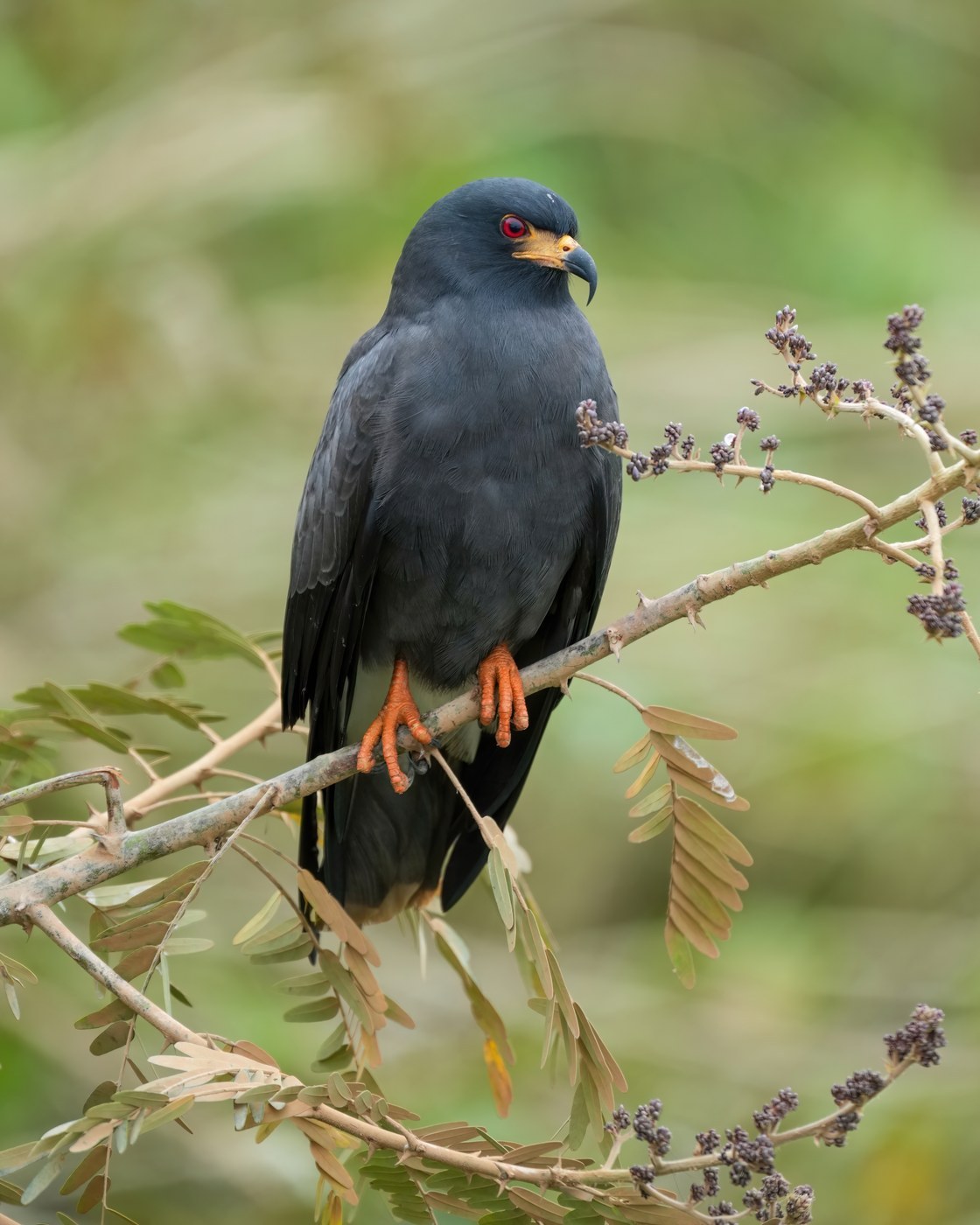
Overview
The Snail Kite (Rostrhamus sociabilis) is a highly specialized wetland raptor found from Florida through Central America and much of South America. Its entire ecology revolves around a single prey type — apple snails (genus Pomacea) — and its bill has evolved a dramatic hook specifically to extract the snail's body from its shell, making this one of the most striking examples of dietary specialization among North American raptors.
Key Field Marks
- Size and shape: A medium-sized raptor, about 36-48 cm long, with broad, rounded wings, a relatively small head, and slow, buoyant flight low over marshes with wings held in a shallow dihedral.
- Bill: The signature feature — a remarkably long, thin, deeply and sharply hooked bill, far more curved than that of other North American hawks and kites, specialized for extracting snails from their shells.
- Adult male: Overall dark slate-gray to blackish plumage, with reddish-orange bare skin at the base of the bill (cere) and reddish-orange legs.
- Adult female: Streaky dark brown above and heavily streaked brown-and-buff below, with a pale supercilium and pale area at the base of the bill; noticeably different from the male's uniform dark gray.
- Immatures: Resemble females, streaky brown, but with variable amounts of buff edging on the upperparts, becoming more uniform as they mature over a couple of years.
- Tail: All ages and both sexes show a broad white band at the base of the tail contrasting with a dark terminal band, a useful mark visible both perched and in flight.
- Behavior: Flies slowly and low over marsh vegetation with a distinctive loose, floppy wingbeat, scanning for snails; when a snail is caught, the kite carries it to a perch and extracts the animal with a practiced twisting motion of the hooked bill, leaving discarded shells accumulated at favored perches.
Separating It From Similar Species
- Northern Harrier: Also flies low over marshes but shows a bright white rump patch (not just tail base), a longer tail, and a more flat-winged, tilting flight; lacks the Snail Kite's deeply hooked bill.
- Black Vulture and Turkey Vulture: Superficially dark and soaring over wetlands, but both are much larger, lack the white tail base, and show the characteristic vulture head shape and soaring flight on flat or dihedral wings without the kite's active, floppy wingbeats.
- White-tailed Kite: Pale gray and white overall with black shoulder patches, quite different from both the dark male and streaky female Snail Kite, and has a much shorter, less hooked bill.
- Female/immature Snail Kite vs. juvenile hawks: The combination of a thin, strongly hooked bill, streaky brown plumage, and white tail base is distinctive; no regularly occurring hawk shares this exact combination.
Habitat and Range
Restricted to freshwater marshes, lake edges, and wet prairies with abundant apple snails, its sole food source. In the United States it is found locally in central and southern Florida, particularly around Lake Okeechobee, the Everglades, and the St. Johns River basin; it is far more widespread from Mexico and Cuba through Central America and much of South America. Populations track water levels and snail abundance, sometimes shifting locations between years in response to drought or flooding.
Voice
Gives a harsh, cackling, rattling call, often rendered as a repeated "ka-ka-ka-ka" or grating chatter, used in territorial and alarm contexts, particularly around nesting colonies.
When to Look
A non-migratory resident where present, so it can be looked for year-round; in Florida, water management and snail availability make some marshes more reliable than others in a given year, so checking current conditions at well-known sites (such as parts of the Everglades and Lake Okeechobee) improves the odds of a sighting.
Frequently asked questions
What is the best field mark for a Snail Kite?
Its remarkably long, thin, deeply hooked bill is the most distinctive feature, evolved specifically for extracting apple snails from their shells; combined with a white base to the tail, it is diagnostic among marsh raptors.
How do male and female Snail Kites differ?
Adult males are uniform dark slate-gray with a reddish-orange bill base and legs, while females and immatures are streaky brown above and below with a pale supercilium.
Where can I see a Snail Kite in the United States?
In the U.S. it is found only in Florida, particularly around the Everglades, Lake Okeechobee, and the St. Johns River basin, where apple snails are abundant.
What does a Snail Kite eat?
Almost exclusively apple snails, which it extracts from their shells using its specialized hooked bill after catching them in shallow marsh water.
Is the Snail Kite endangered?
The Florida population (sometimes called the Everglade Snail Kite) has historically been listed as endangered in the U.S. due to wetland loss and altered water management, though the species as a whole is widespread and common in parts of Central and South America.