
Slaty-tailed Trogon Identification Guide
A large Central American trogon with a glossy green back, red belly, and a plain slate-gray tail lacking barring, identified largely by its bare orange-red eye-ring and stout bicolored bill.
Read the full Slaty-tailed Trogon encyclopedia entry →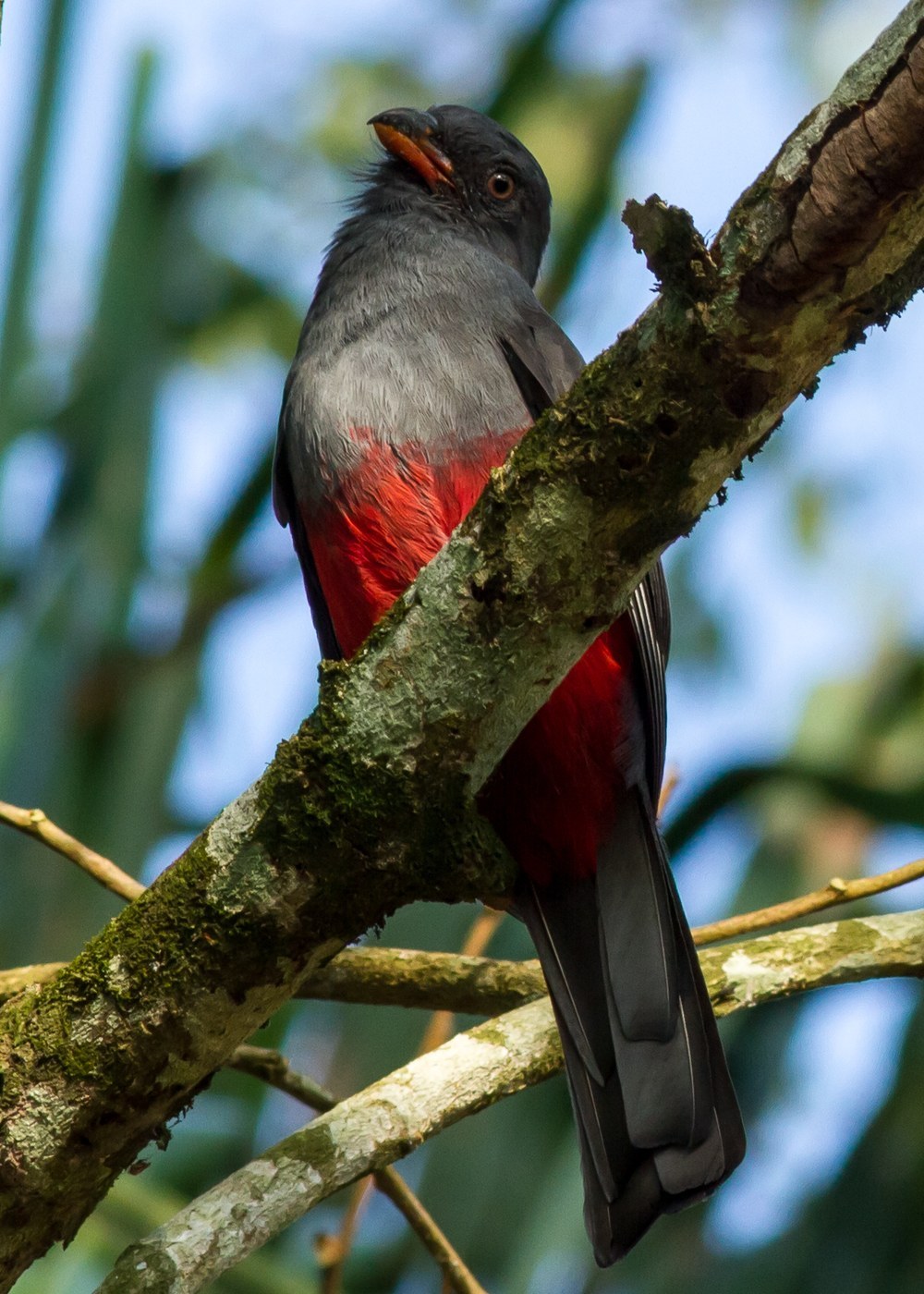
Overview
The Slaty-tailed Trogon (Trogon massena) is one of the largest trogons in Central America, a striking, quiet inhabitant of humid lowland and foothill forest from southern Mexico to northwestern South America. Like other trogons, it sits motionless for long periods, making it easy to overlook despite its bright colors, and is most often located first by voice.
Key Field Marks
- Size and shape: A large, heavy-bodied trogon, roughly 30-34 cm long, with the characteristic upright posture, short neck, and long, broad tail typical of the family.
- Male plumage: Glossy, iridescent green to blue-green head, back, and breast, sharply demarcated from a bright red belly and lower underparts; the upper breast shows a narrow white band separating the green chest from the red belly in some views.
- Female plumage: Duller overall, with the green of the male replaced by slate-gray on the head and back, though still showing the red belly, generally less vivid than the male's.
- Tail: The key diagnostic feature — the tail is plain slaty-gray below without the fine black-and-white barring shown by most other similar trogons in the region, appearing essentially unmarked dark gray from below.
- Bare parts: A conspicuous orange to orange-red, bare skin eye-ring, and a stout, mostly yellowish to orange-yellow bill (duskier at the base in females), both useful supporting marks.
- Behavior: Perches upright and motionless for extended periods at mid to upper forest levels, sallying out to pluck fruit or catch insects in flight before returning to a perch; generally unobtrusive and easiest to find by call.
Separating It From Similar Species
- Black-tailed Trogon: Very similar in overall pattern (green upperparts, red belly) but shows a tail that looks blackish overall from below, and ranges overlap in parts of Central America — underside tail pattern and voice help distinguish the two, with Slaty-tailed's tail appearing more uniformly gray rather than blacker.
- Collared Trogon and Violaceous/Gartered Trogon: These smaller trogons show a fine black-and-white barred pattern on the underside of the tail, immediately separating them from the plain slaty undertail of the Slaty-tailed Trogon.
- Elegant Trogon: Not typically overlapping in range with Slaty-tailed Trogon's core humid lowland forest habitat, and shows a finely barred tail pattern rather than a plain one.
- General trogon separation tip: When a trogon is seen well, check the underside of the tail first — a plain, unbarred gray tail combined with large body size points strongly to Slaty-tailed Trogon among Central American trogons.
Habitat and Range
Found from southeastern Mexico through Central America (Belize, Guatemala, Honduras, Nicaragua, Costa Rica, Panama) into northwestern Colombia and Ecuador. It inhabits the canopy and mid-story of humid lowland and foothill evergreen forest, generally staying below about 1,000-1,200 m elevation, and is a non-migratory resident throughout its range.
Voice
The most reliable way to locate this often-still bird: a series of low, hollow, resonant "cow, cow, cow, cow" or "co-co-co-co" notes, given at a steady pace and carrying well through the forest. The call has a somewhat mournful, hooting quality distinct from the higher, more clucking calls of some smaller trogon species.
When to Look
As a year-round resident, it can be found in any season, though early morning is typically the best time when birds are more vocal and active before the heat of the day, when they tend to sit motionless and quiet for long stretches.
Frequently asked questions
How do you identify a Slaty-tailed Trogon?
Look for a large trogon with a glossy green head and back, a bright red belly, and — most diagnostically — a plain slate-gray tail without the black-and-white barring shown by most similar trogon species.
Where does the Slaty-tailed Trogon live?
It resides in humid lowland and foothill forest from southeastern Mexico through Central America to northwestern Colombia and Ecuador.
How can you tell a Slaty-tailed Trogon from other trogons?
Check the underside of the tail: Slaty-tailed Trogon shows a plain, unbarred gray tail, while most other regional trogons show a fine black-and-white barred pattern.
What does a Slaty-tailed Trogon eat?
Mainly fruit, especially from the laurel family, supplemented with large insects and occasionally small vertebrates, taken in short sallying flights from a perch.
What does a Slaty-tailed Trogon sound like?
It gives a steady series of low, hollow, hooting "cow-cow-cow" notes, often the first clue to its presence since the bird itself sits still and can be hard to spot.