
Shy Albatross Identification Guide
A large, pale-headed Southern Ocean albatross with a black-edged white underwing and grayish thumbprint mark at the wrist, breeding only on a handful of islands off Australia and New Zealand.
Read the full Shy Albatross encyclopedia entry →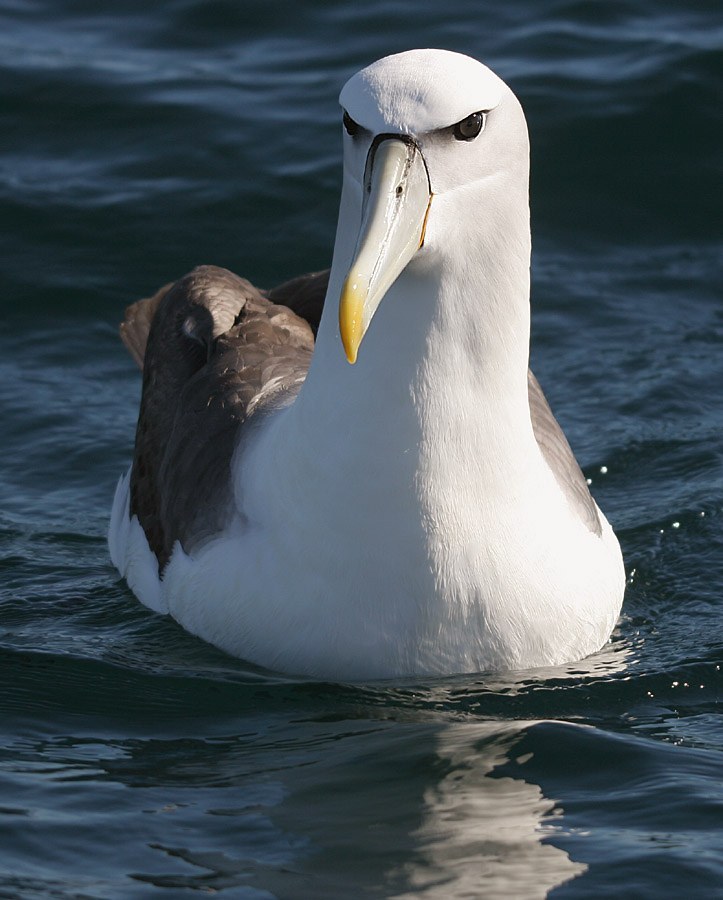
Overview
The Shy Albatross (Thalassarche cauta), also called the Shy Mollymawk, is a large member of the mollymawk group of albatrosses. It breeds almost exclusively on a small number of islands off Tasmania (Australia) and on the Chatham Islands and Auckland Islands group off New Zealand, then disperses widely across the Southern Ocean, regularly reaching the coasts of southern Africa, South America, and Australia outside the breeding season.
Key Field Marks
- Size: One of the larger mollymawks, with a wingspan around 2.5 m (approx. 8 feet), a bulky body, and long, narrow wings held stiffly flat or slightly drooped in flight.
- Head: Mostly white or very pale gray head, giving a clean-headed appearance at a distance; some individuals (especially subadults) show a faint gray wash on the crown and nape.
- Underwing: Predominantly white with a narrow, clean black leading and trailing edge, and a distinctive small dark mark (often described as a gray or blackish "thumbprint") at the base of the leading edge near the wrist — a useful mark shared with some related mollymawks but generally more subtle here.
- Bill: Pale gray-yellow to olive-gray bill with a yellow tip to the culmen (upper ridge) and often a small dark spot near the tip of the lower mandible; the bill looks proportionately large and blunt-tipped.
- Upperparts: Dark gray-black back and upperwings contrasting with the white head and body.
- Behavior: Glides on stiff, flat wings low over the waves in classic albatross fashion, with relatively few wingbeats; often follows fishing vessels and can associate with other albatross and petrel species at chum slicks.
Separating It From Similar Species
- White-capped (Salvin's/Chatham) Albatross complex: Formerly lumped with Shy Albatross, these close relatives are extremely similar; Shy Albatross tends to show a slightly darker gray cap/nape wash in some plumages and subtle underwing pattern differences, but definitive separation at sea can be very difficult and often relies on range and breeding provenance.
- Black-browed Albatross: Has a bold black eyebrow stripe giving an angry expression, a more extensively black-bordered underwing, and a yellow-orange (not gray) bill — both features readily separate it from Shy Albatross's cleaner face and more restrained underwing markings.
- Yellow-nosed Albatrosses: Noticeably smaller and slimmer, with a slender black bill showing a thin yellow stripe along the top, unlike the Shy Albatross's larger, paler, more robust bill.
- Wandering/Royal Albatross group: Much larger, with mostly white bodies and (in adults) extensively white upperwings, unlike the Shy Albatross's uniformly dark gray-black back and upperwing.
Habitat and Range
A true pelagic species, spending almost all its life over open ocean and coming to land only to breed on a handful of subantarctic and temperate islands (notably Albatross Island, Mewstone, and Pedra Branca off Tasmania, plus islands in the Chatham and Auckland groups). Outside the breeding season it disperses widely across the Southern Hemisphere's temperate and subantarctic waters, with regular occurrence off southern Africa and South America.
Voice
Largely silent at sea. At breeding colonies it gives a variety of low, harsh braying and grunting calls during courtship and territorial displays, along with bill-clapping, but voice is not a practical identification tool for birders viewing this species offshore.
When to Look
Best looked for on pelagic boat trips in the waters around Tasmania and New Zealand's subantarctic islands year-round, with concentrations near breeding colonies during the austral breeding season (roughly September to April) and wider dispersal, including occasional appearances off South Africa and South America, outside that period.
Frequently asked questions
What is the easiest way to identify a Shy Albatross?
Look for a large mollymawk with a clean white or pale gray head, a mostly white underwing with only a narrow black border, and a pale gray-yellow bill with a yellow tip — a combination that separates it from the darker-faced, more heavily marked Black-browed Albatross.
Where does the Shy Albatross breed?
It breeds on a very small number of islands off Tasmania, Australia, and on the Chatham and Auckland Islands off New Zealand.
Is the Shy Albatross the same as the White-capped Albatross?
They were once treated as one species and remain closely related and very similar; many authorities now split them, with Shy Albatross breeding off Tasmania and White-capped (and related forms) breeding on New Zealand's subantarctic islands.
How can I tell a Shy Albatross from a Black-browed Albatross?
Shy Albatross has a paler, cleaner face without a bold dark eyebrow, a grayish rather than orange-yellow bill, and a whiter underwing with a narrower dark border.
When is the best time to see a Shy Albatross?
Year-round on pelagic trips near its breeding islands, with the best numbers close to colonies during the austral breeding season from spring through autumn (roughly September to April).