
Short-toed Treecreeper Identification Guide
A mottled brown-and-white bark forager that spirals up tree trunks, best told from the near-identical Eurasian Treecreeper by its duller flanks, shorter hind claw, and distinctive song.
Read the full Short-toed Treecreeper encyclopedia entry →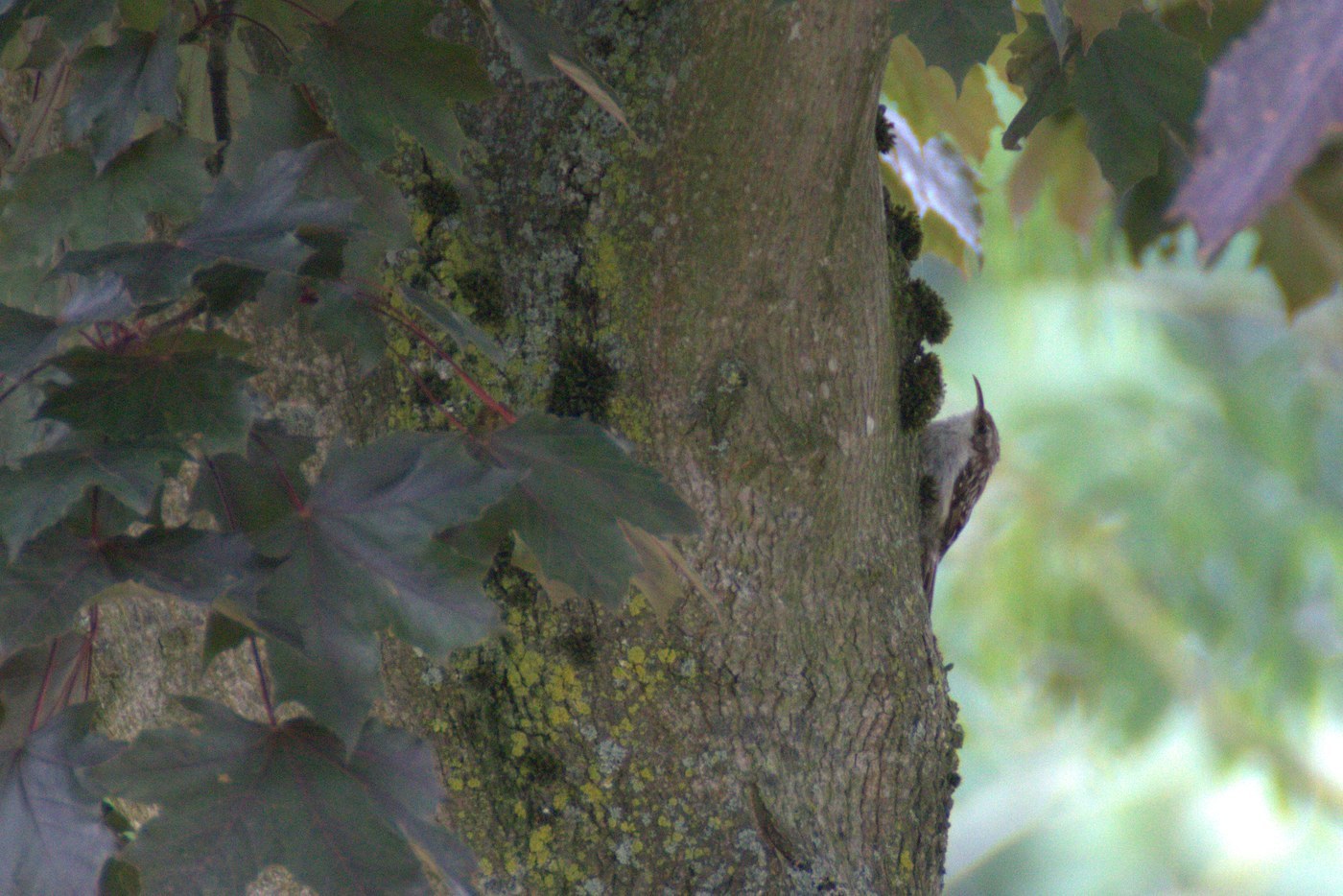
Overview
The Short-toed Treecreeper (Certhia brachydactyla) is a small, cryptically plumaged woodland bird found across much of continental Europe and North Africa. It forages by climbing tree trunks in tight spirals, probing bark crevices with its thin, decurved bill for insects and spiders. It is one of the classic "impossible twin" identification challenges in European birding, closely resembling the Eurasian Treecreeper (Certhia familiaris) wherever their ranges overlap.
Key Field Marks
- Size and shape: Roughly 12-13 cm long, with a slim body, stiff pointed tail used as a prop against bark, and a long, thin, downcurved bill.
- Upperparts: Streaked and mottled brown, buff, and blackish, providing excellent camouflage against tree bark.
- Underparts: Silky white throat and breast grading into dull, grayish-brown or brownish-buff flanks and undertail (a key difference from the whiter-flanked Eurasian Treecreeper).
- Face: Pale supercilium (eyebrow stripe) that is generally less bold and less contrasting than in Eurasian Treecreeper.
- Bill: Slightly longer and more strongly decurved on average than Eurasian Treecreeper's, though this overlaps and is hard to judge in the field.
- Legs and feet: Pale legs with strong claws for gripping bark; the hind claw is shorter than in Eurasian Treecreeper (a trait usually only useful in the hand).
- Behavior: Climbs trunks and branches in a spiraling, jerky fashion, always working upward, then flies down to the base of the next tree to start again. Often joins mixed foraging flocks with tits in winter.
Separating It From Similar Species
- Eurasian Treecreeper: The single most reliable feature is voice (see below); plumage differences (whiter flanks and more contrasting supercilium on Eurasian Treecreeper) are subtle and affected by lighting, wear, and individual variation. Habitat can help: Short-toed Treecreeper favors lower-elevation deciduous and mixed woodland, parks, orchards, and gardens, while Eurasian Treecreeper tends toward coniferous and montane forest, though there is broad overlap and both can occur together.
- Nuthatches: Nuthatches have a stouter, straight bill, blue-gray upperparts, and can climb head-first down trunks, unlike treecreepers which only climb upward.
- Wrens: Superficially similar in size but wrens have a short cocked tail, rounder body, and forage on or near the ground rather than spiraling up trunks.
Habitat and Range
Found throughout most of western, central, and southern Europe, North Africa, and locally into the Middle East. Prefers deciduous and mixed woodland, parkland, orchards, hedgerows, and well-wooded gardens, generally at lower elevations than Eurasian Treecreeper where the two coexist. It is a non-migratory resident across nearly all of its range, so it can be looked for year-round.
Voice
The song is the most dependable identification tool: a short, rhythmic, accelerating phrase often rendered as "tee-tee-tee-tee-terroititt", ending in a distinctive flourish, quite different from the thin, high, more even "tsee-tsee-tsee-sissi-sieu" song of Eurasian Treecreeper. The call is a sharp, hard "tsit" or "srih", slightly harsher and lower-pitched than the very high, thin call of Eurasian Treecreeper. Learning both songs is the single best investment for confident field identification.
When to Look
Because it is resident year-round, any season works, but breeding-season singing males (spring into early summer) offer the best opportunity to confirm identity by voice.
Frequently asked questions
How do I tell Short-toed Treecreeper from Eurasian Treecreeper?
Voice is the most reliable method — the songs are quite different. Plumage clues (Short-toed has duller, more buffy-brown flanks and a less contrasting supercilium) are subtle and best used only to support a voice-based identification.
Where does the Short-toed Treecreeper live?
It is a resident of deciduous and mixed woodland, parks, orchards, and gardens across western, central, and southern Europe and North Africa, generally favoring lower elevations than Eurasian Treecreeper.
What does a Short-toed Treecreeper eat?
It feeds on small insects, spiders, and other invertebrates gleaned from bark crevices as it spirals up tree trunks and along branches.
Does the Short-toed Treecreeper migrate?
No, it is largely sedentary and can be found in the same territories throughout the year.
Why is this species so hard to identify?
It is nearly identical in size, shape, and plumage to the Eurasian Treecreeper, and the two overlap broadly in range and habitat, making voice the only consistently reliable field mark.