
Short-tailed Hawk Identification Guide
A compact tropical buteo occurring in light and dark color morphs, often seen soaring high overhead in Florida and the Southwest with a hooded appearance and short, square tail.
Read the full Short-tailed Hawk encyclopedia entry →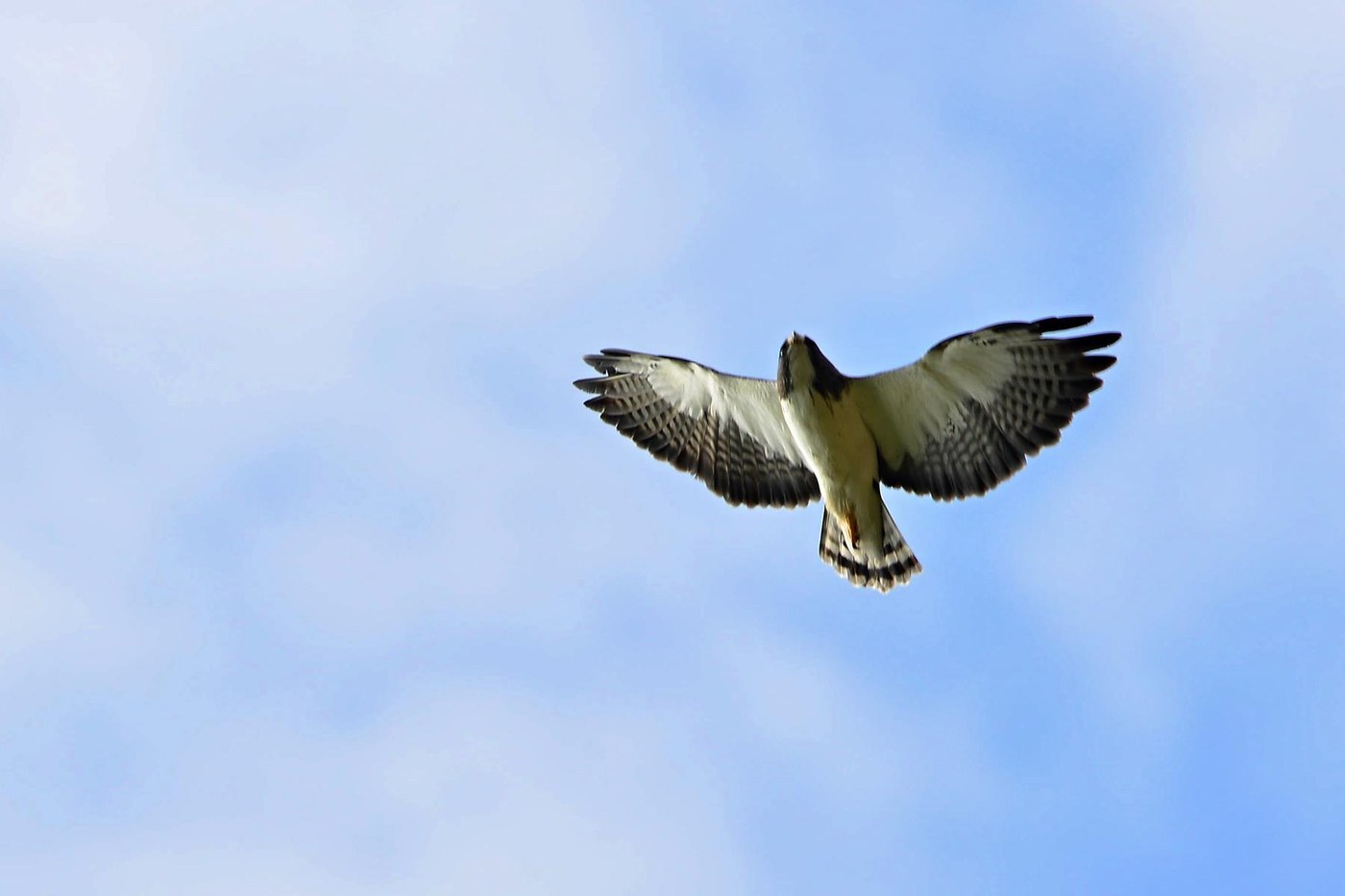
Key Field Marks
- Size & shape: A small, compact buteo, about 39–44 cm, with fairly long, broad wings that taper to somewhat pointed tips, and a proportionally short, square-ended tail.
- Light morph: Crisp dark "hood" covering the head and upper breast, sharply demarcated from clean white underparts and underwing coverts, giving a distinctive capped appearance; underside of the flight feathers is pale and lightly barred.
- Dark morph: Nearly all-blackish-brown body and underwing coverts, with contrastingly pale flight feathers on the underwing — the pale flight feathers against dark coverts and body are a key mark separating it from other dark buteos.
- Tail: Grayish with several narrow dark bands and a slightly wider dark subterminal band; notably short relative to wing length.
- Behavior: A skilled, buoyant soarer that often hunts by circling very high and stooping down on prey (small birds) with great speed; frequently soars kettling with other raptors during migration.
Separating It From Similar Species
- Broad-winged Hawk: Similar size and also occurs in light/dark morphs and forms migrating kettles, but light-morph Broad-winged lacks the sharply demarcated dark hood (it has a more diffusely streaked breast/malar stripe) and shows a broader dark tail band pattern.
- Swainson's Hawk (dark morph): Larger with longer, more pointed wings held in a shallow dihedral while soaring, and typically shows a contrasting dark flight-feather trailing edge rather than the pale flight feathers of dark-morph Short-tailed Hawk.
- Zone-tailed Hawk: Overlaps in the Southwest; adult Zone-tailed is essentially all black with bold white tail bands and a longer tail, and mimics the flight silhouette and low soaring style of a Turkey Vulture, unlike the higher, more buteo-typical soaring of Short-tailed Hawk.
Where & When to See It
- Habitat: Woodland edges, wetland margins, and open country adjacent to forest in Florida; in the Southwest (Arizona, Texas), found in riparian corridors, oak/pine-oak woodland, and canyon country.
- Range: A year-round resident in peninsular Florida (its northernmost stronghold in the U.S.), with a small breeding population in southeastern Arizona and south Texas that is largely migratory, wintering into Mexico; broadly distributed through Central and South America.
- Season: Florida birds can be seen year-round; Arizona/Texas breeders are typically present April–September and largely absent in winter.
Voice
- Gives a thin, high-pitched whistled scream, similar in tone to other buteos but higher and thinner; generally not very vocal away from the nest.
Frequently asked questions
What are the two color morphs of the Short-tailed Hawk?
A light morph with a sharply demarcated dark hood over the head and upper breast contrasting with clean white underparts, and a dark morph that is nearly all blackish-brown on the body and underwing coverts but with contrastingly pale flight feathers.
Where in the United States can I find Short-tailed Hawks?
They are year-round residents in peninsular Florida and occur as a smaller, largely migratory breeding population in southeastern Arizona and parts of south Texas.
How do I tell a dark-morph Short-tailed Hawk from a dark-morph Swainson's Hawk?
Dark-morph Short-tailed Hawk shows pale, lightly barred flight feathers contrasting with its dark body and underwing coverts, while dark-morph Swainson's Hawk typically shows a darker trailing edge to the wing and a different, longer-winged soaring silhouette held in a shallow dihedral.
How does the Short-tailed Hawk hunt?
It typically soars at considerable height and then stoops rapidly to capture small birds, a hunting style that sets it apart from buteos that hunt more from perches.