
Short-eared Owl Identification Guide
A day-flying, open-country owl with buffy mottled plumage, black-rimmed yellow eyes, and a distinctive floppy, moth-like flight low over grasslands and marshes.
Read the full Short-eared Owl encyclopedia entry →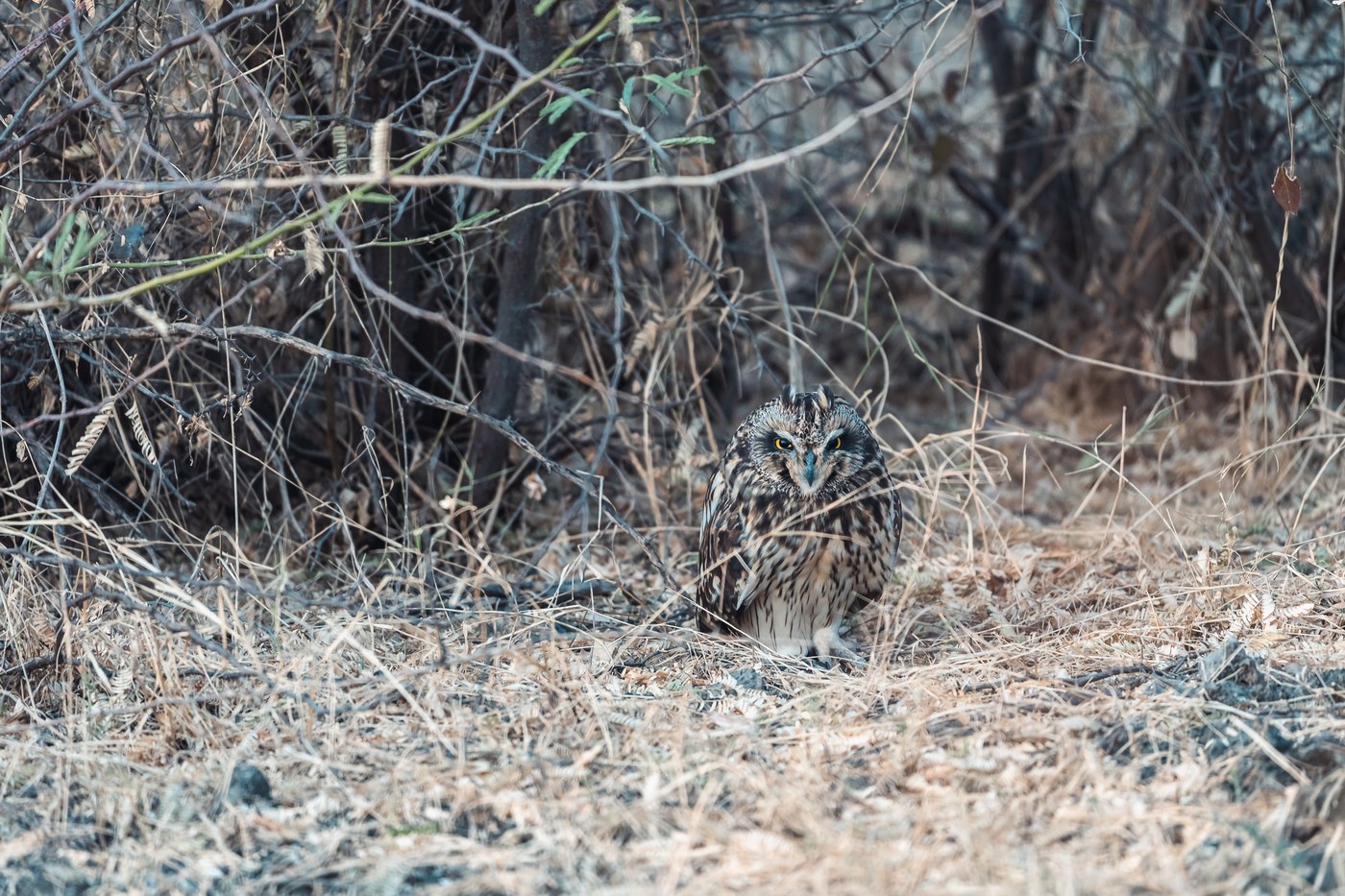
Key Field Marks
- Size & shape: A medium-sized owl, about 34–43 cm, with a round head, very short ear tufts that are usually invisible, and long, rounded wings.
- Plumage: Buffy-brown overall with heavy dark streaking, especially concentrated on the upper breast, becoming sparser on the pale belly.
- Face: Pale facial disk framed in dark, with piercing yellow eyes set in black patches, giving an intense, almost mascara-like look.
- In flight: Long wings show a bold buffy patch at the base of the primaries above and below, a dark carpal (wrist) patch on the underwing, and a dark-tipped trailing edge; flight is buoyant, floppy, and irregular, often likened to a giant moth or bat.
- Behavior: Frequently active by day, especially at dawn and dusk, hunting low over open ground with slow wingbeats interspersed with glides and occasional hovering.
Separating It From Similar Species
- Long-eared Owl: Strictly nocturnal and roosts hidden in dense trees rather than hunting in the open by day; shows long, obvious ear tufts when perched and orange (not pale yellow-buff) facial disk, with more richly patterned underparts including barring on the belly.
- Northern Harrier: Often seen hunting over the same open fields with a similarly buoyant, low flight, but is a hawk with a slim body, long tail, white uppertail covert patch ("white rump"), and holds its wings in a shallow V (dihedral) rather than the owl's floppier wingbeat.
- Barn Owl: Pale, heart-shaped white face and buffy-gold upperparts without heavy streaking; flight is more silent and direct, typically at night.
Where & When to See It
- Habitat: Open grasslands, prairies, tundra, coastal marshes, and agricultural fields; nests on the ground in dense grass or low vegetation, unusual among owls.
- Range: One of the most widespread owl species in the world, breeding across much of North America, Europe, and Asia; northern populations are migratory, while some southern populations are resident.
- Season: Best observed at dawn and dusk year-round in resident areas; winter can bring concentrations ("winter roosts") of many individuals in productive grassland or marsh habitat, especially in years of high vole abundance.
Voice
- Generally quiet outside the breeding season; on territory, gives a deep, hollow hooting boo-boo-boo series, and both sexes give a barking or raspy alarm call near the nest.
Frequently asked questions
Why is the Short-eared Owl easier to see than most owls?
It is one of the few owl species that regularly hunts during daylight, especially around dawn and dusk, flying low over open fields and marshes in a distinctive floppy, moth-like flight.
How do I tell Short-eared Owl from Northern Harrier in flight?
Both hunt low over open fields, but the harrier is a hawk with a slim body, long tail, white rump patch, and wings held in a shallow V, while the Short-eared Owl has a rounder body, no long tail, and a looser, more erratic, floppy wingbeat.
Where does the Short-eared Owl nest?
Unusually for an owl, it nests directly on the ground, typically hidden in dense grass or low vegetation in open grassland, tundra, or marsh habitat.
Does the Short-eared Owl have visible ear tufts?
Its ear tufts are very short and usually not visible in the field, distinguishing it from the Long-eared Owl, which shows prominent tufts when perched.