
Short-billed Dowitcher Identification Guide
A chunky, long-billed shorebird known for its rapid, sewing-machine-like probing feeding action, closely resembling the nearly identical Long-billed Dowitcher.
Read the full Short-billed Dowitcher encyclopedia entry →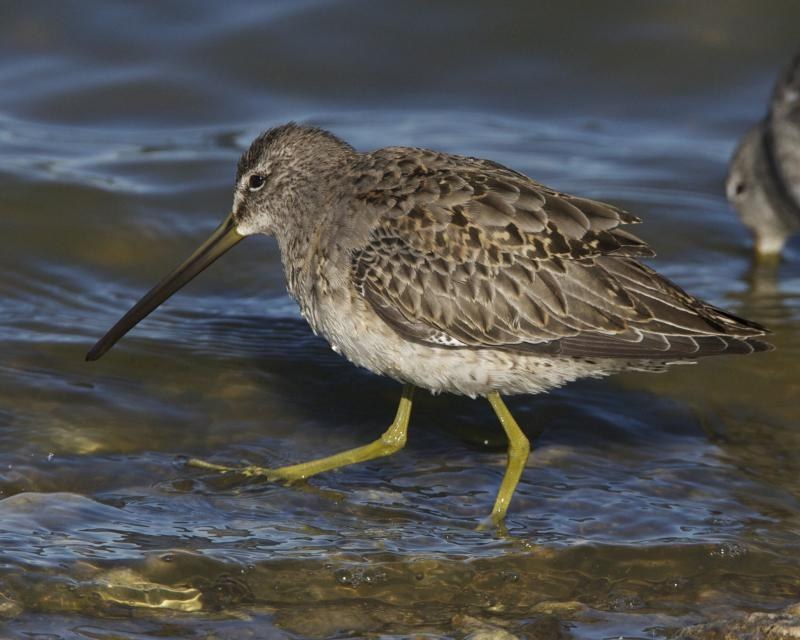
Key Field Marks
- Size & shape: A stocky, medium-sized shorebird (about 27–30 cm) with a plump body, short neck, short legs, and a very long, straight bill.
- Bill: Long and straight, though on average slightly shorter than Long-billed Dowitcher's (overlap makes bill length alone unreliable for identification).
- Plumage (breeding): Variable by subspecies, but generally shows orange-buff underparts with dark spotting/barring most concentrated on the sides and flanks, and pale, spotted (not solidly barred) flanks compared to Long-billed.
- Plumage (nonbreeding): Plain gray above and pale grayish-white below, very similar to Long-billed Dowitcher.
- In flight: White wedge up the back and a white trailing edge on the secondaries, shared with Long-billed Dowitcher.
- Behavior: Feeds with a rapid up-and-down "sewing machine" probing action in shallow water and mud, often in tight flocks.
Separating It From Similar Species
- Long-billed Dowitcher: Extremely similar; the most reliable distinctions are voice (Short-billed gives a mellow, multi-noted tu-tu-tu, while Long-billed gives a sharp single or double keek), habitat (Short-billed favors coastal/tidal salt or brackish habitats, Long-billed favors freshwater), and breeding plumage details (Short-billed shows barring restricted to the flanks with more spotting on the breast, and often a whiter belly, versus Long-billed's more extensively barred underparts, including the belly).
- Wilson's Snipe: Has a boldly striped head and back pattern, is more secretive in dense marsh vegetation, and lacks the dowitcher's steady sewing-machine probing in open mudflats.
- Stilt Sandpiper: Slimmer, with a slightly downcurved bill (versus straight), longer greenish legs, and a different, more mincing feeding style.
Where & When to See It
- Habitat: Coastal mudflats, tidal marshes, and estuaries during migration and winter; breeds in muskeg and boggy taiga/tundra transition zones.
- Range: Breeds in scattered areas of Alaska and northwestern/subarctic Canada; migrates along both coasts and winters mainly along the southern coasts of the U.S. through Central America and northern South America.
- Season: Spring migration peaks April–May; fall migration is protracted, with adults arriving on southbound migration as early as late June/July, followed by juveniles into September.
Voice
- Flight call is a soft, mellow, multi-syllabled tu-tu-tu, distinctly different from the sharp, single or doubled keek of Long-billed Dowitcher — often the most reliable field character for separating the two species.
Frequently asked questions
What is the best way to tell Short-billed from Long-billed Dowitcher?
Voice is the most reliable clue: Short-billed gives a soft, mellow multi-noted tu-tu-tu, while Long-billed gives a sharp, single or double keek. Habitat also helps, since Short-billed favors coastal/tidal areas while Long-billed prefers freshwater.
Is bill length a reliable way to separate the two dowitcher species?
Not by itself — despite the names, bill lengths overlap considerably between the two species, especially in females, so bill length alone is not a dependable field mark.
What does the 'sewing machine' feeding behavior look like?
Dowitchers probe the mud rapidly up and down in place, much like the needle of a sewing machine, to find invertebrates just below the surface.
Where does the Short-billed Dowitcher breed?
It breeds in muskeg and boggy taiga-tundra transition habitat in scattered areas of Alaska and northwestern/subarctic Canada.