
Sharp-tailed Grouse Identification Guide
A prairie and brushland grouse with a short pointed tail, mottled brown plumage, and a spectacular communal courtship dance performed on traditional leks.
Read the full Sharp-tailed Grouse encyclopedia entry →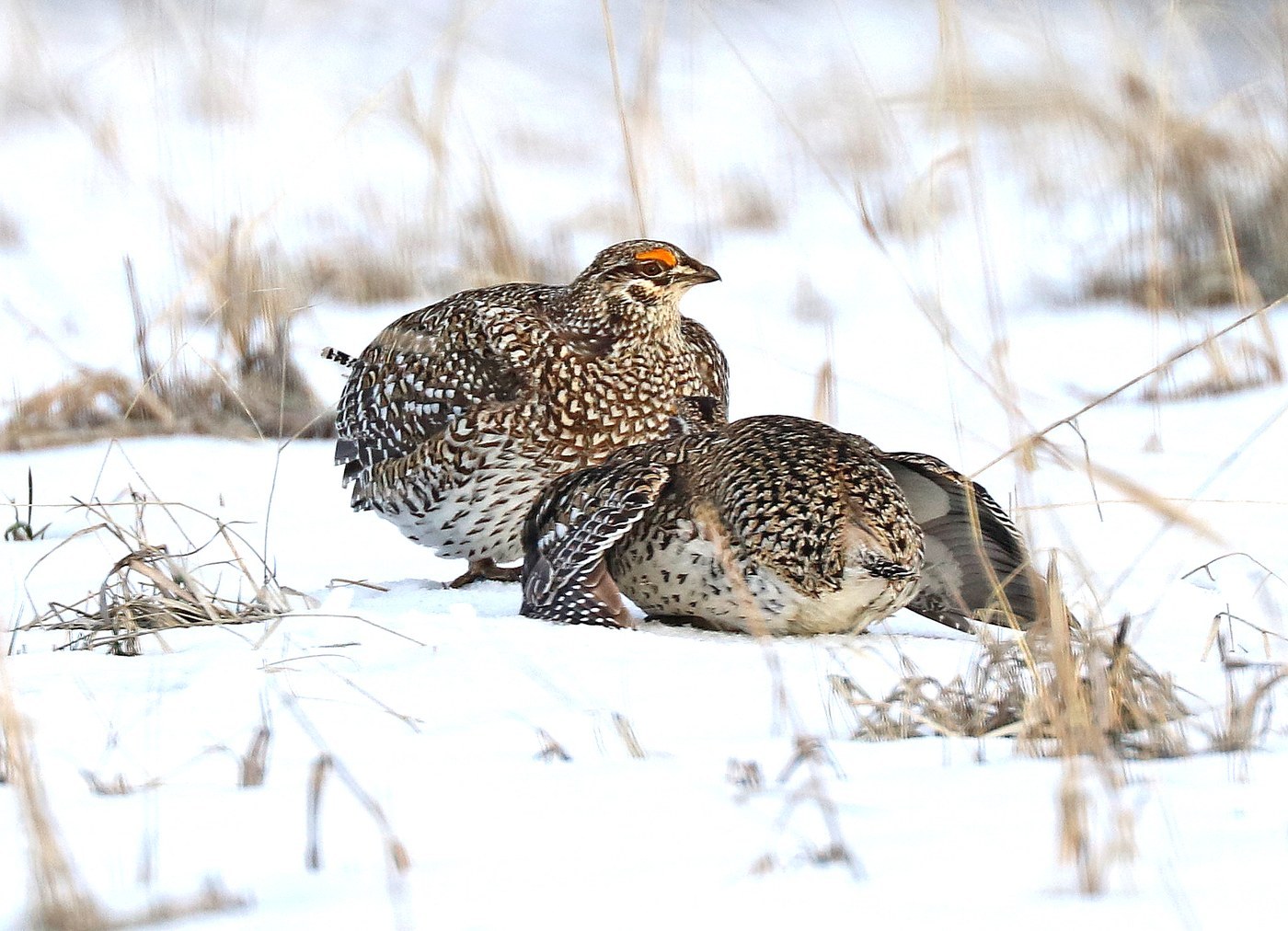
Key Field Marks
- Size & shape: A medium-sized grouse, about 43–48 cm, with a plump body, small head, and a notably short, pointed tail that comes to a point at the center (unlike the fanned tails of prairie-chickens).
- Plumage: Intricately mottled brown, buff, and white above, giving a scaly or barred appearance; underparts are whitish with distinctive V-shaped (chevron) markings on the breast and flanks, rather than the horizontal barring of prairie-chickens.
- Head: Small crest-like feathers can be raised on the crown; males show a small patch of yellow-orange skin over the eye (eyebrow comb) and inflate purple neck sacs during display, less obvious than the bright orange/yellow air sacs of prairie-chickens.
- In flight: Shows white outer tail feathers and a mostly white belly, along with white spotting on the wings.
- Behavior: Famous for its elaborate lek display — males stamp their feet rapidly, rattle tail feathers, extend wings, and inflate neck sacs while cooing and cackling to attract females at traditional communal dancing grounds ("leks").
Separating It From Similar Species
- Greater Prairie-Chicken: Larger, with a rounded (not pointed) dark tail, horizontal barring on the underparts (versus chevrons), and bright orange-yellow inflatable neck sacs and pinnae (long neck feathers) in displaying males.
- Ruffed Grouse: Found in forested habitat rather than open prairie/brush, has a fan-shaped tail with a broad dark subterminal band, and a dark ruff of neck feathers.
- Spruce Grouse: A boreal forest species with a black tail (males) tipped in rufous, red eye combs, and much darker overall plumage; habitat rarely overlaps with Sharp-tailed Grouse.
Where & When to See It
- Habitat: Native mixed-grass and shortgrass prairie, sagebrush steppe edges, brushy grassland, and aspen parkland; often near shrubby draws used for winter cover.
- Range: Resident across the northern Great Plains, parts of the Rocky Mountain foothills, and boreal transition zones of Canada and Alaska.
- Season: Present year-round; the best time to observe the courtship display is at dawn in early spring (March–May) at traditional lek sites.
Voice
- Displaying males produce a low, resonant cooing/hoot combined with cackling, gobbling, and foot-drumming sounds during the lek display; generally quieter outside the breeding season.
Frequently asked questions
How do I distinguish Sharp-tailed Grouse from Greater Prairie-Chicken?
Sharp-tailed Grouse has a pointed central tail (versus a rounded dark tail), chevron-shaped markings on the underparts (versus horizontal barring), and less brightly colored neck sacs than the orange air sacs of displaying male prairie-chickens.
What is a lek and when can I see Sharp-tailed Grouse displaying?
A lek is a traditional communal display ground where males gather to perform their foot-stamping, tail-rattling courtship dance; the best viewing is at dawn from March through May.
What habitat does Sharp-tailed Grouse prefer?
Native mixed-grass prairie, sagebrush-steppe edges, and brushy grassland or aspen parkland, often near shrubby cover used in winter.
Is the Sharp-tailed Grouse migratory?
No, it is a year-round resident, though it may shift locally between open grassland in summer and shrubbier cover in winter.