
Sharp-shinned Hawk Identification Guide
North America's smallest accipiter, a compact woodland raptor with a small rounded head, thin legs, and a squared-off tail, easily confused with the larger Cooper's Hawk.
Read the full Sharp-shinned Hawk encyclopedia entry →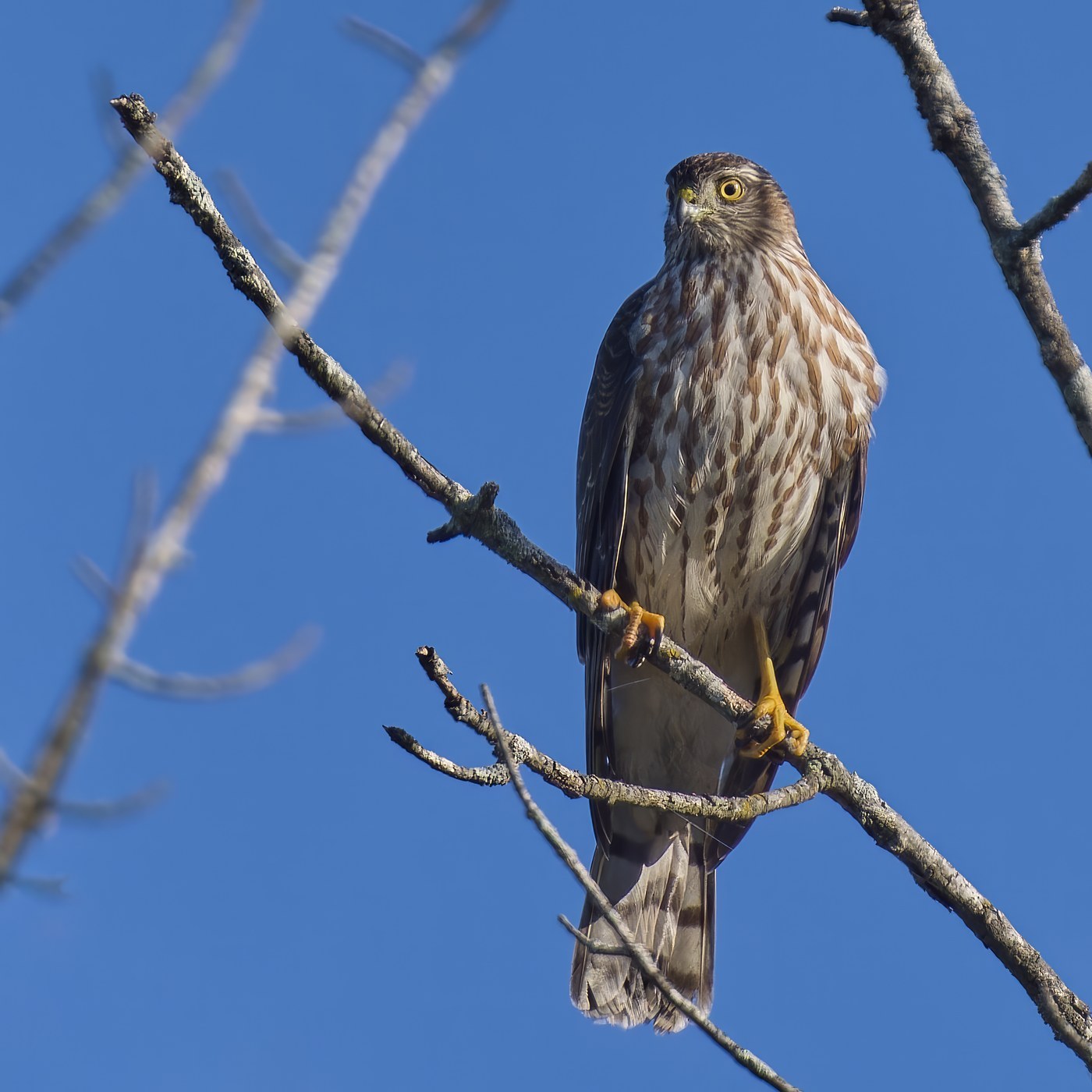
Key Field Marks
- Size & shape: A small accipiter, roughly crow-sized or smaller (24–34 cm, females notably larger than males), with short rounded wings and a long tail adapted for maneuvering through forest.
- Head: Small, rounded head that appears to barely project past the wrists in flight, without a strongly bulging nape.
- Tail: Squared-off or only slightly notched tip (versus rounded with a wide white terminal band in Cooper's Hawk); tail bands are of roughly equal width.
- Plumage: Adults are blue-gray above with fine rufous barring below; juveniles are brown above with coarse brown streaking below.
- Legs: Very thin, pencil-like ("sharp-shinned") legs — the source of the species' name.
- Behavior: Fast, agile flight with quick wingbeats and short glides, typical accipiter "flap-flap-glide" pattern; ambushes small birds at feeders and forest edges.
Separating It From Similar Species
- Cooper's Hawk: Larger, with a proportionally larger head that projects well past the wrist in flight, a longer rounded tail with a broad white terminal band, and slower, stiffer, more deliberate wingbeats; Cooper's also often shows a flat-topped head profile versus the rounded head of Sharp-shinned.
- Northern Goshawk: Much larger and bulkier, with a bold white eyebrow (supercilium) and heavily barred gray underparts in adults; juveniles are more heavily streaked than young Sharp-shinned.
- American Kestrel: Superficially similar size but has pointed falcon wings, rufous back and tail, and a completely different, more direct flight style.
Where & When to See It
- Habitat: Dense coniferous and mixed forests for breeding; during migration and winter, found in a wide variety of wooded and semi-open habitats, including suburban yards with bird feeders.
- Range: Breeds across much of Canada, the northern and western U.S., and mountainous areas farther south; winters throughout most of the U.S. into Mexico and Central America.
- Season: A strong migrant, concentrating at raptor watch sites (e.g., hawk ridges) especially in September–October; winters widely, often visiting feeders to hunt songbirds.
Voice
- Gives a high, sharp kik-kik-kik-kik series near the nest, similar to but higher-pitched and faster than Cooper's Hawk's call; largely silent away from breeding territories.
Frequently asked questions
How do I tell Sharp-shinned Hawk from Cooper's Hawk?
Sharp-shinned Hawk is smaller with a small rounded head that barely projects past the wrist and a squared tail tip, while Cooper's Hawk has a larger head that projects farther, a longer rounded tail with a broad white tip, and slower, more labored wingbeats.
Why is it called 'Sharp-shinned'?
The name refers to its thin, pencil-like legs, which are noticeably slender compared to other accipiters.
Do Sharp-shinned Hawks visit backyard feeders?
Yes, especially in winter, they frequently ambush songbirds at feeders, using nearby cover to launch surprise attacks.
Where do Sharp-shinned Hawks breed?
They breed primarily in dense coniferous or mixed forest across Canada, the northern U.S., and western mountains, building stick nests well hidden in conifers.