
Senegal Parrot Identification Guide
A compact West African parrot easily recognized by its gray head, green back, and bold V-shaped yellow-to-orange belly patch on a green body.
Read the full Senegal Parrot encyclopedia entry →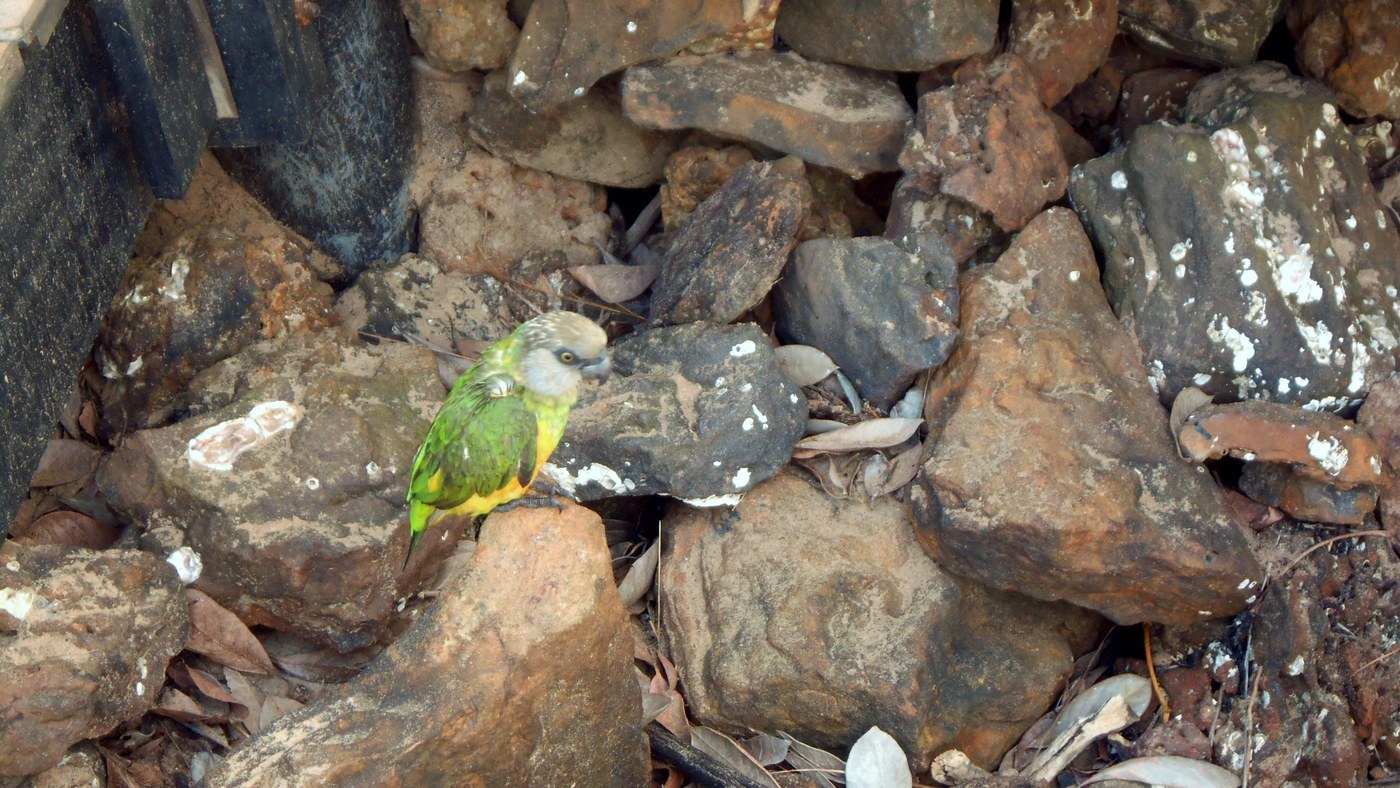
Key Field Marks
- Size & shape: A small, stocky, short-tailed parrot roughly 23 cm long, with a large head and strong hooked bill typical of Poicephalus parrots.
- Plumage: Distinctive tricolor pattern — a gray head with a dark eye set in a pale gray eye-ring, a green back, wings, and upper breast, and a yellow-to-orange belly and thighs, forming a bold V-shaped division on the underparts.
- Bill: Dark grayish-black, stout and strongly hooked.
- Behavior: Often perches quietly and inconspicuously in the canopy; flight is fast and direct with rapid wingbeats. Usually seen in pairs or small flocks, especially at fruiting trees.
Separating It From Similar Species
- Meyer's Parrot: A different Poicephalus species found in eastern and southern Africa (no range overlap with Senegal Parrot), with more extensive yellow on the shoulder and crown and a browner head rather than clean gray.
- Red-bellied Parrot: Found in East Africa, has an orange-brown breast patch rather than the sharply demarcated gray-green-yellow tricolor of Senegal Parrot.
- Brown-headed Parrot: Southern African species with a duller brown (not gray) head and less contrasting underparts.
- Within its own range in West Africa, the Senegal Parrot's clean gray hood and yellow/orange belly patch make it essentially unmistakable among sympatric parrots.
Where & When to See It
- Habitat: Savanna woodland, gallery forest edges, and cultivated areas with scattered large trees; frequently visits fruiting and flowering trees, including cultivated fruit and shea trees.
- Range: A resident (non-migratory) species of West Africa, from Senegal and Guinea-Bissau east to Chad and Cameroon.
- Season: Present year-round throughout its range; most active and vocal in early morning and late afternoon, often gathering in noisy communal roosts at dusk.
Voice
- Calls include shrill, high-pitched whistled notes and harsher screeching contact calls given in flight; generally quieter and less raucous than many larger African parrots.
Frequently asked questions
What is the most distinctive field mark of a Senegal Parrot?
The bold tricolor pattern — a gray head, green back and chest, and a sharply defined yellow-to-orange belly patch — is diagnostic and not shared by any co-occurring parrot in its West African range.
Where in the world is the Senegal Parrot found?
It is a resident of the savanna woodlands of West Africa, ranging from Senegal and Guinea-Bissau eastward to Chad and Cameroon.
Is the Senegal Parrot migratory?
No, it is a non-migratory resident species present in its range year-round, though it may move locally in response to fruiting trees.
How can I tell a Senegal Parrot from a Meyer's Parrot?
Their ranges do not overlap (Senegal Parrot is West African, Meyer's Parrot is found in eastern/southern Africa), and Meyer's Parrot shows more yellow on the crown and shoulder along with a browner head.