
Sedge Warbler Identification Guide
A small, streaky Old World warbler of reedbeds and wet scrub, told from Reed Warbler by its bold pale eyebrow and streaked crown and back.
Read the full Sedge Warbler encyclopedia entry →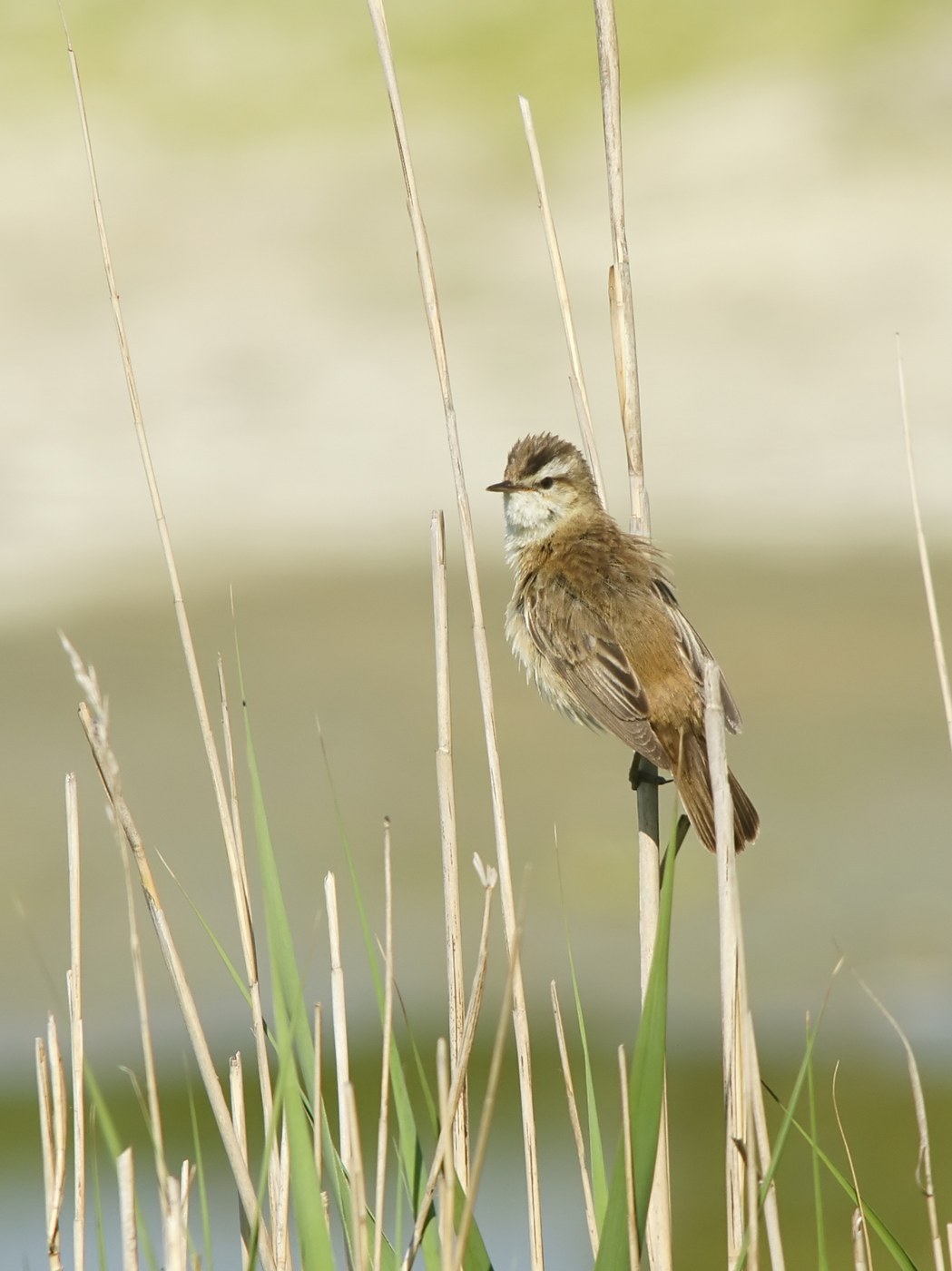
Key Field Marks
- Size & shape: A small, compact Acrocephalus warbler, roughly 12–13 cm long, with a rounded head, short rounded wings, and a fairly long, slightly graduated tail often held cocked.
- Plumage: Warm buffy-brown above with bold dark streaking on the crown and back, unlike the plain-backed Reed Warbler. The most distinctive mark is a broad, creamy-white supercilium (eyebrow stripe) that stands out sharply against a dark eye-stripe and streaked crown.
- Underparts: Pale buff to whitish below, unstreaked, with a warm wash on the flanks.
- Bill & legs: Fine, pointed bill typical of reed-warblers; legs pale pinkish-brown.
- Behavior: Skulking but often sings from an exposed perch atop a reed or bush, unlike the more hidden Reed Warbler. Frequently flicks and cocks its tail.
Separating It From Similar Species
- Eurasian Reed Warbler: Plain unstreaked brown back and crown, indistinct short eyebrow, more uniform rufous-brown tone — the single best distinction from Sedge Warbler's bold streaking and eyebrow.
- Moustached Warbler: Also striped-backed with a strong supercilium, but has a darker cap sharply demarcated from the eyebrow, a shorter tail, and darker, more contrasting underparts; more restricted to southern Europe/Asia.
- Aquatic Warbler: Similar streaked pattern but shows a pale central crown stripe (unlike Sedge Warbler's uniformly streaked crown) and is much rarer, with a more buffy overall tone.
- Grasshopper Warbler: Finely streaked all over including underparts and tail, lacks the bold clean eyebrow, and has a more reptilian, insect-like reeling song.
Where & When to See It
- Habitat: Reedbeds, sedge fen, wet scrub, ditches, and damp vegetation near lakes, rivers, and marshes; slightly more tolerant of drier, scrubbier edges than the more strictly reed-bound Reed Warbler.
- Range: Breeds across Europe and western/central Asia; a long-distance migrant that winters in sub-Saharan Africa.
- Season: Present on breeding grounds from April to September; passage migrants can turn up in a wide range of scrubby, weedy habitats away from typical breeding wetlands.
Voice
- Song is a fast, chattering, highly varied mix of harsh, grating notes interspersed with mimicked phrases and clear whistles, delivered in bursts often from a perch or during a brief song-flight — more varied and hurried than the steady, rhythmic chugging of Reed Warbler.
- Call is a hard, sharp tuc or churring alarm note given from cover.
Frequently asked questions
What is the easiest way to tell a Sedge Warbler from a Reed Warbler?
Look for the bold cream-colored eyebrow stripe and dark streaking on the crown and back of the Sedge Warbler; the Reed Warbler is plain unstreaked brown above with only a faint, short eyebrow.
Does the Sedge Warbler sing from cover or in the open?
Unlike many skulking Acrocephalus warblers, Sedge Warblers often sing from an exposed perch on a reed stem or bush top, and males sometimes deliver part of the song in a brief fluttering song-flight.
Where is the best habitat to find a Sedge Warbler?
Look in reedbeds, sedge fen, and damp scrubby vegetation along the edges of lakes, rivers, and marshes; it tolerates slightly drier and scrubbier sites than the Reed Warbler.
When do Sedge Warblers arrive on their breeding grounds?
In Europe they typically arrive in April and depart by September, wintering in sub-Saharan Africa.