
Secretarybird Identification Guide
An unmistakable, long-legged African raptor that stalks grassland on foot, topped with long black quill-like crest feathers.
Read the full Secretarybird encyclopedia entry →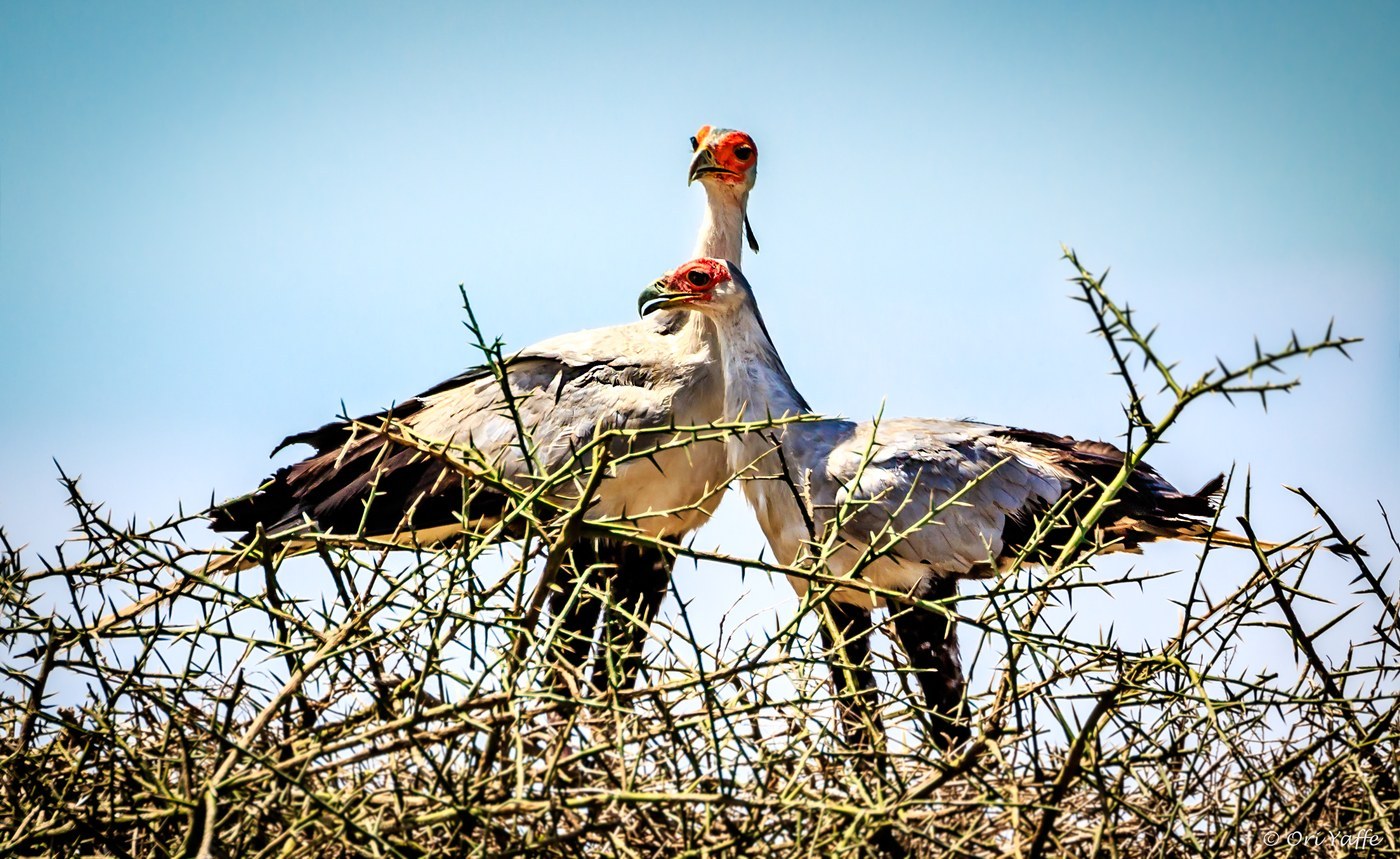
Key Field Marks
- Size & shape: A very large, terrestrial bird of prey standing about 1.2–1.5 m tall on extremely long, crane-like legs, with a body length (including tail) of over 1 m.
- Plumage: Pale grey body and wing coverts, contrasting with black flight feathers, black "shorts" (thigh feathers), and a black-tipped tail with two elongated central tail feathers.
- Head: Bare orange-red facial skin around the eye, a strongly hooked raptor bill, and a distinctive fan of long black feathers projecting from the back of the head, resembling quill pens tucked behind an ear — the source of its common name.
- Legs: Long, thick, pinkish legs with short toes; the legs are protected by thick scales when stomping on prey.
Separating It From Similar Species
- No other raptor has this combination of long legs and a hooked bill; at a distance it can suggest a crane in silhouette, but its raptorial hooked bill, bare red facial skin, and hunting behavior (stomping prey rather than wading or grazing) immediately separate it from any crane.
- In flight, it shows broad wings and trailing legs with a long tail, unlike any crane or stork silhouette, and it is essentially unmistakable once its shape and head pattern are seen.
Habitat, Range & Season
- Resident across open grassland, savanna, and lightly wooded plains throughout sub-Saharan Africa, avoiding dense forest.
- Requires open ground for hunting and tall trees, such as flat-topped acacias, for nesting.
- Non-migratory, though pairs and individuals range widely over large territories in search of prey.
Behavior
- Hunts almost entirely on foot, walking steadily through grassland and striking prey — including snakes, lizards, rodents, and large insects — with rapid, forceful stomps of its feet.
- Famous for its snake-hunting ability, using its wings as a shield while stomping venomous snakes to death.
- Roosts and nests in trees but spends the great majority of daylight hours walking on the ground.
Voice
- Generally silent; occasionally gives deep guttural croaking or grunting calls during courtship displays or at the nest.
Frequently asked questions
Why is it called a Secretarybird?
The long black crest feathers projecting from the back of its head resemble the quill pens 19th-century clerks or secretaries used to tuck behind their ears, giving the bird its name.
How does a Secretarybird catch its prey?
It walks through grassland and stomps on prey such as snakes, lizards, and rodents with rapid, forceful strikes of its long legs, sometimes using its wings as a shield against retaliating snakes.
Is the Secretarybird related to cranes or storks?
No, despite its long legs and superficially crane-like silhouette, it is a true bird of prey (raptor) with a hooked bill, most closely related to hawks and eagles.
Where can Secretarybirds be seen?
They are found across open grassland and savanna throughout sub-Saharan Africa, from Senegal east to Somalia and south to South Africa, generally avoiding dense forest.