
Seaside Sparrow Identification Guide
A large, dark, long-billed sparrow that skulks through Atlantic and Gulf Coast salt marshes and rarely strays far from Spartina grass.
Read the full Seaside Sparrow encyclopedia entry →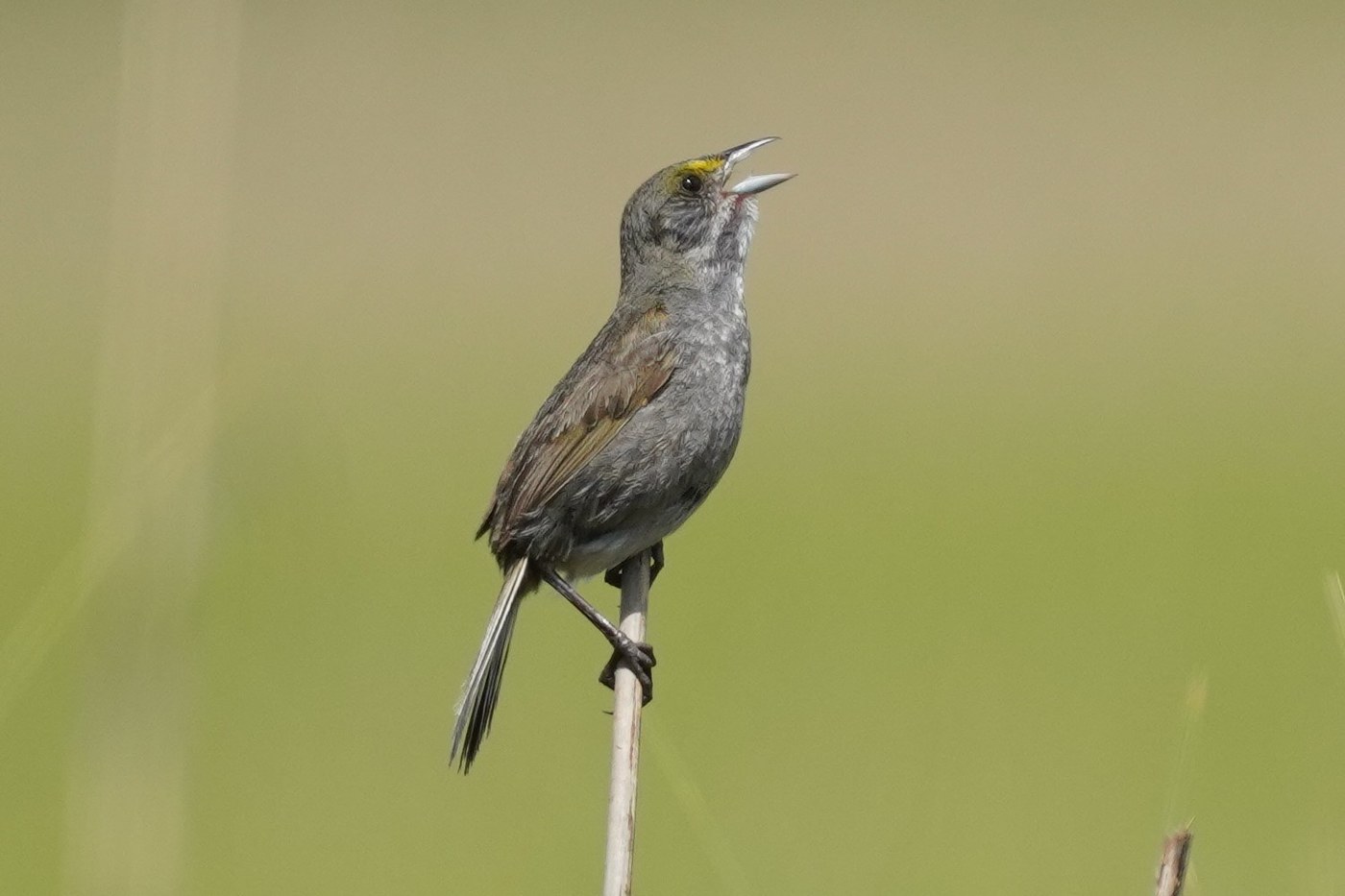
Key Field Marks
- Size & shape: A large sparrow, about 15 cm, with a notably long, spike-like bill, a flat-headed look, and a short tail — bulkier and longer-billed than most sparrows.
- Plumage: Overall dark olive-grey to blackish-grey, with a streaked breast, a small yellow spot in front of the eye (supraloral), and a whitish throat bordered by dark malar stripes.
- Regional variation: Plumage tone varies geographically from grey-olive along much of the Atlantic coast to notably darker, blacker birds in parts of the Gulf Coast (the extinct Dusky Seaside Sparrow of Florida was an extreme dark subspecies).
- Behavior in the field: Often runs or walks mouse-like through dense marsh grass rather than flying, and when flushed flies low and briefly before dropping back into cover.
Separating It From Similar Species
- Saltmarsh Sparrow shares the same habitat but is smaller, has a shorter bill, and shows a much more contrasting, rich orange face and breast pattern.
- Nelson's Sparrow is also smaller with a shorter bill and a soft orange-buff face, and typically shows less breast streaking than Seaside Sparrow.
- Seaside Sparrow is the largest, darkest, and longest-billed of the three tidal marsh sparrows, with the least colorful facial pattern.
Habitat, Range & Season
- Restricted almost entirely to salt marsh dominated by cordgrass (Spartina), along the Atlantic coast from New England to Florida and along the Gulf Coast to Texas.
- Non-migratory in the south; northern populations move short distances to milder coastal marshes in winter.
- Rarely found away from tidal marsh habitat at any season.
Behavior
- Forages low in marsh vegetation and on mudflats for insects, spiders, and small crustaceans.
- Builds its nest just above the high-tide line in marsh grass, making populations vulnerable to sea-level rise and storm surge.
Voice
- Song is a buzzy, insect-like "kri-e-e-e-uh," with a cadence recalling a Red-winged Blackbird's song but drier and more mechanical.
- Call is a sharp "chip" note.
Frequently asked questions
How do I distinguish a Seaside Sparrow from a Saltmarsh Sparrow?
Seaside Sparrow is larger and darker with a longer bill and a much plainer, less orange face, while Saltmarsh Sparrow is smaller with a shorter bill and a strongly contrasting orange facial pattern.
What habitat should I search for a Seaside Sparrow?
Look specifically in salt marsh dominated by cordgrass (Spartina) along the Atlantic and Gulf coasts — this species is rarely found away from tidal marsh at any time of year.
Is the Dusky Seaside Sparrow still around?
No, that very dark Florida subspecies of Seaside Sparrow went extinct in 1987 due to habitat loss and pesticide impacts on its Merritt Island and St. Johns River marshes.
What does a Seaside Sparrow sound like?
Its song is a dry, buzzy "kri-e-e-e-uh" phrase with a cadence somewhat similar to a Red-winged Blackbird, but harsher and more insect-like.