
Screech Owl Identification Guide
A group of small, compact North American owls with prominent ear tufts and cryptic bark-like plumage, best told apart by voice.
Read the full Screech Owl encyclopedia entry →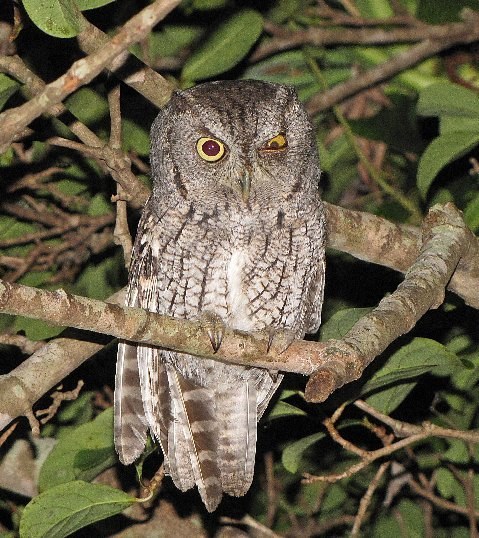
Key Field Marks
- Size & shape: Small, stocky owls, roughly 18–25 cm tall, with a large rounded head, prominent pointed ear tufts, and a short tail.
- Plumage: Intricately mottled and streaked grey or reddish-brown ("rufous morph") plumage that provides excellent camouflage against tree bark; underparts show fine vertical streaking with cross-barring.
- Eyes & face: Bright yellow eyes set in a distinct facial disc; bill is pale, mostly hidden by facial feathers.
- Roosting posture: By day, often roosts tucked in a tree cavity entrance or pressed against a trunk, becoming remarkably inconspicuous.
Separating the Screech-Owl Species
Screech-owls (genus Megascops) are a group of closely related species best distinguished by voice and range rather than plumage:
- Eastern Screech-Owl occurs in the eastern half of North America and gives a distinctive descending, whinnying tremolo, plus a separate even-pitched trill.
- Western Screech-Owl replaces it in the western US and gives an accelerating series of short hoots often likened to a bouncing ball coming to rest.
- Whiskered Screech-Owl overlaps with Western Screech-Owl in the Southwest (notably southeastern Arizona) but gives a more irregular, Morse-code-like rhythm of hoots.
- Plumage overlaps heavily between species (both grey and rufous morphs occur in Eastern and Western), so range plus voice is the most reliable identification method.
Habitat, Range & Season
- Found in a wide range of wooded habitats, including deciduous and mixed forest, riparian corridors, parks, and even well-treed suburban neighborhoods.
- Nests and roosts in natural tree cavities or old woodpecker holes, and readily uses nest boxes.
- Resident year-round across their respective ranges; strictly nocturnal.
Behavior
- Hunts at night from a perch, taking large insects, small rodents, and occasionally small birds or amphibians.
- Highly vocal at dusk and after dark, especially during the breeding season; can sometimes be lured into view by imitating or playing its call (used sparingly and responsibly).
Voice
- Voice is the single best identification tool for screech-owls: listen for a descending whinny (Eastern) versus an accelerating hoot series (Western) versus an irregular hoot pattern (Whiskered).
Frequently asked questions
How do I tell Eastern and Western Screech-Owls apart?
Plumage is very similar in both species, so voice is key: Eastern Screech-Owl gives a descending, horse-like whinny plus a level trill, while Western Screech-Owl gives a series of short hoots that accelerate like a bouncing ball.
Do screech-owls always have ear tufts raised?
No, ear tufts can be raised or flattened depending on the bird's alertness and mood; a relaxed or roosting owl may show barely visible tufts.
What does it mean if a screech-owl is reddish instead of grey?
Screech-owls occur in grey and rufous (reddish-brown) color morphs within the same species and even the same population, so color alone does not indicate species or subspecies.
Where do screech-owls nest?
They nest in tree cavities, old woodpecker holes, or artificial nest boxes placed in wooded or well-treed suburban areas.