
Scarlet Tanager Identification Guide
A brilliant red-and-black canopy songbird of eastern North American forests, best known for its striking breeding-plumage males.
Read the full Scarlet Tanager encyclopedia entry →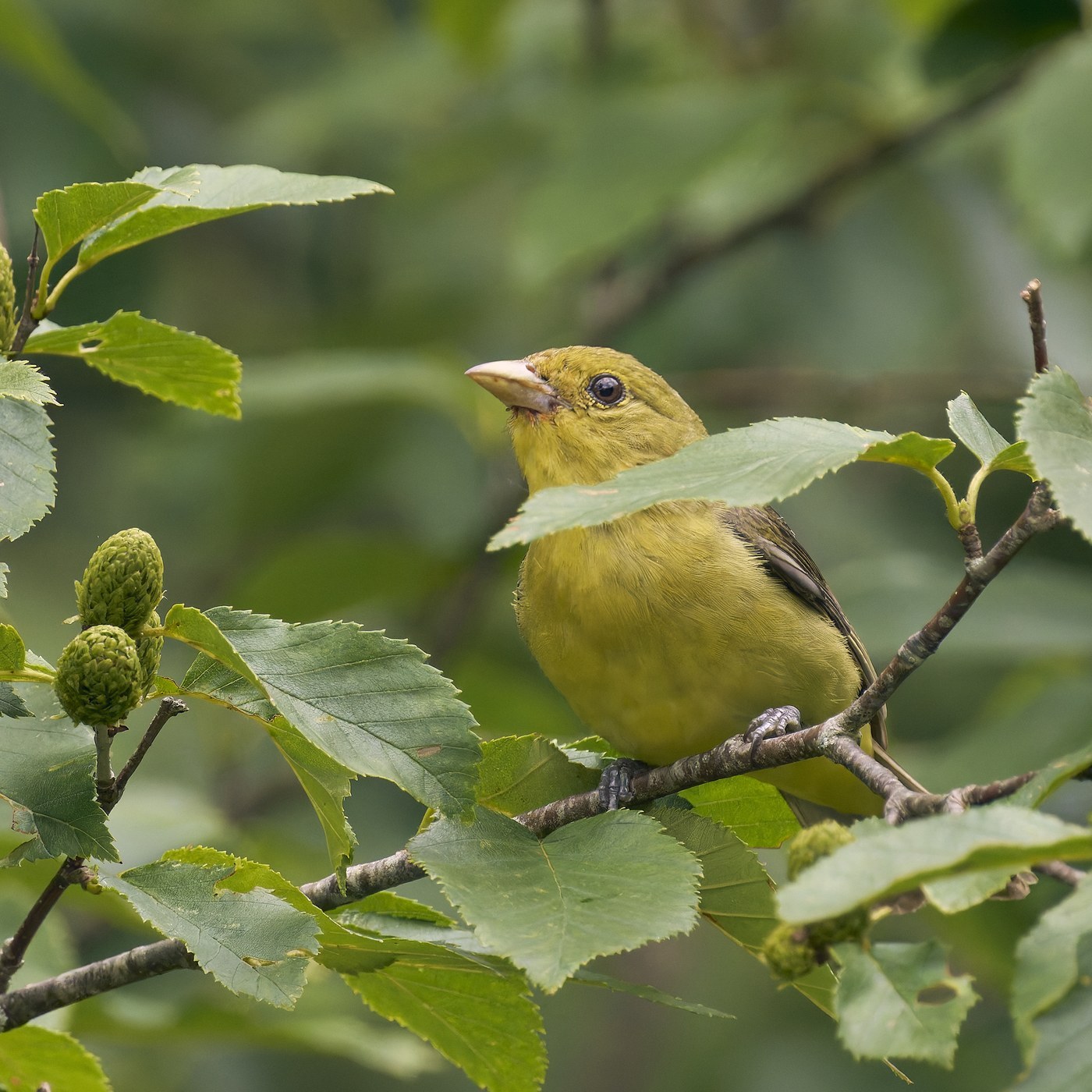
Key Field Marks
- Size & shape: A stocky, medium-sized songbird about 16–17 cm long, with a fairly thick, blunt bill typical of tanagers.
- Breeding male: Brilliant scarlet-red body contrasting sharply with jet-black wings and tail — one of the most vivid birds in eastern North America.
- Female / nonbreeding male: Olive-yellow above and yellow below; males in fall retain blackish wings even as the body molts toward yellow-green, while females show duller, olive (not black) wings year-round — a key way to separate the sexes outside breeding season.
- Bill & legs: Pale, thick bill; blue-grey legs and feet.
Separating It From Similar Species
- Summer Tanager male is red all over, including the wings, with no black; female Summer Tanager is a more uniform mustard-yellow without contrasting dark wings, and has a longer, more pointed bill.
- Western Tanager male has a red head only, with a black back, black wings, and bold yellow and white wing bars — ranges barely overlap.
- A molting male Scarlet Tanager (blotchy red-and-green) can look odd but the black wings remain a constant clue.
Habitat, Range & Season
- Breeds in mature deciduous and mixed forests across the eastern United States and southeastern Canada, favoring large tracts of continuous canopy.
- Winters in northern and western South America, in forest and forest edge.
- Present in North America from late April through September/October; forages and sings mostly high in the canopy, often heard before seen.
Behavior
- Gleans insects from foliage in the upper canopy; also eats fruit, especially before migration.
- Can be inconspicuous despite bright color because it stays high and still in dense leaves — listen for its voice.
Voice
- Song is a series of short, burry phrases resembling an American Robin with a hoarse voice: "querit queer query querit queer."
- Call is a distinctive, dry "chip-burr" or "chip-churr," often the best clue to locating the bird in dense canopy.
Frequently asked questions
How do I tell a Scarlet Tanager from a Summer Tanager?
Male Scarlet Tanagers have black wings and tail against a red body, while male Summer Tanagers are entirely red with no black anywhere in the plumage.
What does a female Scarlet Tanager look like?
Females are olive-yellow above and yellow below, with duller olive (not black) wings, distinguishing them from fall males which keep black wings while the body turns greenish-yellow.
Why is the Scarlet Tanager hard to spot despite being bright red?
It typically forages high in the forest canopy among dense leaves, so it's often detected by its distinctive burry song or dry chip-burr call before it's seen.
Where do Scarlet Tanagers spend the winter?
They migrate to northern and western South America, including the Andean foothills, from roughly October through March.