
Scarlet Macaw Identification Guide
A huge, unmistakable rainforest parrot with fiery red body plumage set off by blue-and-yellow wings and a long pointed tail.
Read the full Scarlet Macaw encyclopedia entry →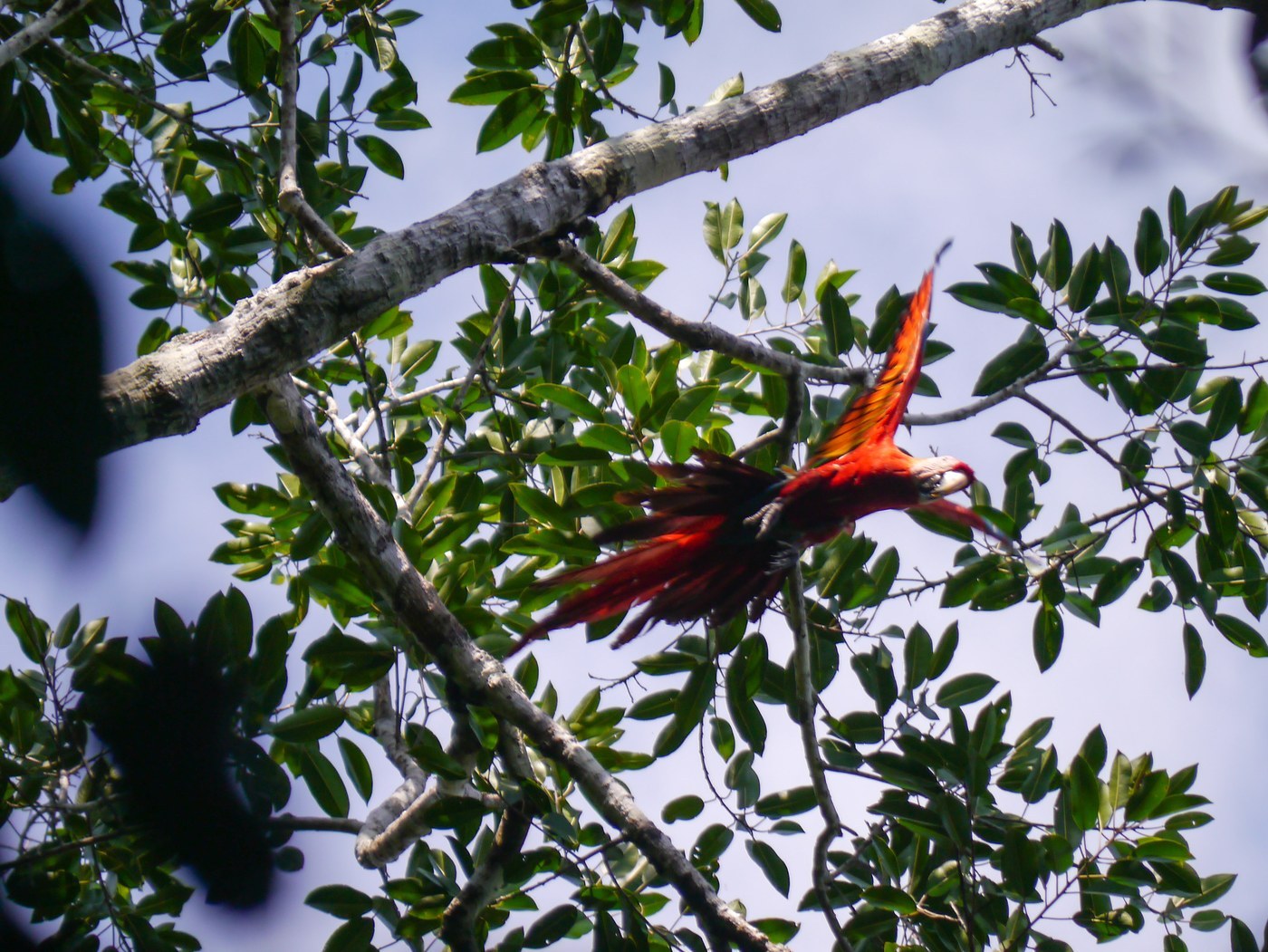
Key Field Marks
- Size & shape: One of the largest parrots in the Americas, roughly 80–90 cm long including a very long, pointed, graduated tail.
- Plumage: Overall brilliant red on the head, neck, and underparts; wings show a band of yellow feathers followed by blue flight feathers; tail mostly red with blue tips.
- Face & bill: Large pale, bare whitish facial patch crossed by thin lines of tiny red feathers; massive pale horn-colored upper mandible and blackish lower mandible.
- Flight: Flies with slow, deep wingbeats, long tail streaming behind; often travels in pairs or small, noisy flocks.
Separating It From Similar Macaws
- Green-winged (Red-and-green) Macaw is larger, shows a green (not yellow) band on the wing, and has more extensive fine red lines across its facial patch.
- Military Macaw is predominantly green, not red, with a red forehead only.
- No other large macaw combines an all-red body with a yellow wing band, making adult Scarlet Macaws essentially unmistakable once seen well.
Habitat, Range & Season
- Resident from southern Mexico through Central America to Bolivia and Brazil, in lowland tropical rainforest, gallery forest, and forest edge, mainly below 500 m elevation.
- Often seen at riverside clay licks in the Amazon and Central America, where flocks gather to eat mineral-rich clay.
- Resident year-round; pairs mate for life and are frequently seen flying together.
Behavior
- Feeds on fruit, seeds, nuts, and flowers, using its powerful bill to crack tough seed pods.
- Nests in large tree cavities, often reusing sites for years; population is threatened in parts of its range by habitat loss and the pet trade.
Voice
- Very loud and raucous: harsh, far-carrying squawks, screeches, and croaking calls, especially in flight or when flushed.
Frequently asked questions
What's the difference between a Scarlet Macaw and a Green-winged Macaw?
Scarlet Macaw has a yellow band on the upper wing and a mostly bare white face with only thin red feather lines, while Green-winged Macaw is larger, shows green (not yellow) on the wing, and has more red lines crossing its facial patch.
Where do Scarlet Macaws live?
They range through lowland tropical forests from southern Mexico and Central America south to parts of Bolivia and Brazil, generally below 500 meters elevation.
Why do Scarlet Macaws gather at clay licks?
They visit exposed riverbank clay deposits to ingest minerals that help neutralize toxins in the unripe fruits and seeds that make up much of their diet.
Are Scarlet Macaws found in the wild in the United States?
No, they are native to Latin America; any Scarlet Macaws seen in the US are escaped or released captive birds, though a small reintroduced population exists in parts of southern Florida.