
Scarlet Ibis Identification Guide
A South American and Caribbean wading bird whose adults are almost entirely brilliant scarlet, famous for spectacular mass roosts.
Read the full Scarlet Ibis encyclopedia entry →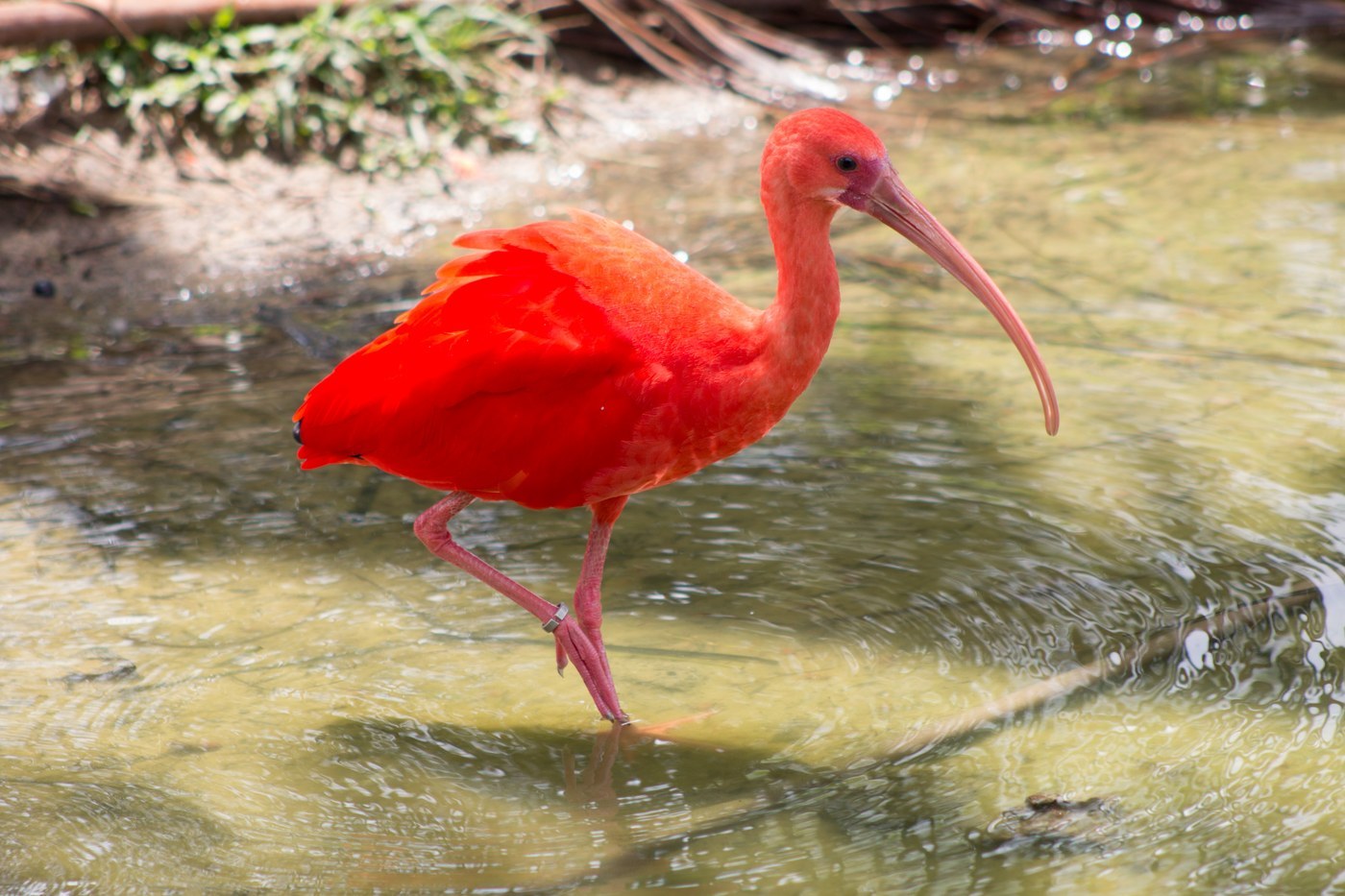
Key Field Marks
- Size & shape: A medium-large ibis, roughly 55–65 cm long, with long legs, a long neck, and a long, evenly decurved bill.
- Adult plumage: Overall vivid scarlet, with black tips confined to the outer primaries (visible in flight); bill is pinkish-red to dusky at the tip.
- Immatures: Start out grey-brown and white, gradually acquiring scarlet coloration as they mature — the red pigment comes from carotenoids in their crustacean diet, so captive or poorly fed birds can look duller or pinkish.
- Flight: Flies with neck and legs extended, often in lines or V-formation, showing black wingtips against the scarlet body.
Separating It From Similar Species
- American Flamingo is much larger, has a sharply down-bent (kinked) bill rather than an evenly curved one, and stands and flies with a very different silhouette.
- White Ibis is a close relative and can hybridize with Scarlet Ibis where ranges overlap; hybrids and some captive-influenced populations show pink or blotchy plumage rather than pure scarlet.
- Immature Scarlet Ibis can resemble immature White Ibis; range and any accompanying red adults help confirm identification.
Habitat, Range & Season
- Native to coastal and inland wetlands of northern and eastern South America (including the Amazon and Orinoco deltas) and Trinidad, where Caroni Swamp hosts spectacular evening roosting flocks.
- Inhabits mangroves, mudflats, lagoons, and marshes; forages by probing soft mud and shallow water for crabs, crustaceans, and small aquatic prey.
- Largely resident, though some local and seasonal movements occur with water levels; vagrants occasionally turn up well outside the core range.
Behavior
- Highly gregarious, feeding, flying, and roosting in large flocks, sometimes alongside herons, spoonbills, and other ibises.
- The evening return to communal roosts, when hundreds of birds turn a mangrove island scarlet, is one of the most famous birding spectacles in the Caribbean and South America.
Voice
- Generally quiet away from breeding colonies; gives low grunting and croaking calls at roosts and nest sites.
Frequently asked questions
Why do Scarlet Ibises turn from grey to red?
Chicks hatch grey and white; as they mature and feed on carotenoid-rich crustaceans and crabs, their plumage gradually turns scarlet, usually reaching full color by about two years old.
How do I tell a Scarlet Ibis from a flamingo?
The ibis has an evenly curved bill and is smaller and more compact, while the flamingo is much larger with a bill that bends sharply downward partway along its length.
Where is the best place to see large numbers of Scarlet Ibis?
Caroni Swamp in Trinidad is world-famous for evening flights of hundreds of Scarlet Ibis returning to mangrove roosts; large numbers also occur in coastal Venezuela, Guyana, and the Amazon/Orinoco deltas.
Can Scarlet Ibis interbreed with White Ibis?
Yes, where their ranges meet they can hybridize, producing birds with mixed pink-and-white plumage rather than the pure scarlet of typical adults.