
Scarlet Honeyeater Identification Guide
Australia's smallest honeyeater, with males glowing brilliant scarlet against black wings and a whitish belly.
Read the full Scarlet Honeyeater encyclopedia entry →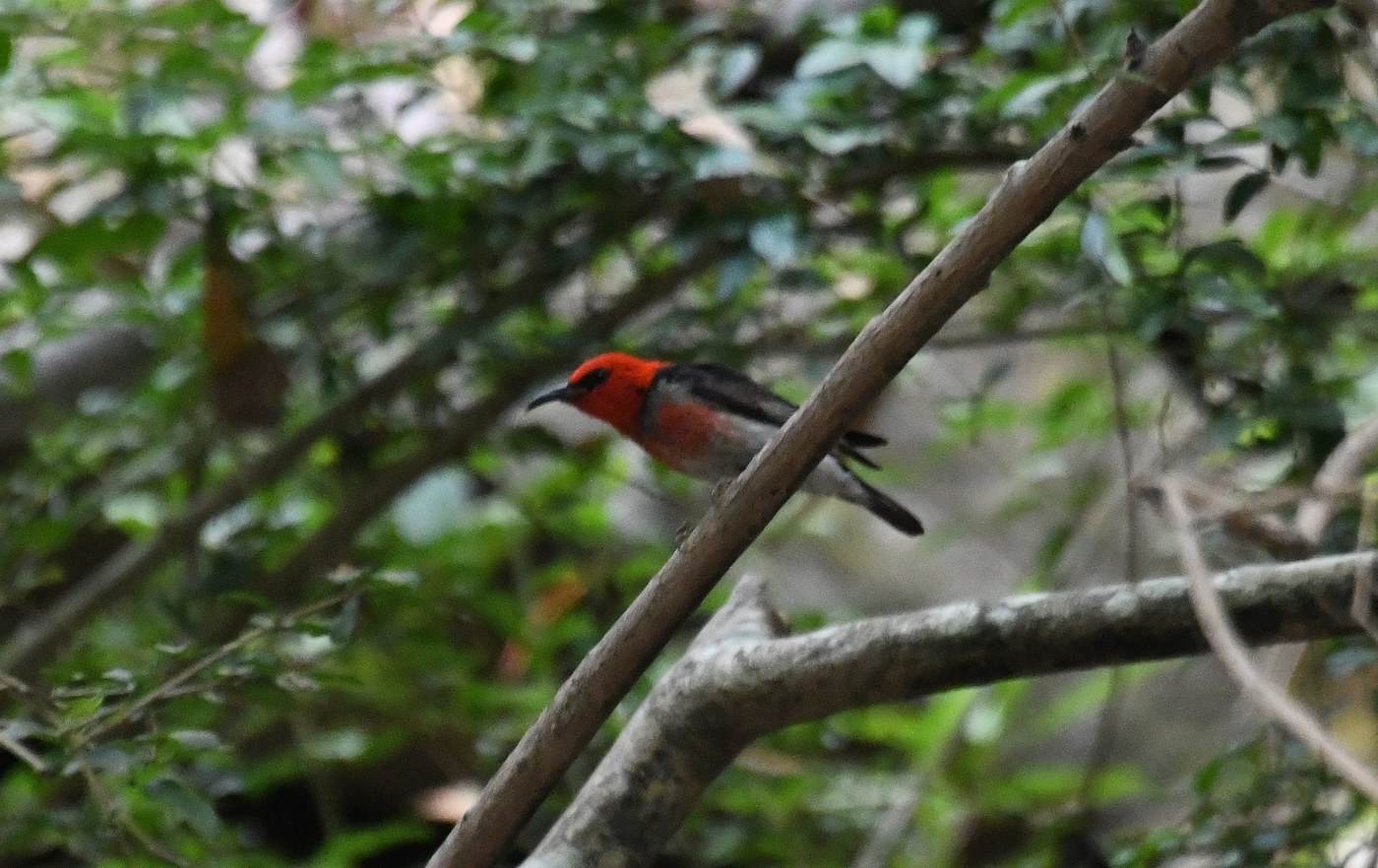
Key Field Marks
- Size & shape: Tiny — around 9–11 cm, one of the smallest honeyeaters in Australia — with a fine, thin, slightly decurved bill built for nectar feeding.
- Male plumage: Vivid scarlet head, throat, breast, and back contrasting with blackish wings, blackish tail, and a whitish to pale grey belly.
- Female plumage: Plain grey-brown above and pale below, often with a faint pinkish or reddish wash on the face and rump — much less conspicuous than the male.
- Bare parts: Dark bill, dark legs; small dark eye.
Separating It From Similar Species
- The Mistletoebird male also shows a red throat/breast, but has a glossy blue-black back and a white (not red) rump and belly with a black central belly stripe — the Scarlet Honeyeater's red extends onto the back and it lacks the belly stripe.
- Female Scarlet Honeyeaters can be confused with other small brown honeyeaters or female Mistletoebirds; look for the thin decurved bill and any hint of pink on the face/rump, plus the tiny overall size.
Habitat, Range & Season
- Found along the eastern coast of Australia, from Cape York Peninsula south to Victoria, favoring eucalypt forests, woodlands, coastal heath, and flowering paperbarks or bottlebrush.
- Highly nomadic, following blossom availability; can appear in large numbers wherever eucalypts or melaleucas are flowering and be scarce elsewhere.
Behavior
- Actively forages high in flowering canopy for nectar, also taking small insects.
- Often joins mixed nectar-feeding flocks with other small honeyeaters.
- Males sing from exposed perches, sometimes performing a brief display flight.
Voice
- Song is a distinctive, high-pitched, tinkling series of notes, often described as bell-like or ringing.
- Calls include thin, sharp "tsip" notes and a rapid descending trill.
Frequently asked questions
How can I tell a male Scarlet Honeyeater from a Mistletoebird?
The Scarlet Honeyeater's red covers its back and it has no black belly stripe, while the Mistletoebird has a glossy black back, white rump, and a black stripe down a white belly.
Why do Scarlet Honeyeaters appear and disappear from an area?
They are nomadic nectar feeders that track flowering eucalypts and melaleucas, so numbers fluctuate seasonally and locally with blossom availability.
Is the female Scarlet Honeyeater red too?
No, females are plain grey-brown, sometimes with a faint pink wash on the face or rump, making them far less conspicuous than males.
What is the best clue to identify a Scarlet Honeyeater by ear?
Listen for its high, tinkling, bell-like song, often given from a high perch in flowering trees.