
Scaled Quail Identification Guide
A pale grayish desert quail of the American Southwest, identified by its scaly-looking breast pattern and a distinctive white, cottony crest ('cotton top').
Read the full Scaled Quail encyclopedia entry →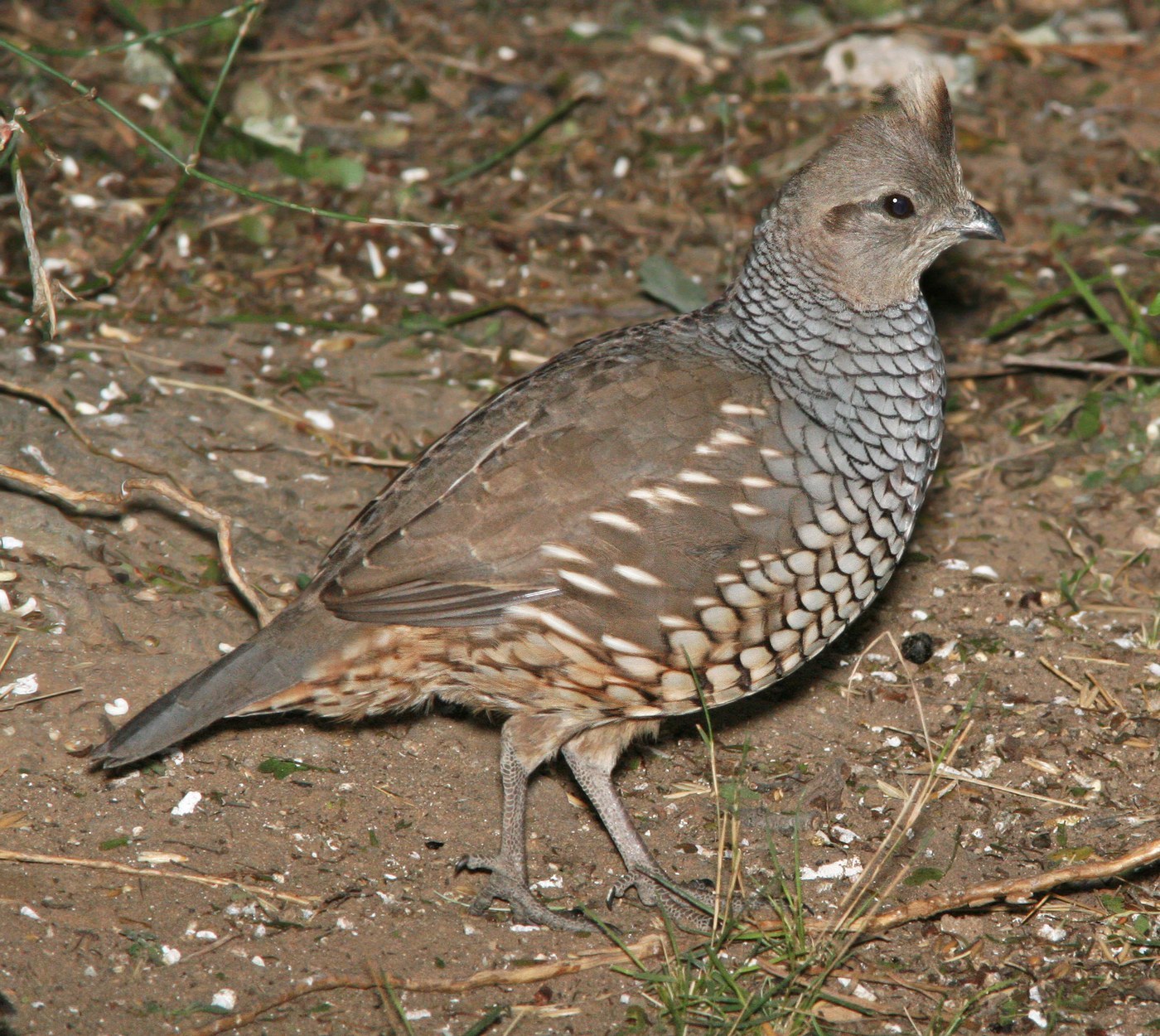
Key Field Marks
- Size & shape: A plump, ground-dwelling quail with a short tail and a rounded body typical of New World quail, slightly larger and paler overall than Gambel's or California Quail.
- Plumage pattern: Overall bluish-gray to grayish-brown body with feathers on the breast, neck, and back edged in dark crescents, creating a distinctive scaled or fish-scale pattern across the underparts — the source of its name.
- Crest: A short, bushy, whitish or pale buffy crest on the crown that looks like a tuft of cotton, especially conspicuous when raised — often called "cotton top."
- Face: Plain grayish face without the bold black facial markings seen in male California or Gambel's Quail.
- Behavior: Highly terrestrial and runs rather than flies when disturbed, often in coveys moving quickly through sparse desert scrub; flushes explosively only as a last resort.
Separating Scaled Quail from Similar Species
- Gambel's Quail: Male Gambel's has a bold black face patch, chestnut cap, and a forward-curving black head plume, quite different from the plain gray face and cotton-top crest of Scaled Quail; Gambel's also lacks the extensive scaled breast pattern.
- California Quail: Similar forward-curving black plume and bold facial pattern in males, plus a scaled belly pattern that is more restricted than Scaled Quail's; ranges barely overlap (California Quail is further west).
- Northern Bobwhite: Rounder, more compact shape with a reddish-brown overall tone and bold white throat/eyebrow stripes in males — quite different from Scaled Quail's uniform gray, scaled look.
- Overall impression: No other North American quail combines the pale grayish scaled body pattern with a whitish cotton-top crest — Scaled Quail is fairly distinctive once seen well.
Where & When to See One
Scaled Quail is a resident of arid and semi-arid grasslands, desert scrub, and brushy plains across the southwestern United States (Texas, New Mexico, Arizona, Oklahoma, Colorado, Kansas) and northern Mexico. It does not migrate, remaining on territory year-round, and prefers areas with scattered low shrubs, cactus, or yucca for cover interspersed with open ground. Coveys are most easily seen at dawn or dusk running across roads or foraging in open desert flats, or at reliable water sources during dry periods.
Voice
A distinctive nasal, barking pey-cos or chik-AR-go call, along with various clucking and chattering contact notes used to keep coveys together while moving through cover.
Frequently asked questions
What gives the Scaled Quail its name?
Its breast, neck, and back feathers are edged in dark crescents that create a fish-scale or scaled pattern across the body, which is the origin of both its common name and the descriptive nickname 'blue quail.'
What is the 'cotton top' on a Scaled Quail?
It refers to the short, bushy whitish or pale buffy crest on the crown, which looks like a tuft of cotton and is especially noticeable when the bird raises it while alert.
How do you tell Scaled Quail from Gambel's Quail?
Scaled Quail has a plain gray face with a whitish cotton-top crest and an extensively scaled body, while male Gambel's Quail shows a bold black face patch, chestnut cap, and a forward-curving black head plume.
Where does the Scaled Quail live?
It is a year-round resident of arid grasslands and desert scrub across the southwestern United States and northern Mexico, favoring areas with scattered low cover and open ground.
Does Scaled Quail fly readily when disturbed?
No, it strongly prefers to run for cover and only flushes into flight as a last resort, which is a useful behavioral clue when trying to identify quail on the ground.