
Say's Phoebe Identification Guide
A pale, long-tailed flycatcher of the arid West, identified by its soft grayish-brown upperparts, pale cinnamon-buff belly, and habit of pumping its tail while perched.
Read the full Say's Phoebe encyclopedia entry →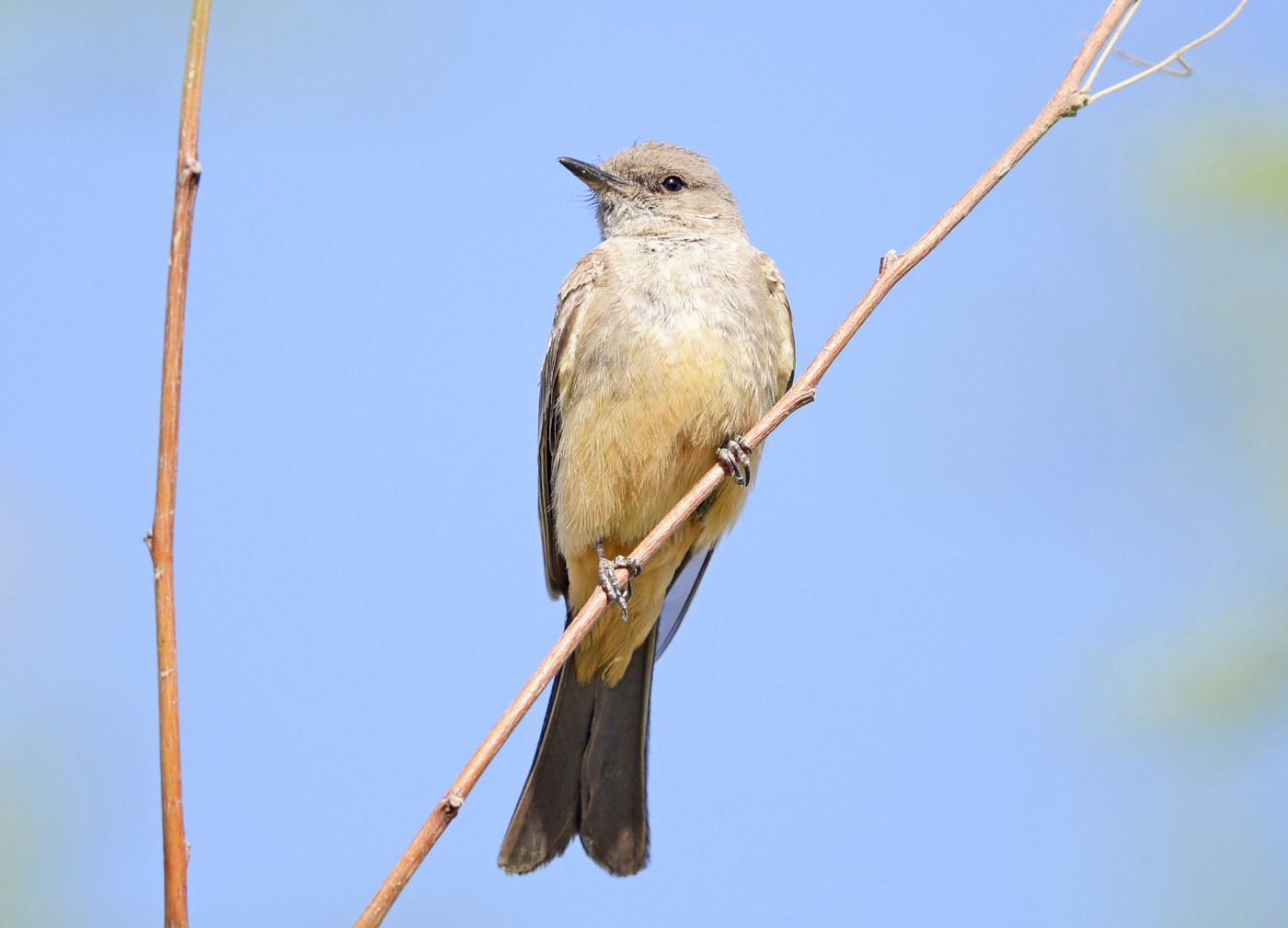
Key Field Marks
- Size & shape: A medium-sized flycatcher with a fairly long tail and an upright perching posture typical of phoebes, slightly larger and longer-tailed than Eastern Phoebe.
- Plumage: Soft grayish-brown head, back, and breast contrasting with a warm cinnamon-buff to pale orange belly and undertail — no other North American phoebe shows this warm-toned belly.
- Head: Plain grayish-brown face with no strong eye-ring or wing bars; overall subdued, soft-toned appearance.
- Bill: Thin, black, typical flycatcher bill.
- Behavior: Frequently pumps or dips its tail downward while perched, a classic phoebe trait; often perches on fence posts, wires, rocks, or low shrubs in open country, sallying out to catch insects and returning to the same perch.
Separating Say's Phoebe from Similar Species
- Eastern Phoebe: Lacks the cinnamon belly, showing instead a whitish underside with a pale yellowish wash at most, and darker overall grayish-olive upperparts; ranges mostly separate (Eastern Phoebe is east of the Great Plains, Say's Phoebe is western).
- Black Phoebe: Sooty black head, breast, and upperparts sharply demarcated from a white belly — much darker and more contrastingly patterned than the uniformly soft-toned Say's Phoebe.
- Vermilion Flycatcher (female/juvenile): Female Vermilion has a streaked breast and a peachy (not uniform cinnamon) belly wash, plus a different, more contrasty face pattern; male Vermilion is unmistakably bright red.
- Ash-throated Flycatcher: Larger-billed with a bushier crested look, pale gray throat, and yellow (not orange-cinnamon) belly, plus rufous in the tail visible in flight.
Where & When to See One
Say's Phoebe breeds across arid and semi-arid open country of western North America, from Alaska and western Canada south through the western United States into Mexico, favoring canyons, ranchlands, badlands, sagebrush flats, and even urban/suburban areas with buildings that provide nest ledges. Many populations are migratory, wintering in the southwestern U.S. and Mexico, though southern populations are resident. It is one of the earliest flycatchers to arrive on breeding territory in spring and one of the hardiest, sometimes wintering farther north than other flycatchers. Look for it perched low and alone in open, sparsely vegetated terrain.
Voice
A soft, plaintive, slightly downslurred whistle, pit-tseer or pee-ur, and a mournful rising phee-eur song; overall quieter and less emphatic than the sharp fee-bee of Eastern Phoebe.
Frequently asked questions
How do you identify a Say's Phoebe?
Look for a plain grayish-brown flycatcher with a warm cinnamon-buff belly, a habit of pumping its tail while perched, and a preference for open, arid habitats in the western United States.
How is Say's Phoebe different from Black Phoebe?
Say's Phoebe is uniformly soft grayish-brown with a cinnamon belly, while Black Phoebe is sooty black on the head and chest with a sharply contrasting white belly and no cinnamon tones.
What habitat does Say's Phoebe prefer?
It favors open, arid to semi-arid country such as canyons, ranchlands, sagebrush flats, and badlands, and readily nests on buildings, bridges, and other structures in addition to natural cliff ledges.
Does Say's Phoebe migrate?
Northern populations are migratory and winter in the southwestern United States and Mexico, while southern populations are largely resident, and it is often one of the first flycatchers to return in early spring.
Why does Say's Phoebe pump its tail?
Like other phoebes, it regularly dips or pumps its tail downward while perched, a behavioral tic useful for identification even when plumage details are hard to see.