
Sarus Crane Identification Guide
The world's tallest flying bird, identified by its all-gray body, bare red head and upper neck, and pale gray (not red) crown patch in Indian populations.
Read the full Sarus Crane encyclopedia entry →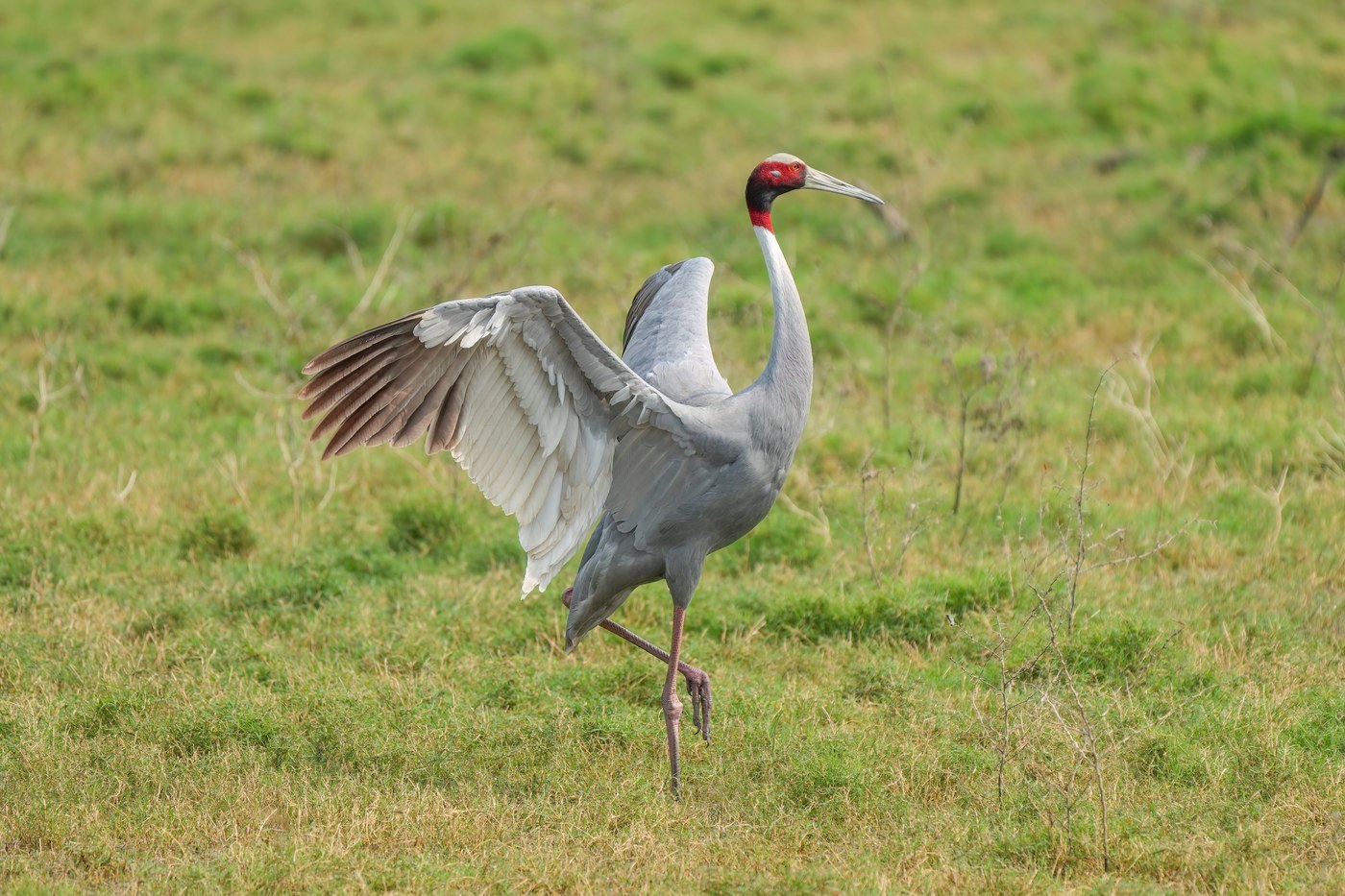
Key Field Marks
- Size & shape: An enormous crane, standing up to 1.8 m (nearly 6 ft) tall — the tallest of all flying birds — with a long neck, long legs, and a heavy, straight bill.
- Plumage: Overall pale gray body plumage with blackish primary wingtips visible in flight; juveniles are duller with feathered, buffy heads before the bare skin develops.
- Head & neck: Extensive bare red skin covering the head and upper neck (more extensive than in most other crane species), with a grayish-white crown patch and a small grayish ear patch; legs are pale pinkish-red to gray depending on population.
- Bill: Long, straight, pale grayish-green to pinkish bill.
- Behavior: Usually seen in pairs or family groups (less flocking than Sandhill or Common Crane), often in or near flooded rice paddies and wetlands; performs loud duetting calls and dramatic dancing displays.
Separating Sarus Crane from Similar Species
- Sandhill Crane: Smaller, with red confined to a smaller crown/forehead patch (not extending down the neck) and a grayer, less pinkish overall look; ranges do not naturally overlap (Sarus is Asian/Australian, Sandhill is North American).
- Common Crane: Shows a black-and-white striped head/neck pattern with only a small red crown patch, versus Sarus's much more extensive bare red skin over the whole head and upper neck.
- Brolga (Australia): Very similar red head pattern, but Brolga's red skin is more restricted, with a gray crown patch that is smaller and a dewlap (loose skin fold) under the chin that Sarus lacks; Brolga also has grayish (not pinkish-red) legs. Range overlaps in northern Australia where both occur.
- White-naped Crane: Has a red facial patch but combined with a gray body, whitish nape stripe, and different leg color; overall pattern is quite distinct on close view.
Where & When to See One
Sarus Crane occurs in scattered populations across the Indian subcontinent (its stronghold, where it is non-migratory and considered sacred in parts of India), Southeast Asia, and northern Australia (where it was only confirmed breeding in the 20th century and is sometimes treated as a separate population/subspecies alongside Brolga). It favors freshwater wetlands, marshes, and flooded agricultural land such as rice paddies, typically in pairs or small family groups rather than the huge flocks seen in migratory cranes. Best looked for at wetland reserves in northern India, Nepal's lowlands, Cambodia, and tropical Queensland/Northern Territory in Australia.
Voice
A loud, far-carrying trumpeting call, often given as a coordinated duet between paired birds with the male's higher-pitched call layered over the female's, audible from a long distance across open wetlands.
Frequently asked questions
What makes the Sarus Crane unique among cranes?
It is the tallest of all flying birds, reaching up to about 1.8 meters, and is notable for its extensive bare red skin covering both the head and much of the upper neck.
How do you tell Sarus Crane from Brolga?
Sarus Crane has red skin extending further down the neck, pinkish-red legs, and no dewlap under the chin, while Brolga shows a more restricted red face, gray legs, and a loose skin fold (dewlap) beneath the throat.
Is the Sarus Crane migratory?
Indian and Southeast Asian populations are largely non-migratory or make only local movements tied to wetland water levels, unlike the long-distance migratory Sandhill and Common Cranes.
What habitat should I search for Sarus Cranes?
Look in freshwater marshes, shallow lakes, and flooded rice paddies, typically finding pairs or small family groups rather than large migratory flocks.
Why is the Sarus Crane considered culturally significant in parts of its range?
In parts of India and Nepal it is revered as a symbol of marital fidelity because pairs mate for life and are often seen together, leading to strong local protection in some regions despite ongoing wetland habitat loss elsewhere.