
Sandhill Crane Identification Guide
A tall, long-necked gray crane with a red crown patch, told from herons by its straight neck in flight and famous rolling bugle call.
Read the full Sandhill Crane encyclopedia entry →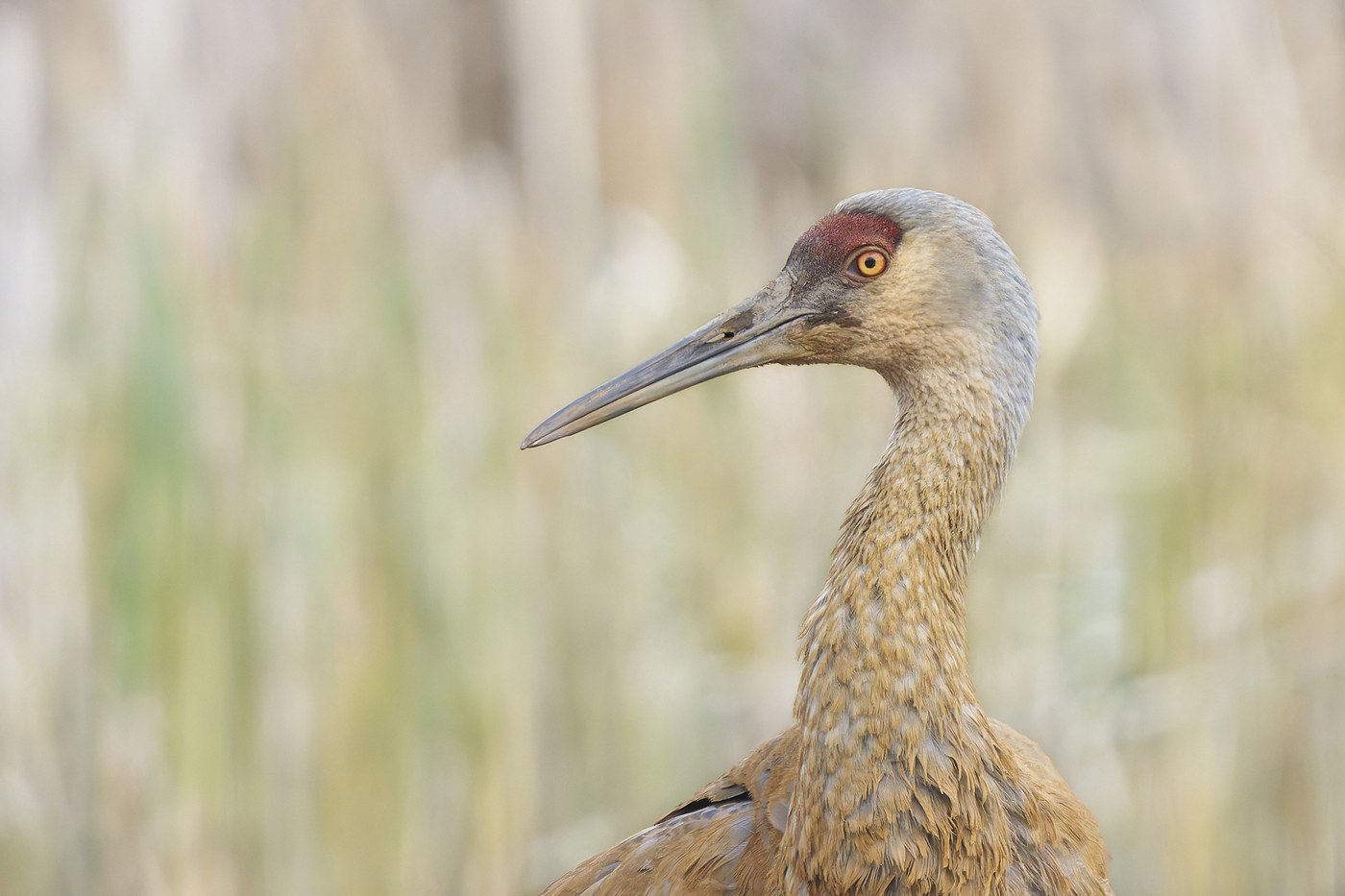
Key Field Marks
- Size & shape: A very large, long-legged, long-necked bird standing about 1–1.3 m (3.3–4.3 ft) tall, with a bulky body, a slightly drooping "bustle" of curved tertial feathers over the tail, and a straight, dagger-like bill.
- Plumage: Overall gray, often stained rusty-brown on the neck and back from preening with iron-rich mud; some populations look cleaner gray.
- Head: Bare, bright red skin patch on the crown/forehead contrasting with a pale cheek and grayish body — visible at surprisingly long range.
- Legs & bill: Long black legs; long, straight, pointed grayish bill (not dagger-curved like a heron's, and held straight rather than kinked).
- Flight: Flies with the neck fully outstretched (unlike herons, which fly with the neck tucked in an S-curve), on slow, deep wingbeats, often in large V-formations or long lines during migration.
- Behavior: Highly social outside the breeding season, gathering in large flocks at staging and roosting sites; performs elaborate leaping, wing-flapping courtship dances.
Separating Sandhill Crane from Similar Species
- Great Blue Heron: Similar gray coloring and tall stature but flies with neck retracted in an S-shape, has a much longer dagger bill, lacks the red crown patch, and is typically solitary or in small groups rather than huge flocks.
- Whooping Crane: Much rarer, almost entirely white with black wingtips (vs. all-gray Sandhill), though young Whooping Cranes are cinnamon-washed and sometimes travel with Sandhill flocks — check overall white body and black primaries.
- Common Crane (Eurasia, rare vagrant elsewhere): Similar gray crane but shows a black-and-white head/neck pattern with a smaller red crown spot, versus Sandhill's plainer gray head with a larger bare red patch.
Where & When to See One
Sandhill Cranes breed across a broad swath of North America from Alaska and Canada south through the northern Great Lakes and scattered western wetlands, plus resident populations in Florida, Mississippi, and Cuba. Migratory populations stage in massive numbers — most famously hundreds of thousands along Nebraska's Platte River in March — before continuing to breeding grounds, and winter in flocks across the southern U.S. and northern Mexico. Look for them in wet meadows, grain fields, marshes, and shallow river roosts, especially at dawn and dusk during migration staging.
Voice
An unmistakable loud, rolling, bugling garooo-a-a-a or rattling kar-r-r-o-o-o, produced by a specially coiled trachea and audible for over a mile; often heard well before the birds are seen, especially from flying flocks.
Frequently asked questions
How do you tell a Sandhill Crane from a Great Blue Heron?
Sandhill Cranes fly with their necks fully outstretched and have a bare red crown patch, while Great Blue Herons fly with the neck tucked into an S-curve and lack any red on the head.
What is that loud rattling call I hear from high-flying flocks?
That is almost certainly the Sandhill Crane's bugling call, a distinctive rolling, rattling sound produced by its long coiled windpipe and audible from great distances, even before the birds come into view.
Where is the best place to see huge numbers of Sandhill Cranes?
The Platte River valley in central Nebraska hosts one of the largest gatherings in the world each March, when hundreds of thousands of cranes stage there during northbound migration.
Why do some Sandhill Cranes look rusty brown instead of gray?
Many individuals stain their gray feathers with iron-rich mud while preening, giving them a rusty or brownish wash, especially on the neck and back, that can vary seasonally and by location.
Do Sandhill Cranes migrate every year?
Most populations are highly migratory between northern breeding grounds and southern wintering areas, but several populations, including in Florida, Mississippi, and parts of the West, are non-migratory residents.