
Sanderling Identification Guide
A plump, pale sandpiper famous for chasing waves on sandy beaches, told by its bill-less-looking short black bill, black legs, and near-white nonbreeding plumage.
Read the full Sanderling encyclopedia entry →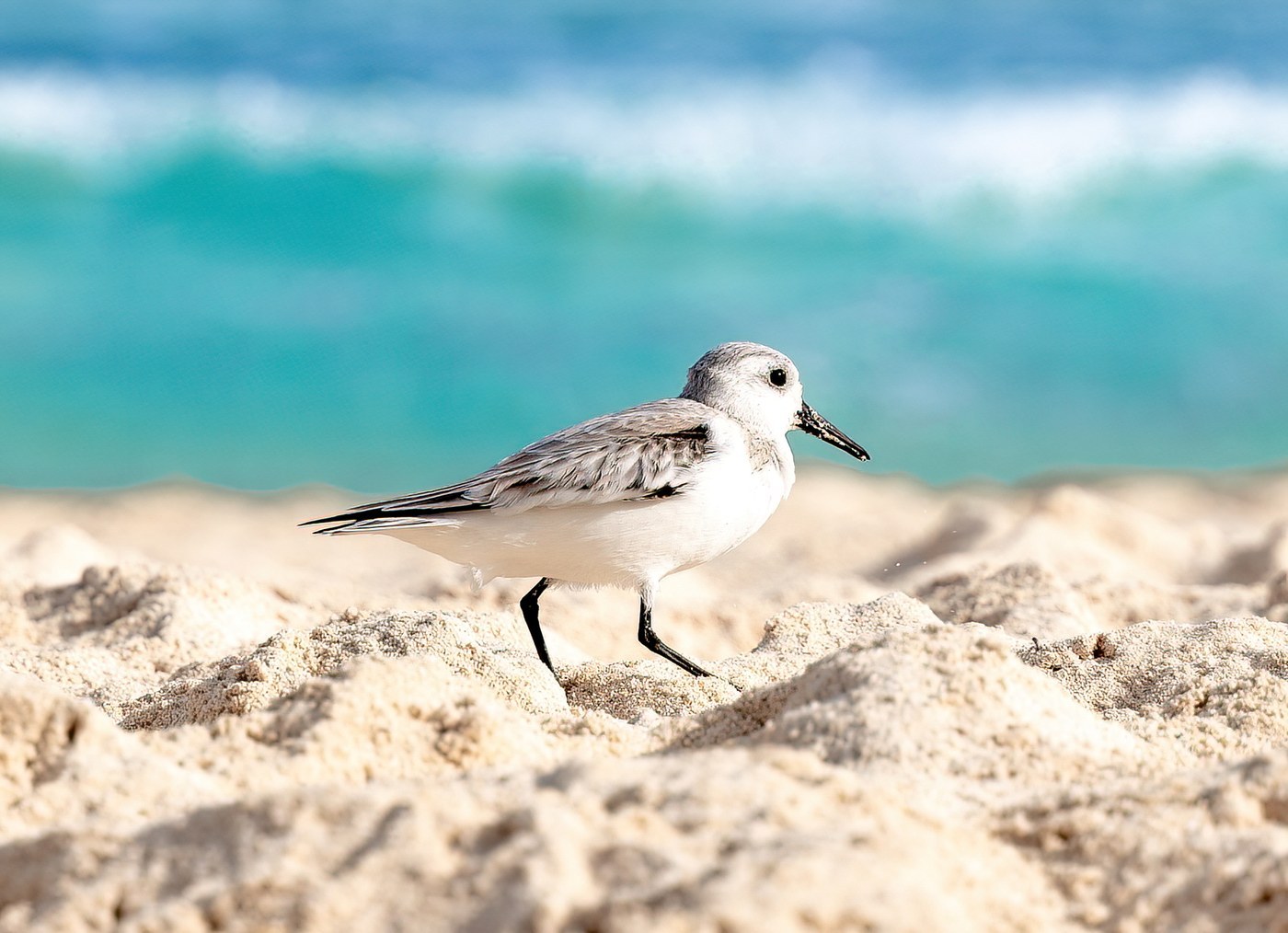
Key Field Marks
- Size & shape: A medium-small, plump, round-bodied sandpiper with a short, straight black bill and no hind toe (unique among North American sandpipers), giving a slightly different gait than other "peeps."
- Nonbreeding plumage: Very pale — the palest sandpiper on the beach — with pearly gray upperparts, a white face and underparts, and a dark shoulder patch (carpal bar) at the bend of the wing.
- Breeding plumage: Head, breast, and upperparts turn rich rufous-chestnut with dark mottling, contrasting with a white belly.
- Bill & legs: Bill is stout, black, and slightly shorter than many similar shorebirds; legs are black and relatively short.
- Flight: Shows a bold white wing stripe in flight, broader and more obvious than in most small sandpipers.
- Behavior: Classic "wind-up toy" beach behavior — runs rapidly back and forth with the surf, feeding right at the wave's edge, rarely staying still.
Separating Sanderling from Similar Species
- Dunlin: Longer, slightly drooped bill; in breeding plumage shows a black belly patch (Sanderling never does); in winter Dunlin is grayer and less pure white than Sanderling.
- Red Knot: Much larger and bulkier, with a longer bill and, in breeding plumage, an entirely rusty-red underside rather than rufous confined mostly to head/breast.
- Semipalmated Sandpiper and other small "peeps": Smaller, browner or grayer overall, with a hind toe present, and lack the extremely pale, bright white nonbreeding look of Sanderling; peeps also typically probe in mixed flocks on mudflats rather than chasing surf on open sand.
- Overall impression: No other common beach shorebird combines the very pale winter plumage, stout black bill, black legs, and frantic wave-chasing habit of Sanderling.
Where & When to See One
Sanderlings breed in the high Arctic tundra of Canada, Alaska, Greenland, and Siberia, but away from the breeding season they are one of the most widespread shorebirds on sandy beaches worldwide, found on nearly every ice-free coastline. In North America look for them year-round on ocean beaches (nonbreeders oversummer at lower latitudes too), running the surf line in loose flocks, especially common from fall through spring.
Voice
A short, sharp plit or kip flight call, often given as flocks wheel low over the water; relatively quiet compared to some shorebirds.
Frequently asked questions
Why do Sanderlings run back and forth at the beach?
They are following the swash of breaking waves, probing the wet sand for small invertebrates uncovered as water recedes, then retreating quickly to avoid the next incoming wave.
How can I tell a Sanderling from a Dunlin in winter?
Sanderling is noticeably paler and whiter overall with a straight black bill, while Dunlin is grayer-brown with a longer bill that droops slightly at the tip.
What does a Sanderling look like in breeding plumage?
Its head, neck, and breast turn rich rufous-chestnut mottled with black, sharply contrasting with a clean white belly, quite different from the pale gray-and-white winter look most birders know.
Where do Sanderlings breed?
They nest on high Arctic tundra in northern Canada, Alaska, Greenland, and Siberia, then migrate long distances to spend most of the year on beaches across nearly every continent.
Do Sanderlings have a hind toe like other sandpipers?
No, Sanderling is unusual among sandpipers in lacking a hind toe entirely, which is a technical but useful mark if you get a close look at the feet.