
Saffron Finch Identification Guide
A bright yellow-orange South American finch-tanager with an orange-tinged crown, popular in aviculture and now established as a feral species in several regions outside its native range.
Read the full Saffron Finch encyclopedia entry →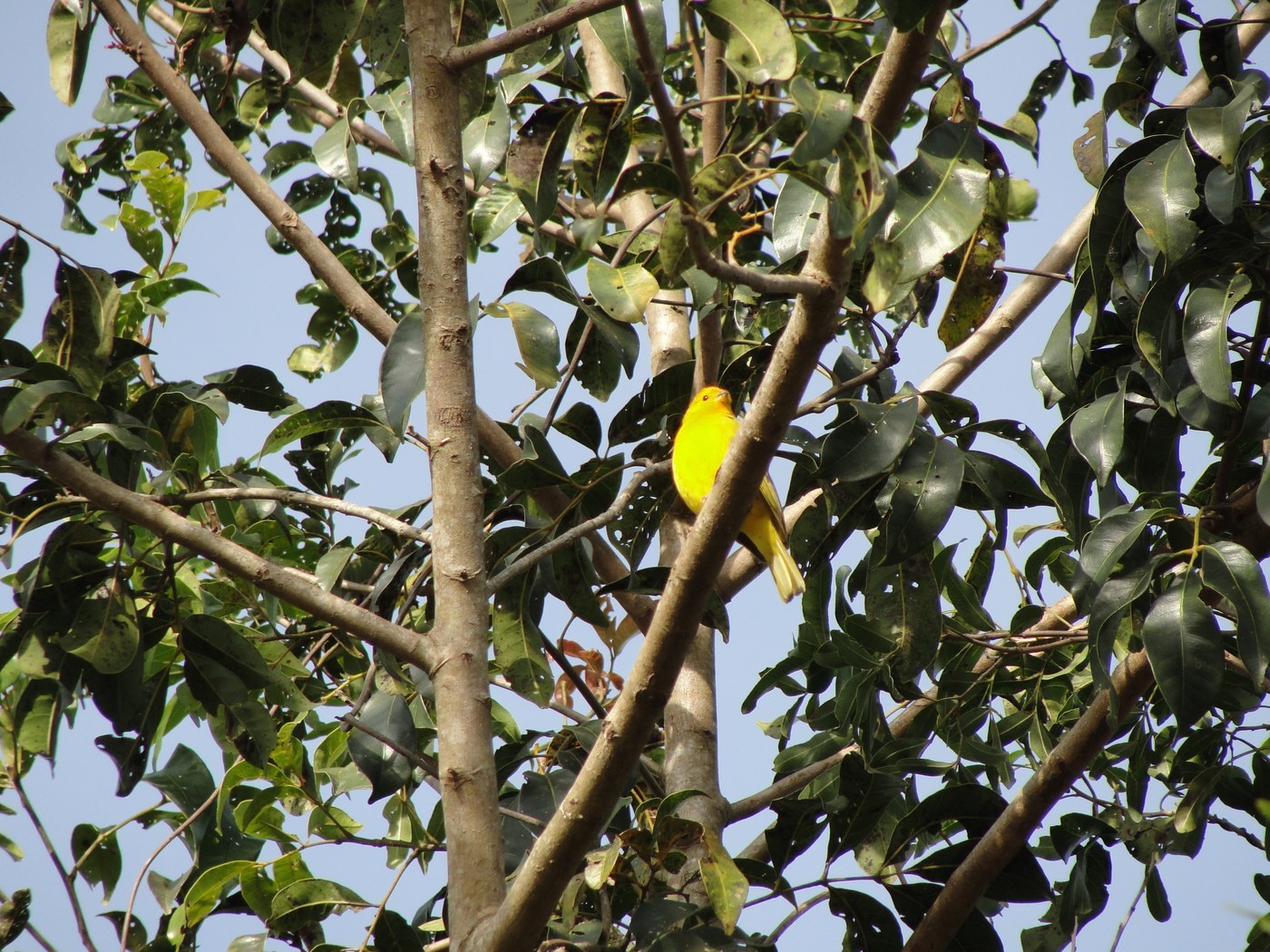
Key Field Marks
- Small, stocky finch-like bird, roughly sparrow-sized, with a short, thick, conical bill suited to seed-eating.
- Adult male: bright golden-yellow overall, with an orange-rufous wash concentrated on the crown that intensifies with age; back is olive-yellow, lightly streaked.
- Adult female and immatures: duller and more olive-yellow overall, with little or no orange on the crown, making sex and age often distinguishable at a glance.
- Legs are pale pinkish; bill is pale horn-colored.
- Often seen in small flocks foraging on the ground for seeds in open habitats.
Similar Species
- Grassland Yellow-Finch: smaller and slimmer, lacking the orange crown patch, with a more uniformly streaked appearance and different habitat preference for grassland.
- Orange-fronted Yellow-Finch: similar orange forehead patch but generally smaller-billed and found in different, more restricted range; best separated by range and subtle plumage tone.
- Immature/female Saffron Finches can suggest other yellow-olive finches, but the stout conical bill and typically social, ground-foraging behavior aid identification.
Habitat & Range
- Native to open and semi-open habitats across much of South America, including grassland, savanna, scrub, agricultural land, and parks and gardens, from the Amazon periphery south through much of the continent.
- Adaptable to human-altered landscapes and frequently found in city parks, gardens, and roadsides within its native range.
- Introduced and now well-established as a feral species in Hawaii, Puerto Rico, and some other regions outside South America, where it has adapted readily to urban and suburban settings.
Voice
- Song is a bright, sweet series of warbling and twittering notes, often delivered from an exposed perch such as a wire, fence, or treetop.
- Calls include short chip notes given in flight and while foraging in flocks.
Best Times & Approach Tips
- Look in open grassy areas, parks, and gardens where flocks forage on the ground for seeds; birds are often approachable in urban and suburban settings, especially in introduced populations.
- Males are easiest to identify confidently by their bright orange-crowned yellow plumage; take extra care with duller females and immatures, checking bill shape and social context.
Frequently asked questions
What is the easiest way to identify a male Saffron Finch?
Bright golden-yellow overall plumage with an orange-rufous patch on the crown, paired with a short, thick, conical bill typical of a seed-eating finch.
How do females differ from males?
Females are duller and more olive-yellow, generally lacking or showing only a faint hint of the male's orange crown patch.
Is the Saffron Finch native to Hawaii?
No, it was introduced to Hawaii (and Puerto Rico, among other places) from its native South American range and has become well-established there as a feral species.
What habitat does the Saffron Finch prefer?
Open and semi-open areas such as grassland, savanna, agricultural land, and especially parks, gardens, and urban green spaces.
How can I tell it apart from a Grassland Yellow-Finch?
Grassland Yellow-Finch is smaller, more streaked, and lacks the orange crown patch that develops in adult male Saffron Finches.