
Saddleback Identification Guide
A glossy black New Zealand endemic wattlebird named for its striking rufous-chestnut saddle across the back, now largely restricted to predator-free islands.
Read the full Saddleback encyclopedia entry →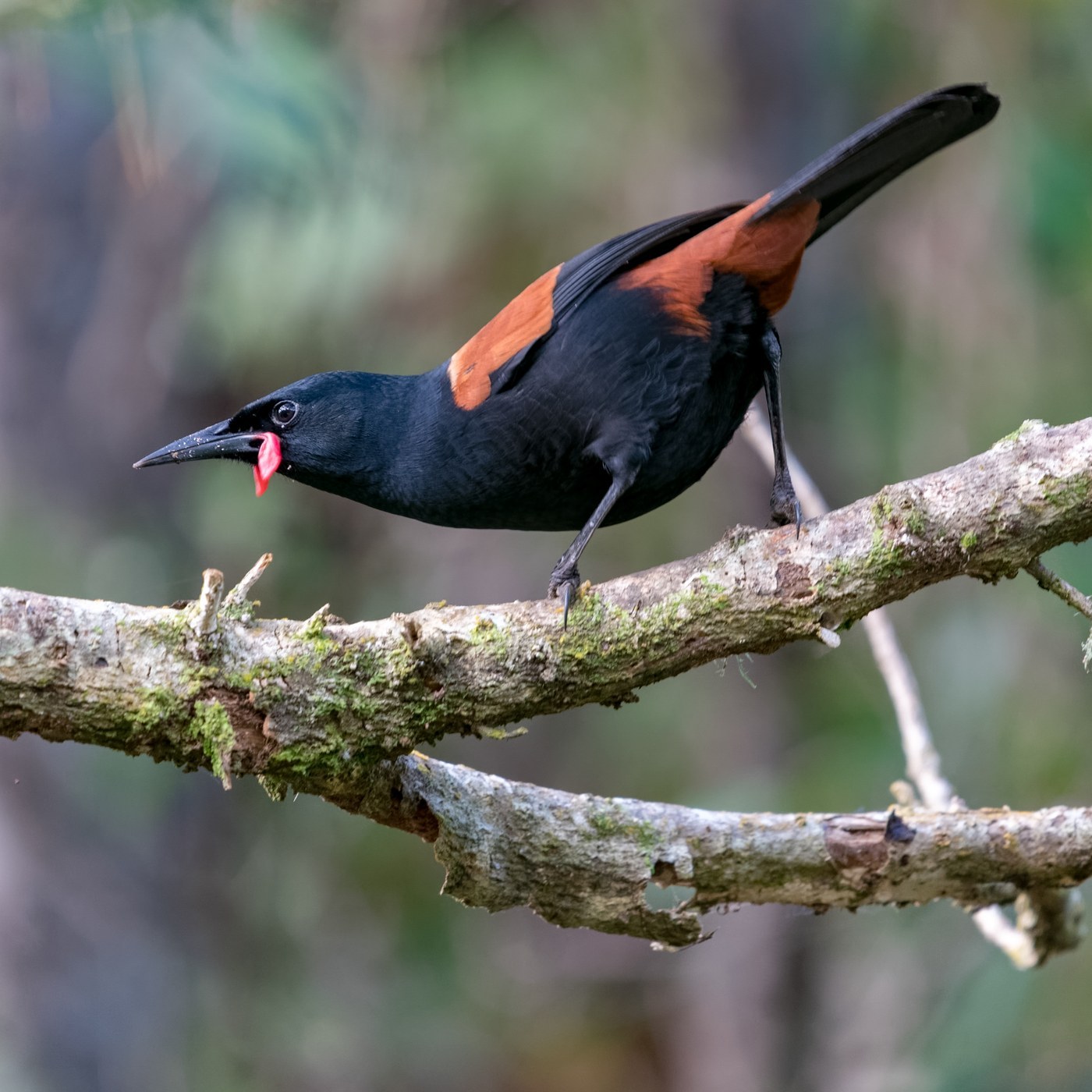
Key Field Marks
- Medium-sized forest bird, glossy black overall, with a bold chestnut-rufous "saddle" patch covering the back and inner wing area, sharply contrasting with the black head, breast, and tail.
- Fleshy, brightly colored orange-red wattles hang at the base of the bill on each side of the gape, a key feature shared with its relative the Kōkako but absent in most other New Zealand birds.
- Relatively short, rounded wings reflect weak flying ability; the species moves mainly by hopping and bounding along branches, tree trunks, and the forest floor.
- Long, sturdy black legs adapted for an active, hopping foraging style, probing bark and leaf litter for invertebrates.
- Two recognized subspecies differ subtly in wattle shape: North Island Saddleback (Tīeke) has more rounded wattles, South Island Saddleback slightly more triangular/pointed wattles.
Similar Species
- Kōkako: larger, blue-gray overall (not black with a chestnut saddle), with blue (not orange-red) wattles and a very different, haunting organ-like song.
- Tūī: iridescent black-green plumage with white throat tufts, lacking a saddle patch or fleshy wattles at the bill.
- No other New Zealand bird combines the glossy black body, chestnut saddle, and orange-red wattles, making adult Saddlebacks unmistakable once seen well.
Habitat & Range
- Historically widespread in native forest throughout New Zealand, but decimated by introduced predators (rats, stoats, cats) and now confined to predator-free offshore islands and fenced or intensively managed mainland sanctuaries following conservation translocations.
- Prefers dense native forest with a well-developed understory and abundant leaf litter and rotting wood for foraging.
Voice
- Loud, harsh, rattling or clattering calls carry well through dense forest; alarm calls include sharp "cheet" notes.
- Vocal and often heard well before being seen, especially when agitated by intruders near the nest.
Best Times & Approach Tips
- Visit managed predator-free sanctuaries or offshore island reserves (such as those in the Hauraki Gulf or around Fiordland/Stewart Island for the South Island subspecies) for realistic viewing opportunities.
- Saddlebacks are often confiding and curious in predator-free reserves, approaching visitors closely as they forage low in vegetation and leaf litter.
Frequently asked questions
Why is it called a Saddleback?
The chestnut-rufous patch across the back and inner wings resembles a saddle draped over the otherwise glossy black body.
Where can Saddlebacks be seen today?
Because of predator-driven declines on the New Zealand mainland, they now survive mainly on predator-free offshore islands and in fenced or intensively managed mainland sanctuaries.
How is it different from the Kōkako?
Kōkako is larger and blue-gray with blue wattles, while Saddleback is black with a chestnut saddle and orange-red wattles — quite different in both color and size.
Are there different types of Saddleback?
Yes, there are two subspecies — North Island Saddleback (Tīeke) and South Island Saddleback — which differ subtly in wattle shape and are managed as separate conservation populations.
What does a Saddleback eat?
Mainly invertebrates gleaned from bark, leaf litter, and rotting wood, along with some fruit and nectar, foraged actively while hopping through the forest understory.