
Saddle-billed Stork Identification Guide
One of Africa's tallest and most striking storks, unmistakable for its dramatic red, black, and yellow bill and glossy black-and-white plumage.
Read the full Saddle-billed Stork encyclopedia entry →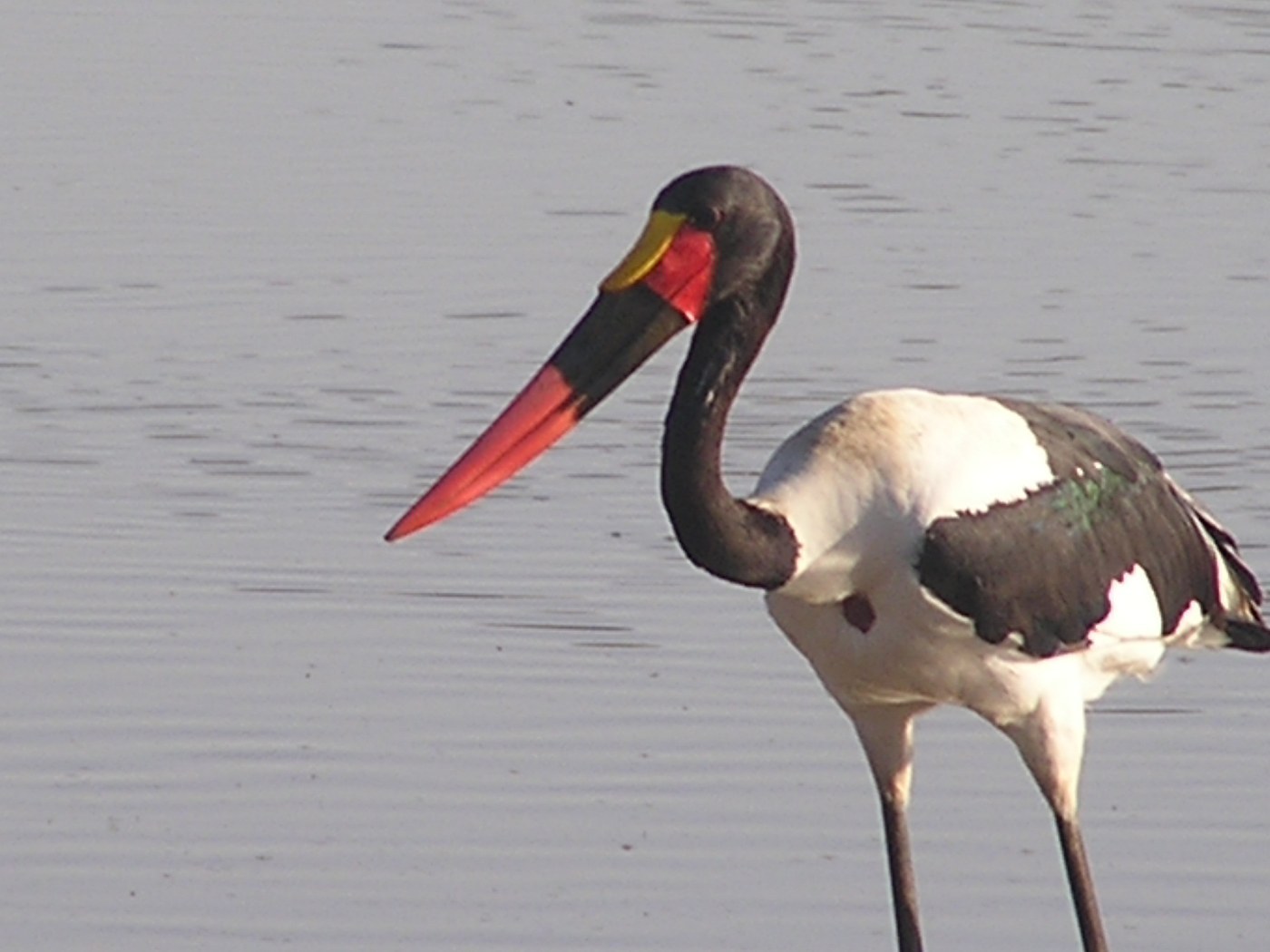
Key Field Marks
- Very large, tall stork, among the tallest in the world at around 145–150 cm, with a commanding upright stance on long black legs marked with pink "knee" (tibiotarsal) joints.
- Spectacular bicolored bill: red at the base and tip with a bold black band across the middle, plus a yellow frontal shield (the "saddle") at the base of the upper mandible where it meets the forehead.
- Plumage is glossy iridescent black on the head, neck, and a broad wing band, contrasting sharply with a white body and white secondaries.
- Sexually dimorphic: males have dark brown eyes and small yellow wattles hanging near the base of the bill; females have bright yellow eyes and lack the wattles.
Similar Species
- Black-necked Stork (Asian/Australian jabiru): similar black-and-white body pattern but has an entirely black bill without the red-and-yellow saddle pattern, and occurs in a different (Asian/Australasian) range.
- Yellow-billed Stork: much smaller, with an all-yellow (not bicolored) bill and a bare pink face, lacking the saddle-billed species' dramatic bill coloration.
- Marabou Stork: far bulkier with a huge pale bill, bare pink head and neck, and a large throat pouch — very different overall structure.
Habitat & Range
- Found across sub-Saharan Africa in wetlands, floodplains, rivers, lake margins, and large marshes, generally favoring undisturbed water bodies with adequate fish and amphibian prey.
- Typically solitary or found in pairs rather than large colonial flocks, often defending exclusive feeding territories along stretches of river or wetland.
Behavior & Voice
- Forages by wading slowly through shallow water, using its long bill to catch fish, frogs, crustaceans, and other aquatic prey, sometimes probing with the bill partly submerged.
- Largely silent, like most storks, communicating mainly through bill-clattering displays at the nest rather than vocal calls.
- Builds a large stick nest high in a tree, typically raising just one or two chicks per breeding attempt.
Best Times & Approach Tips
- Scan quiet stretches of African rivers, floodplains, and wetland edges, particularly during the dry season when birds concentrate around shrinking water bodies with abundant fish.
- Its great size and unmistakable bill pattern make it identifiable at considerable distance, even without close approach.
Frequently asked questions
What gives the Saddle-billed Stork its name?
The yellow frontal shield at the base of the bill, positioned where the bill meets the forehead, resembles a saddle sitting atop the striking red-and-black bill.
How can I tell males and females apart?
Males have dark brown eyes and small yellow wattles hanging near the base of the bill, while females have bright yellow eyes and no wattles.
How does it differ from the Yellow-billed Stork?
The Yellow-billed Stork is much smaller with an entirely yellow bill and bare pink face, lacking the Saddle-billed Stork's dramatic red-black-yellow bill pattern and greater height.
Is the Saddle-billed Stork a social species?
No, unlike many storks it is typically solitary or seen in pairs, often defending a feeding territory along a river or wetland rather than gathering in large flocks.
Where in Africa is it found?
Across much of sub-Saharan Africa in wetlands, rivers, floodplains, and lake margins, wherever suitable fish-rich shallow water is available.