
Sabine's Gull Identification Guide
A small, elegant Arctic-breeding gull instantly recognizable by its forked tail and bold black-white-gray triangular wing pattern.
Read the full Sabine's Gull encyclopedia entry →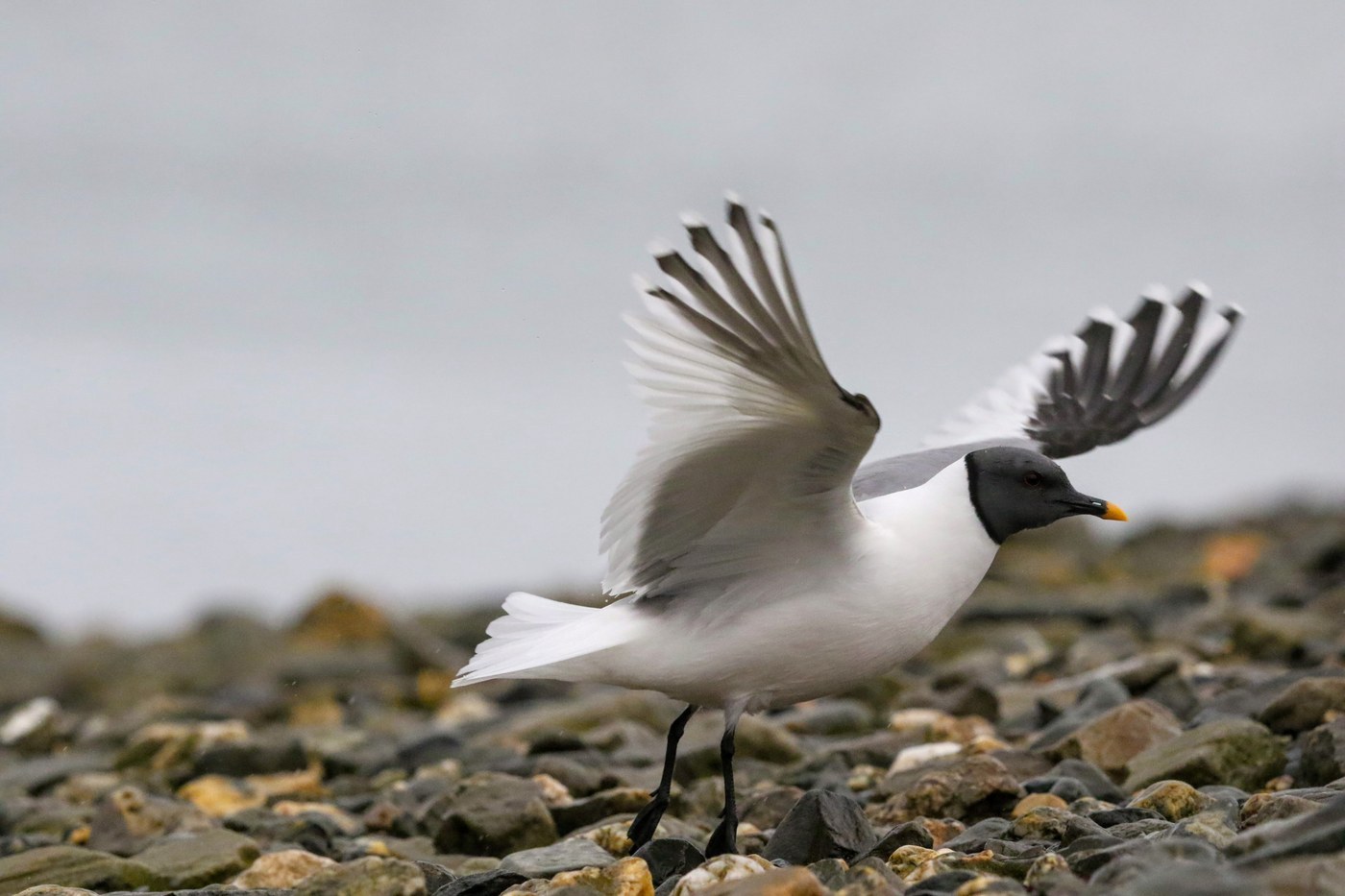
Key Field Marks
- Small, buoyant, tern-like gull with a distinctly forked (wedge-shaped) tail — unusual among gulls and a strong identification clue at any age.
- Striking three-toned upperwing pattern in flight: black outer primaries, a clean white triangle across the inner primaries and secondaries, and gray-brown upperwing coverts, forming a bold tricolor triangle pattern unlike any other gull.
- Breeding adult: dark gray hood outlined by a thin black neck ring, black bill with a yellow tip, white body, and black legs.
- Nonbreeding adult: white head with dusky gray smudging on the nape and hindneck, retaining the same wing pattern.
- Juvenile: scaly gray-brown upperparts with pale feather fringes, a black-tipped tail, and the same diagnostic wing triangle pattern already visible.
Similar Species
- Black-legged Kittiwake: has a squared or slightly notched (not deeply forked) tail and a different, more uniformly gray-and-black wingtip pattern lacking the bold white triangle.
- Terns (e.g., Arctic Tern): more slender bill and different flight silhouette; lack the gull's wing pattern and overall gull-like bill shape.
- No other regularly occurring gull combines a forked tail with this tricolor wing pattern, making adult and juvenile Sabine's Gulls relatively straightforward once the pattern is learned.
Habitat & Range
- Breeds on wet Arctic tundra, often near coastal lagoons or freshwater pools, across the high Arctic of North America, Greenland, and Eurasia.
- Highly pelagic outside the breeding season, migrating far offshore and wintering at sea, notably off the Pacific coasts of South America (Peru, Chile) and off West Africa.
- Regularly seen from land during migration watches at coastal headlands, especially after storms push birds closer to shore.
Behavior & Voice
- Light, buoyant, tern-like flight with shallow wingbeats; forages by picking food items from the water's surface rather than plunge-diving.
- Often associates loosely with terns and other small gulls at sea.
- Generally quiet away from the breeding grounds; on territory gives harsh, tern-like grating calls.
Best Times & Approach Tips
- Fall pelagic trips or seawatches, particularly after onshore winds or storms, offer the best chance of close views away from the remote Arctic breeding grounds.
- Focus on the wing pattern in flight — it's diagnostic even on distant or juvenile birds when other features are hard to judge.
Frequently asked questions
What is the single best field mark for Sabine's Gull?
The bold tricolor upperwing pattern in flight — black outer primaries, a white triangle on the inner wing, and gray-brown coverts — combined with a forked tail, is unique among regularly occurring gulls.
Does the forked tail appear at all ages?
Yes, the distinctly forked tail is present in juveniles, nonbreeding, and breeding adults alike, making it a reliable feature year-round.
Where is the best place to see Sabine's Gulls outside the breeding season?
They are highly pelagic, so offshore seawatches and boat trips, especially off the Pacific coast during migration or in their wintering areas off Peru, Chile, and West Africa, offer the best opportunities.
How does it differ from a Black-legged Kittiwake?
Kittiwake has a squared tail and a more uniform dark wingtip pattern without the bold white triangle, whereas Sabine's Gull shows a forked tail and a striking three-part wing pattern.
What habitat does Sabine's Gull breed in?
Wet Arctic tundra, typically near coastal lagoons, marshes, or shallow freshwater pools in the high Arctic.