
Russet-backed Oropendola Identification Guide
A large, noisy South American icterid recognized by its dark body, chestnut back and rump, pale-based bill, and long hanging colonial nests.
Read the full Russet-backed Oropendola encyclopedia entry →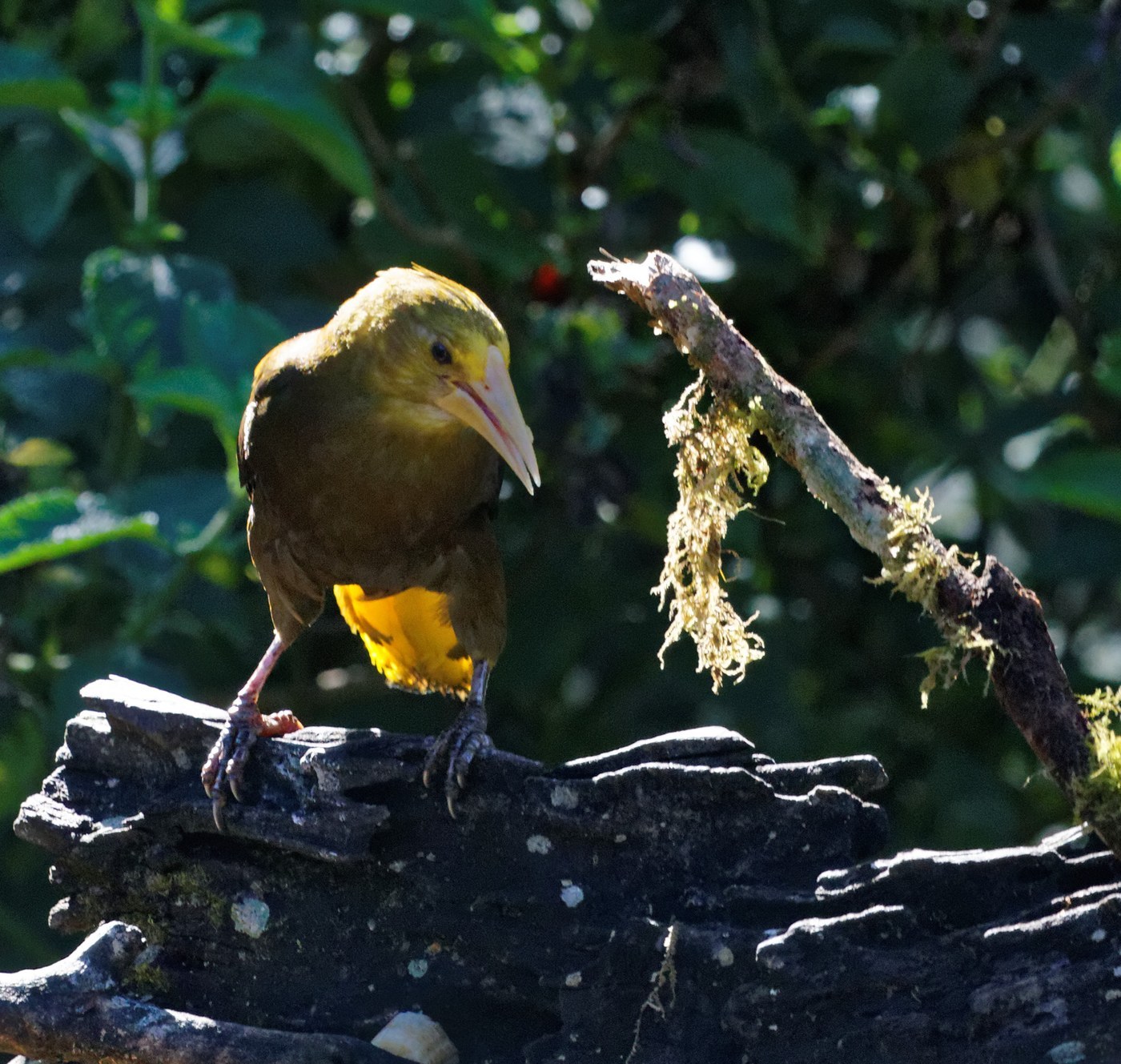
Key Field Marks
- Large icterid (blackbird family), notably bigger and longer-tailed than most songbirds, with males distinctly larger than females.
- Body plumage is mostly dark olive-black, contrasting with a rich chestnut-russet patch across the lower back and rump — the source of the name.
- Bill is long, pointed, and pale bluish-white to greenish at the base, often with a darker tip, standing out against the dark head.
- Pale, whitish-blue eyes are noticeable at close range.
- Outer tail feathers are bright yellow with the central pair dark, visible as a flash of color in flight or when the tail is fanned.
Similar Species
- Crested Oropendola: shows an obvious erectile crest and a more contrastingly pale-tipped bill; the two can occur in the same colonies in parts of the range.
- Chestnut-headed Oropendola: has chestnut extending onto the head and mantle, not just the lower back/rump, and is overall smaller with a shorter tail.
- Dusky-green Oropendola: greener overall tone and lacks the well-defined chestnut rump patch.
Habitat & Range
- Found through much of the Amazon Basin and adjacent Andean foothills of South America, in humid forest edge, secondary growth, riverine woodland, and semi-open areas with tall trees.
- Highly social, nesting in colonies of woven, hanging pouch nests suspended from the outer branches of tall emergent trees, often over water or in isolated trees away from predators.
Behavior & Voice
- Males perform a distinctive bowing display at the nest colony, dropping the head and fanning the tail while giving loud, liquid, gurgling song notes that carry a long distance.
- Feeds on fruit, nectar, and insects, often foraging in small groups high in the canopy.
- Colonies can be very vocal and active, especially during the breeding season when males compete for female attention with repeated display songs.
Best Times & Approach Tips
- Locate an active nesting colony (clusters of long woven pouches hanging from a single tree) for the most reliable and prolonged views.
- Early morning is best for hearing the full bowing display song, which is one of the most useful confirmations of identity among similar oropendola species.
Frequently asked questions
What is the most reliable field mark for Russet-backed Oropendola?
A chestnut-russet patch confined to the lower back and rump, contrasting with an otherwise dark olive-black body, combined with a pale bluish bill base.
How is it different from the Crested Oropendola?
Crested Oropendola shows a visible crest of thin feathers on the crown, which Russet-backed Oropendola lacks; bill and rump-color patterns also help separate them where ranges overlap.
Why do oropendolas build hanging nests?
The long, woven pouch nests suspended from thin outer branches, often over water, make it much harder for snakes and other predators to reach the eggs and chicks.
What does the male's display look like?
Males bow forward, drop their wings, and fan the tail while giving a loud, gurgling, liquid song — a display performed repeatedly at the breeding colony to attract females.
What habitat should I search for this species?
Amazonian lowland forest edges, riverine woodland, and semi-open areas with tall trees, especially near active colonial nesting sites.