
Rüppell's Vulture Identification Guide
A large African vulture famous for holding the record for highest confirmed flight altitude, recognized by its scaly, pale-fringed dark plumage and pale head.
Read the full Rüppell's Vulture encyclopedia entry →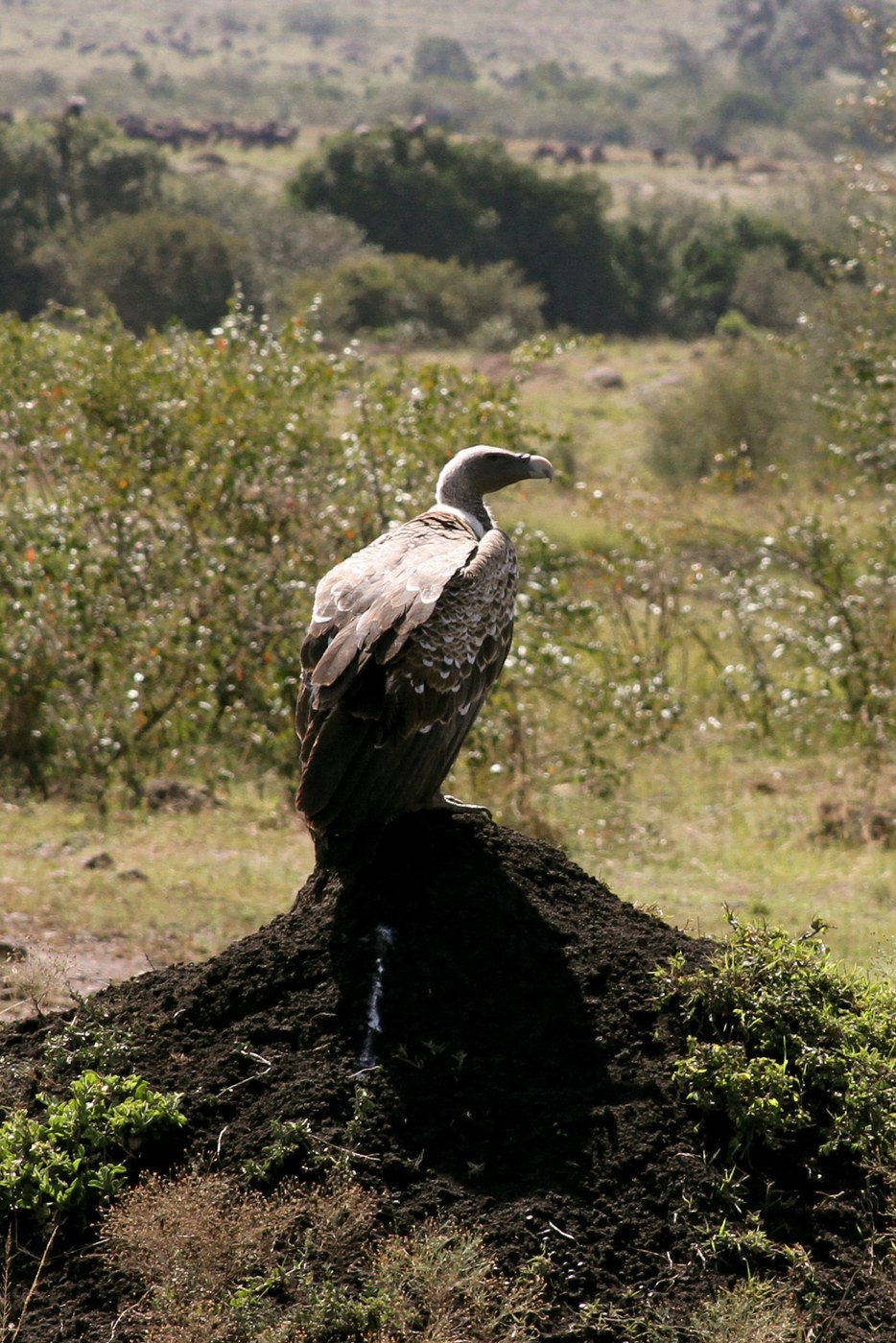
Key Field Marks
- Large Old World vulture with a wingspan of roughly 2.3–2.6 m and a heavy, hooked bill suited to tearing carrion.
- Overall dark brown body plumage with pale buff-to-whitish fringes on the feathers, giving a distinctive scaly or mottled appearance across the back, wing coverts, and underparts.
- Head and neck are covered in sparse whitish down rather than bare skin, giving a pale-headed look at a distance; bill is pale horn to yellowish.
- Pale, straw-colored eye is a useful close-range feature.
- In flight, broad rounded wings held flat or slightly raised while soaring on thermals; underwing shows pale scaly coverts contrasting with darker flight feathers.
Similar Species
- African White-backed Vulture: smaller, plainer dark brown overall (lacks the strong scaly pattern), with a contrasting white lower back/rump patch visible in flight and a dark bill.
- Eurasian Griffon Vulture: paler sandy-buff overall, less scaly-patterned, generally found in different (more northern/Eurasian) range with limited overlap.
- Lappet-faced Vulture: much larger, with a massive pink/red bare head and heavier bill, lacking the scaly plumage pattern.
Habitat & Range
- Found across the Sahel and East African savanna belt, from Senegal and Mali east to Sudan, Kenya, and Tanzania, favoring open grassland, savanna, and semi-arid woodland.
- Nests colonially on cliffs and rock escarpments, sometimes in large colonies of hundreds of pairs.
- A highly efficient scavenger, ranging widely over open country in search of carcasses, often traveling long distances on thermals.
Behavior & Flight
- Renowned for extreme high-altitude flight; a Rüppell's Vulture was confirmed to have collided with an aircraft at over 11,000 m, the highest verified flight altitude for any bird.
- Gathers in numbers at carcasses alongside other vulture species, using keen eyesight to locate food from great heights.
- Populations have declined sharply due to poisoning (accidental and targeted) and habitat loss, and the species is now considered Critically Endangered.
Best Times & Approach Tips
- Look for soaring birds over open savanna in the heat of the day when thermals are strongest.
- Check gatherings at carcasses or near known cliff-nesting colonies for the best comparative views against other vulture species.
Frequently asked questions
What makes Rüppell's Vulture look 'scaly'?
Each dark brown body and covert feather has a pale buff-to-white fringe, and the overlapping pattern of these edges creates a scaled or mottled appearance across the back and underparts.
How can I separate it from an African White-backed Vulture?
White-backed Vulture is smaller and plainer with a bright white lower back patch and dark bill, while Rüppell's is larger, more heavily scaled, and has a paler bill and head.
Is it true this species can fly extremely high?
Yes — a Rüppell's Vulture was recorded colliding with an aircraft at roughly 11,300 m (over 37,000 feet), the highest confirmed flight altitude documented for any bird species.
Where do Rüppell's Vultures nest?
They nest colonially on cliff ledges and rocky escarpments, often in large colonies, across the Sahel and East African savanna.
Why is this species considered endangered?
Rapid population declines are driven mainly by poisoning (both accidental and deliberate) at carcasses, along with habitat degradation and loss of wild ungulate prey across its African range.