
Rufous-tailed Jacamar Identification Guide
A slender, iridescent, hummingbird-like insect-hunter of Neotropical forest edges, best known for its long, thin bill, glittering green-and-coppery upperparts, and rufous-orange underparts and tail.
Read the full Rufous-tailed Jacamar encyclopedia entry →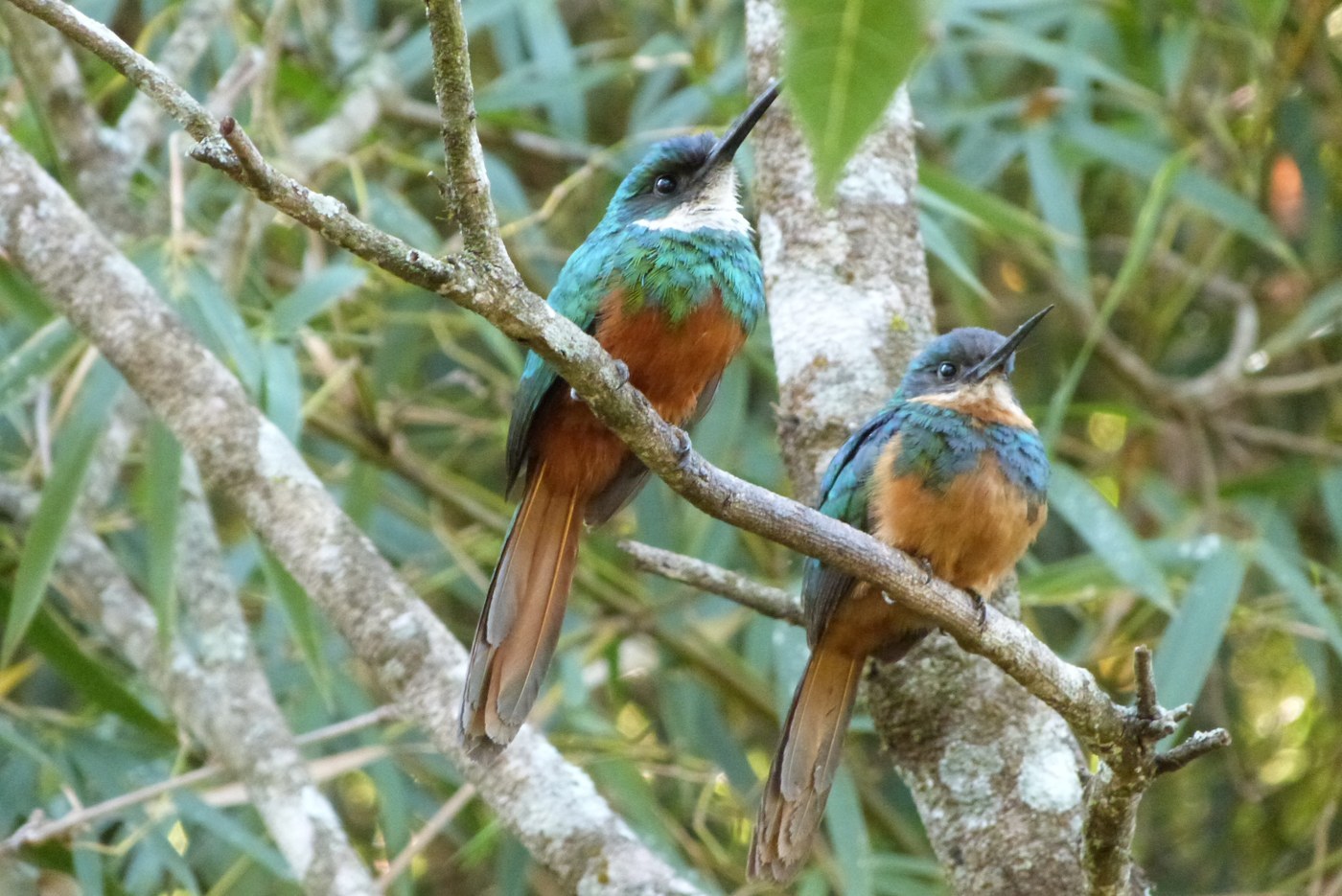
Key Field Marks
- Slender, long-tailed bird with a notably long, thin, straight bill, giving it a distinctive silhouette often compared to an oversized hummingbird or a giant bee-eater.
- Upperparts are brilliantly iridescent, shining metallic green to coppery-bronze depending on the light.
- Underparts and much of the tail are rich rufous-orange, a key field mark reflected in the species' name.
- Throat patch differs by sex: males show a clean white throat patch, while females show a buffy or pale cinnamon throat patch instead of white.
Separating It From Similar Species
- Green-tailed Jacamar and other jacamar species show a green rather than rufous tail, making tail color a quick way to separate them from Rufous-tailed Jacamar.
- White-chinned Jacamar and other relatives differ in throat color and the extent of rufous versus green in the plumage; careful attention to tail color and throat patch color resolves most confusion.
- The combination of a very long thin bill, iridescent green upperparts, and an extensively rufous tail and underparts is diagnostic within most of its range.
Where and When to Look
- Found from Mexico south through Central America and into much of northern and central South America, including the Amazon basin.
- Frequents forest edges, clearings, secondary growth, riverbanks, and gaps rather than deep, unbroken forest interior.
- Non-migratory resident throughout its range; most easily seen by scanning open perches along trails, streams, and clearings.
Voice and Behavior
- Vocalizations include thin, high-pitched, sharp "peek" or "pseep" calls, along with occasional longer, slightly trilling or whistled song phrases.
- Characteristically perches upright and motionless on an exposed branch, then sallies out in fast, acrobatic flight to snatch flying insects, especially butterflies and dragonflies, from the air.
- After capturing prey, typically returns to a perch and beats the insect repeatedly against the branch to remove wings and subdue it before swallowing.
- Nests in burrows excavated into earthen banks or termite mounds.
Frequently asked questions
What is the easiest field mark for the Rufous-tailed Jacamar?
Its long, thin, straight bill combined with iridescent green upperparts and a rufous-orange tail and underparts makes it one of the more distinctive birds in its range.
How do male and female Rufous-tailed Jacamars differ?
Males have a clean white throat patch, while females show a buffy or cinnamon-colored throat patch instead of white.
How does Rufous-tailed Jacamar catch its food?
It perches conspicuously and sallies out in fast flight to catch flying insects, especially butterflies and dragonflies, then returns to a perch to beat the prey against the branch before eating.
What habitat should I look in for a Rufous-tailed Jacamar?
Look along forest edges, clearings, secondary growth, and riverbanks rather than deep forest interior, from Mexico through Central America and into South America.