
Rufous Hummingbird Identification Guide
A small, fiery orange hummingbird that breeds farther north than any other hummingbird species, with males glowing rufous overall and an iridescent red-orange throat.
Read the full Rufous Hummingbird encyclopedia entry →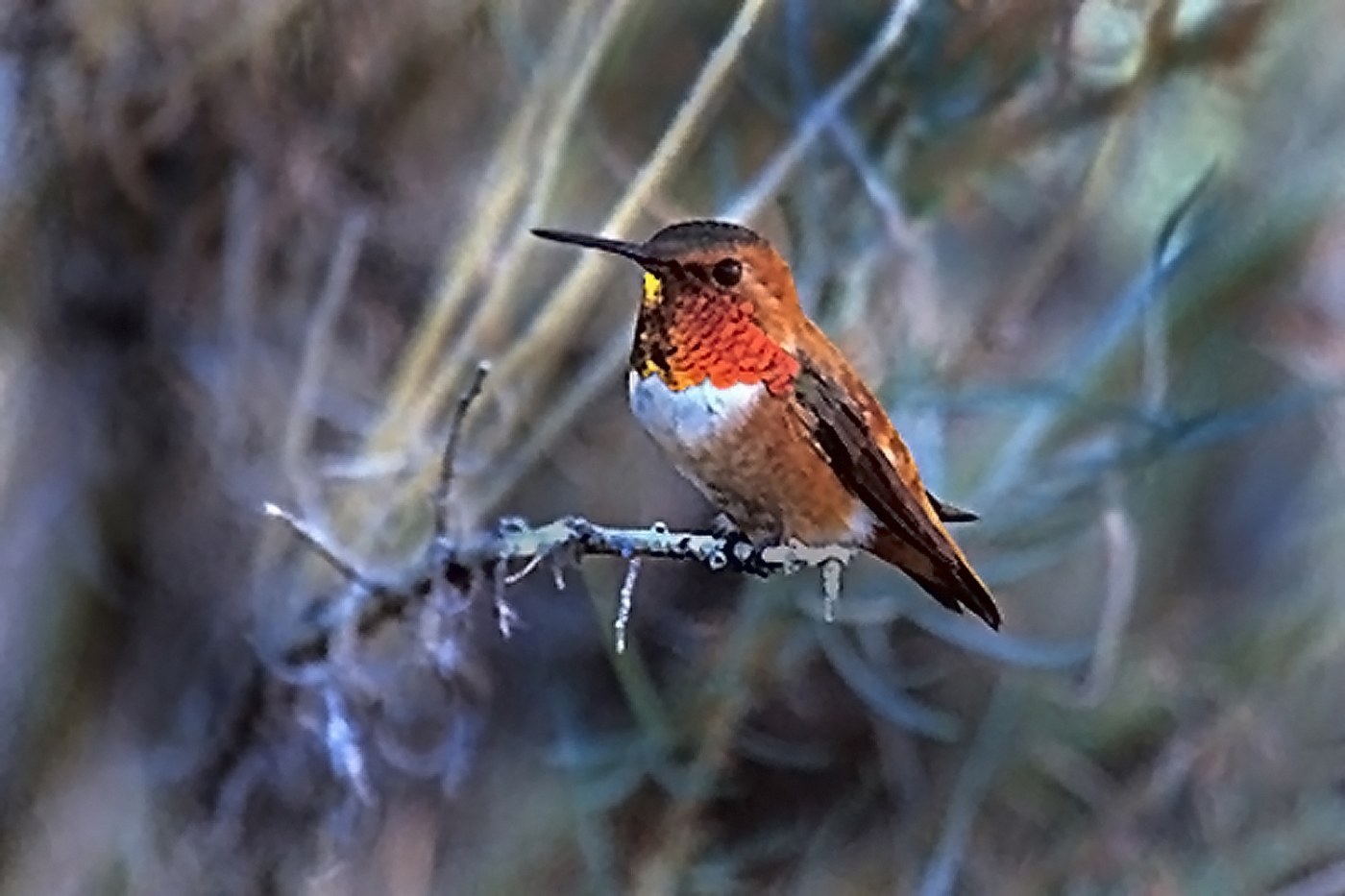
Key Field Marks
- Small hummingbird with a straight, thin black bill.
- Adult male: bright rufous-orange body and tail, with an iridescent, fiery red-orange throat (gorget) and sometimes a patch of green on the crown or back.
- Adult female and immatures: green above with rufous coloring concentrated on the flanks and at the base of the tail; the tail shows white tips on the outer feathers, and the throat may show light spotting or a small central patch of orange/red iridescence.
- Overall small, compact size with a relatively short tail compared with the body.
Separating It From Similar Species
- Allen's Hummingbird is extremely similar; the clearest distinction is that male Allen's has a solid green back (not rufous), while male Rufous typically shows a mostly or entirely rufous back. Female and immature birds of the two species are nearly identical in the field, and reliable separation often requires close examination of individual tail feather shapes, best done in the hand.
- Broad-tailed Hummingbird males have a rose-pink (not orange-red) gorget and a mostly green back and lack the extensive rufous coloring of male Rufous Hummingbird.
- Range and season are useful supporting clues, as Rufous Hummingbird is a scarce but regular fall/winter vagrant well east of its normal western range, unlike Allen's, which is far more range-restricted.
Where and When to Look
- Breeds farther north than any other hummingbird, from the Pacific Northwest through British Columbia and into southern Alaska.
- Migrates in a clockwise loop: north along the Pacific Coast in spring, then south through the Rocky Mountains in late summer and fall, visiting high-elevation wildflower meadows along the way.
- Winters mainly in Mexico, with increasing numbers of individuals overwintering along the U.S. Gulf Coast and southeastern states at feeders.
- Look for migrants at mountain flowers and feeders in the West from July through September.
Voice and Behavior
- Calls include sharp, buzzy "chip" notes, often given rapidly when chasing other hummingbirds.
- Extremely aggressive and feisty at feeders and flowers, frequently dominating and chasing off much larger hummingbird species.
- Males perform steep J-shaped or oval diving displays accompanied by a wing/tail buzz during courtship.
Frequently asked questions
What is the best way to tell male Rufous and Allen's Hummingbirds apart?
Look at the back color: male Rufous Hummingbird usually has a solid rufous-orange back, while male Allen's Hummingbird has a green back; females and immatures of the two species are very difficult to separate in the field.
Why is Rufous Hummingbird notable among hummingbirds?
It breeds farther north than any other hummingbird species, reaching southern Alaska, and undertakes one of the longest migrations relative to its tiny size.
Can Rufous Hummingbirds be seen in the eastern United States?
Yes, small numbers regularly show up as vagrants at feeders in the southeastern U.S. in fall and winter, making it the most frequently recorded "out of range" western hummingbird in the East.
Are Rufous Hummingbirds aggressive?
Yes, they are known for being unusually pugnacious, often chasing away much larger hummingbirds and other birds from feeders and flower patches.