
Rufous-crowned Sparrow Identification Guide
A plain, unstreaked gray-breasted sparrow of dry, rocky western hillsides, identified by its rufous cap, gray face bordered by a dark whisker mark, and habit of running through grass rather than flying.
Read the full Rufous-crowned Sparrow encyclopedia entry →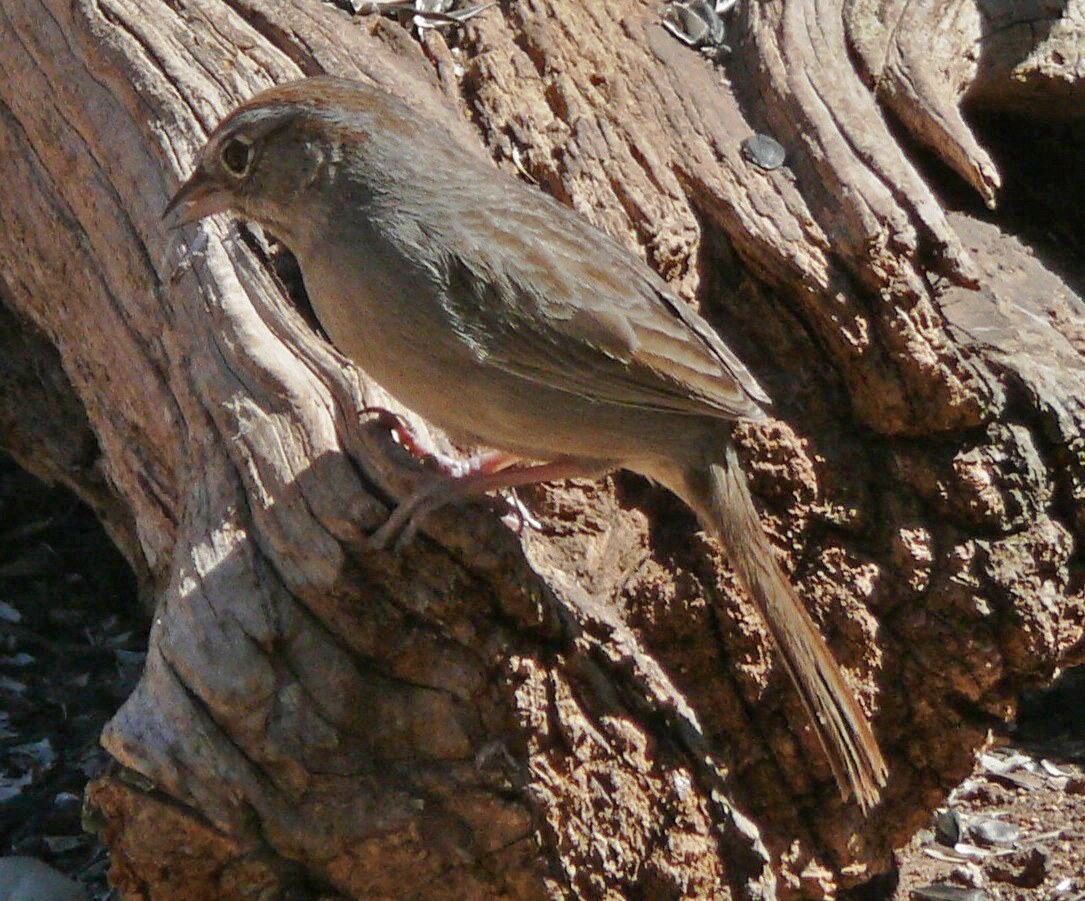
Key Field Marks
- Medium-sized sparrow with an overall plain, unstreaked gray-brown appearance below and a warm rufous crown above.
- Gray face shows a distinct dark whisker (malar) stripe bordering a whitish throat, plus a thin dark line behind the eye and a pale eye-ring.
- Back and wings are brownish with fine dark streaking, contrasting with the plain, unstreaked gray breast and belly.
- Long, rounded tail is often pumped or flicked, especially when the bird is agitated or moving through cover.
- A thin, whitish-buff supercilium (eyebrow) and a stout, conical bill complete the look.
Separating It From Similar Species
- Chipping Sparrow also shows a rufous crown but has a thinner bill, a bold black eyeline, a clean white supercilium, and typically a grayer, more streaked nonbreeding plumage; it also favors more open, often less rocky habitat.
- Rufous-winged Sparrow has rufous patches on the wing (not a solid rufous crown) and two-toned bill; ranges overlap only in parts of the Southwest.
- The combination of an unstreaked gray breast, rufous cap, and bold facial whisker mark, paired with skulking behavior in dry rocky habitat, is diagnostic.
Where and When to Look
- Resident (non-migratory) across dry hillsides, coastal sage scrub, and chaparral of California, the Southwest, and parts of Mexico and Texas.
- Prefers steep, rocky, grassy slopes with scattered shrubs rather than dense woodland or flat open grassland.
- Present year-round in its range; best looked for by walking slowly along rocky, brushy hillsides and listening for its distinctive song.
Voice and Behavior
- Song is a bouncy, often described as "dear-dear-dear-dear" or a jumbled, sputtering series of chip notes and trills, delivered from a low perch or the ground.
- Notoriously secretive; tends to run and scurry through grass and rocks rather than flush into flight, making it a challenging species to observe well.
- Forages on the ground for seeds and insects, often staying close to cover.
Frequently asked questions
How do you tell Rufous-crowned Sparrow from Chipping Sparrow?
Rufous-crowned Sparrow has a thicker bill, a bold dark whisker stripe on the face, and an unstreaked gray breast, while Chipping Sparrow has a thinner bill, a bold black eyeline, and a cleaner white eyebrow, often in more open habitat.
What habitat does the Rufous-crowned Sparrow prefer?
It favors dry, rocky hillsides with grass and scattered shrubs, such as chaparral and coastal sage scrub, mainly in California, the Southwest, and Mexico.
Is the Rufous-crowned Sparrow migratory?
No, it is largely a year-round resident within its range and does not undertake long migrations.
Why is the Rufous-crowned Sparrow hard to see well?
It is secretive and tends to run through grass and rocky cover rather than fly when disturbed, so patient, quiet observation is often needed.