
Ruddy Shelduck Identification Guide
A large, goose-like orange-chestnut duck with a pale head, black tail, and bold white wing patches that flash in flight, found across Central Asia and parts of Europe and Africa.
Read the full Ruddy Shelduck encyclopedia entry →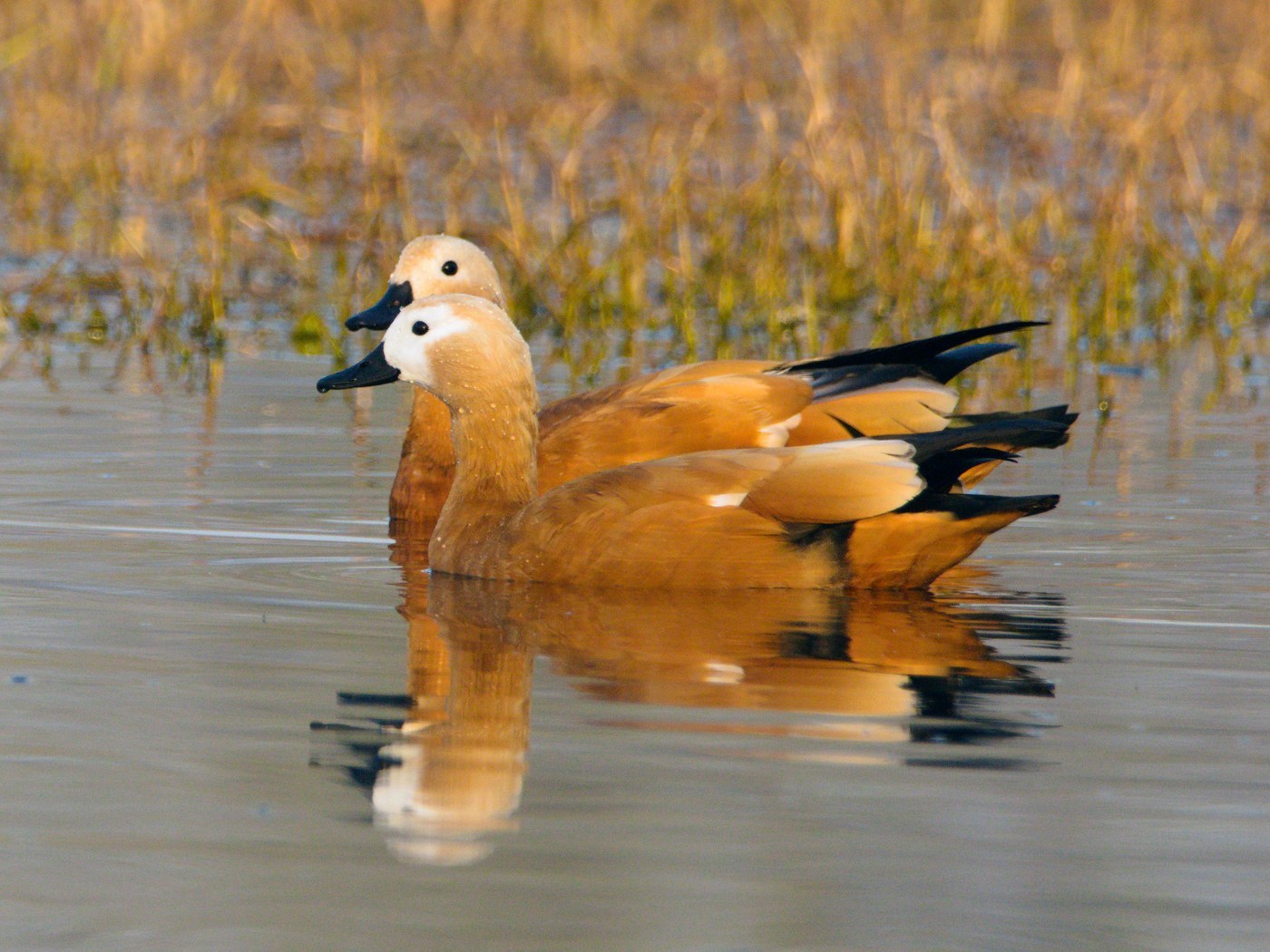
Key Field Marks
- Large, long-legged duck with a goose-like build; overall body color is warm orange-chestnut.
- Head and neck are noticeably paler, buffy-cream to whitish, contrasting with the darker body.
- Bill, legs, and tail are black; in flight, both sexes show large white wing coverts contrasting with black flight feathers and an iridescent green speculum.
- Breeding male develops a thin black neck ring (collar) that is absent or faint in females.
Separating It From Similar Species
- Egyptian Goose overlaps in some regions but shows a distinctive dark patch around the eye, a paler grayish-buff body, and different wing pattern with more white and a black-bordered green speculum arranged differently; overall Egyptian Goose looks more patterned and less uniformly orange.
- Common Shelduck is boldly patterned in white, black, and chestnut with a red bill knob, very different from the uniformly orange-chestnut Ruddy Shelduck.
- In flight, the combination of orange-chestnut body, pale head, and bold white forewing patches is distinctive among ducks sharing its range.
Where and When to Look
- Breeds across Central Asia, from the Mediterranean and North Africa (notably Ethiopia's highlands) eastward through the steppes of Kazakhstan, Mongolia, and China.
- Favors lakes, rivers, reservoirs, and wetlands, including high-altitude water bodies, and often forages in adjacent grassland or farmland.
- Northern populations migrate south for winter to the Indian subcontinent and parts of the Middle East; some populations, including feral/introduced birds in parts of Europe, are largely resident.
- Look for pairs or small flocks on open water and nearby fields; the species is often found away from dense vegetation.
Voice and Behavior
- Loud, far-carrying, nasal honking calls, often rendered as "aakh-aakh" or a trumpeting "paaon," frequently given in flight.
- Territorial and often seen in pairs even outside the breeding season, sometimes gathering in larger flocks at favored wintering wetlands.
- Nests in cavities, including cliff crevices, old burrows, and even ruins, sometimes far from water.
Frequently asked questions
What color is a Ruddy Shelduck?
It is a warm orange-chestnut overall with a paler, buffy-cream head and black bill, legs, and tail.
How can you tell a Ruddy Shelduck from an Egyptian Goose?
Ruddy Shelduck lacks the dark eye patch of Egyptian Goose and is more uniformly orange-chestnut, while Egyptian Goose is paler and more patterned with a distinctive dark eye mask.
Does the Ruddy Shelduck have a special call?
Yes, it gives loud, nasal honking calls, often described as "aakh-aakh," frequently heard in flight.
Where does the Ruddy Shelduck breed?
It breeds across Central Asia and parts of the Mediterranean region and Ethiopia, using lakes, rivers, and wetlands, including high-altitude waters.