
Ruddy Duck Identification Guide
A small, chunky stiff-tailed diving duck best known for the breeding male's chestnut body, white cheek, sky-blue bill, and habit of cocking its stiff tail straight up.
Read the full Ruddy Duck encyclopedia entry →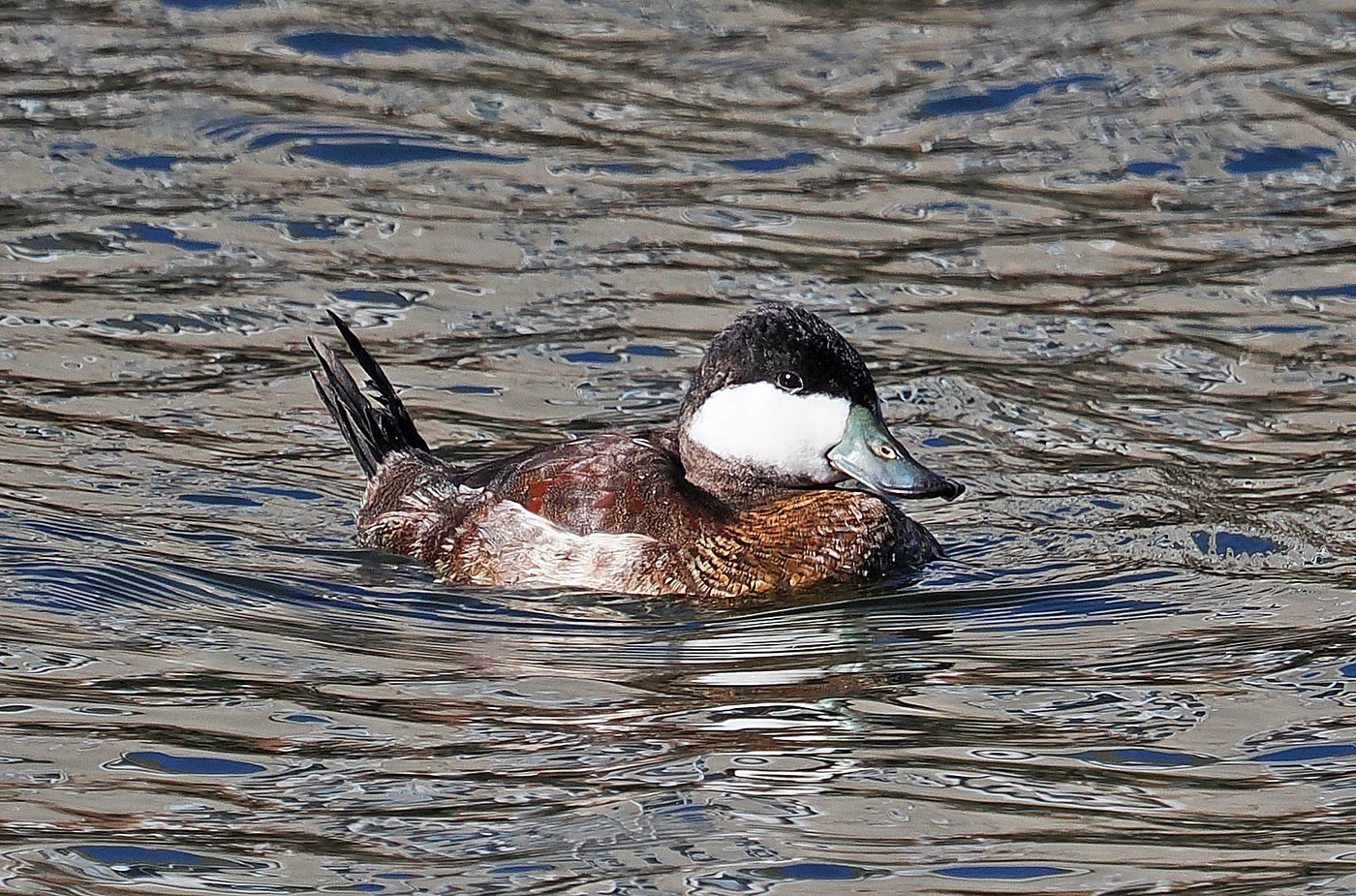
Key Field Marks
- Small, dumpy diving duck with a large head, thick neck, and a stiff, often upturned tail that is frequently cocked vertically while resting or displaying.
- Breeding male: rich chestnut-red body, black cap extending to just above the eye, contrasting white cheek patch, and a bright sky-blue bill.
- Nonbreeding male and female: dull grayish-brown overall, with a dusky cap and a pale cheek crossed by a single dark line (female) or a plainer pale cheek (nonbreeding male); bill dark gray, not blue.
- Wings are short and plain, rarely seen in flight since the species prefers to dive or swim away from disturbance.
Separating It From Similar Species
- The stocky shape, oversized head, and stiff cocked tail separate Ruddy Duck from all regularly occurring dabbling and diving ducks at a glance.
- Masked Duck, a rare stray from the tropics, is smaller with a shorter bill and, in the male, a black face mask rather than a white cheek patch; females of both species are similar but Masked Duck shows bolder facial striping and a smaller size.
- Female/nonbreeding male Ruddy Ducks can be told from other small brown ducks by the combination of stiff tail, big head, and single dark cheek line.
Where and When to Look
- Breeds on prairie potholes, marshes, and reedy ponds across much of the western and central United States and Canada.
- Winters widely on coastal bays, estuaries, reservoirs, and open lakes across the southern and coastal United States, Mexico, and parts of Central America.
- Look for dense rafts of Ruddy Ducks on open water in fall and winter, often diving in unison.
Voice and Behavior
- Generally quiet; males produce odd popping, tapping, and belching sounds during an elaborate courtship display in which they slap their bill against an inflated neck to strike the water and create bubbles.
- Feeds mainly by diving, and rarely flies, preferring to escape danger by diving or swimming low with only the head above water.
- Takes off from water with a running start, showing whirring, fast wingbeats.
Frequently asked questions
What is the easiest way to recognize a Ruddy Duck?
Look for a small, chunky duck with a big head and a stiff tail cocked up at an angle; breeding males add a chestnut body, white cheek, and bright blue bill.
Why doesn't the male Ruddy Duck have a blue bill in winter?
The bright blue bill is a breeding-season feature; in nonbreeding plumage the bill turns dull gray and the body becomes dull brownish-gray.
How is a female Ruddy Duck told from other brown ducks?
Look for the stocky shape, oversized head, stiff cocked tail, and a single dark line crossing an otherwise pale cheek.
Do Ruddy Ducks fly much?
They fly less than most ducks, preferring to dive or swim away from danger, and require a running start across the water to become airborne.