
Ruby-topaz Hummingbird Identification Guide
A small South American and Caribbean hummingbird whose breeding male combines a fiery ruby crown with a glowing golden-orange throat, unlike any other hummingbird in its range.
Read the full Ruby-topaz Hummingbird encyclopedia entry →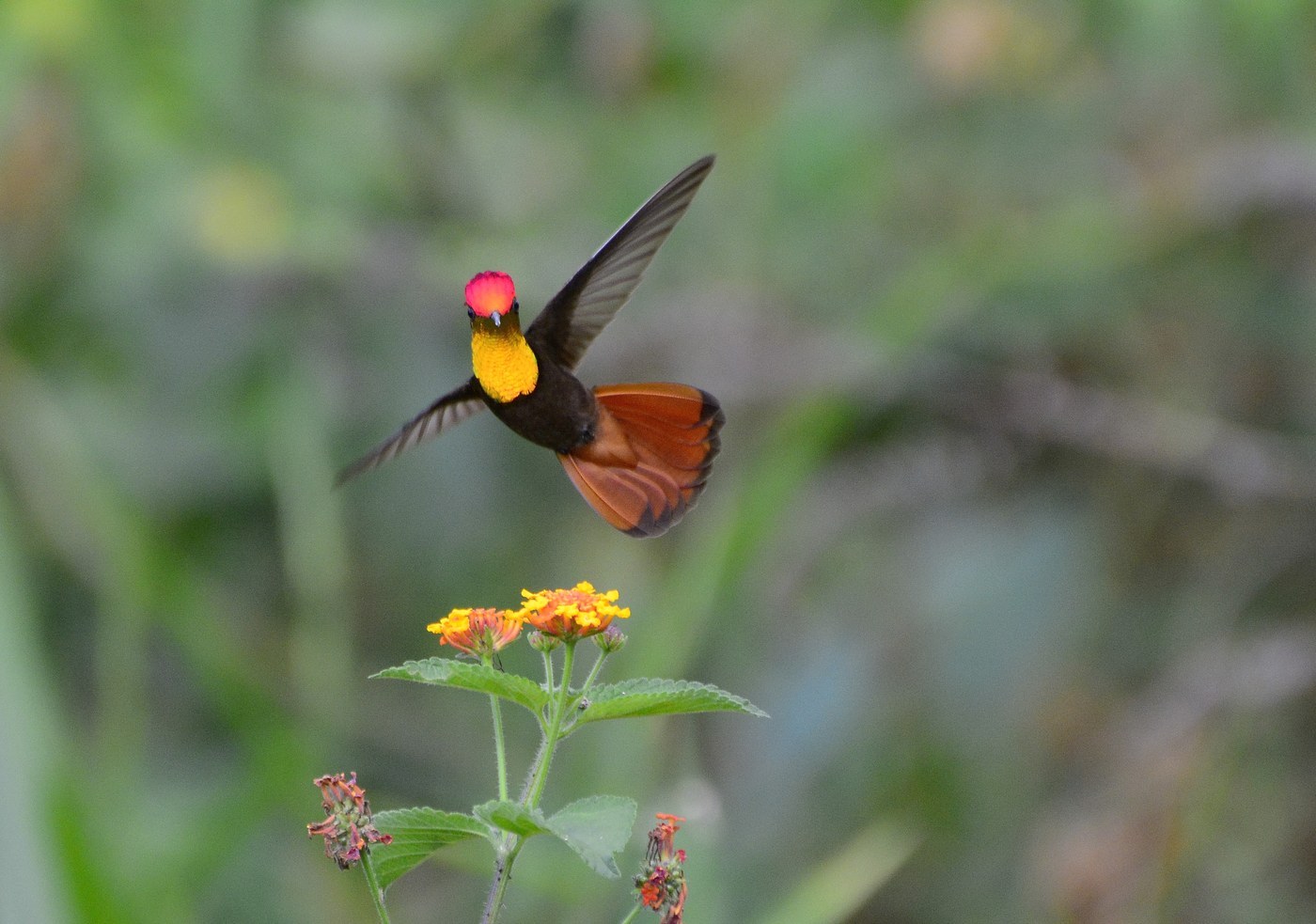
Key Field Marks
- Small, compact hummingbird with a short, straight black bill.
- Breeding male: unmistakable — a glittering ruby-red crown paired with an incandescent golden-orange to topaz throat, chestnut-colored body, and a blackish, slightly notched tail.
- Female and nonbreeding/eclipse male: bronzy-green above, pale grayish-white below, lacking the male's iridescent head and throat colors; some show a dark central tail band with white-tipped outer feathers.
- Overall shape is stocky and short-tailed compared to many other hummingbirds in its range.
Separating It From Similar Species
- No other hummingbird in its range combines a red crown with an orange/gold throat, so adult males are essentially unmistakable when seen well.
- Females and immatures are harder to place and can resemble female Black-throated Mango or other female Amazilia-type hummingbirds; focus on the plain grayish underparts and the dark-and-white tail pattern rather than throat color.
- Told from Black-throated Mango (a similar-sized species sharing part of its range) by lacking that species' bronzy-green mango-colored body and by the tail pattern.
Where and When to Look
- Resident across northern South America (Venezuela, the Guianas, northern Brazil, Colombia) and on Trinidad and Tobago.
- Found in open and semi-open habitats: savanna, scrubby edges, gardens, and cultivated land rather than deep forest interior.
- Present year-round within its range; no long-distance migration, though some local seasonal movements track flowering.
Voice and Behavior
- Calls are sharp, dry chips and buzzy chatters.
- Males give buzzy, mechanical-sounding trills during display flights and while defending flowering shrubs.
- Feeds low in open scrub and gardens, often perching conspicuously between bouts of nectar feeding, unlike many forest hummingbirds that stay hidden.
Frequently asked questions
What makes a male Ruby-topaz Hummingbird so distinctive?
Its combination of an iridescent ruby-red crown and a golden-orange (topaz) throat is unique among hummingbirds in its range, making adult males easy to identify in good light.
How do you identify a female Ruby-topaz Hummingbird?
Females lack the male's bright head and throat colors; look for bronzy-green upperparts, plain grayish-white underparts, and a dark tail band with white-tipped outer feathers.
Where is the Ruby-topaz Hummingbird found?
It lives in northern South America and on Trinidad and Tobago, favoring open savanna, scrub, and garden habitats rather than dense rainforest.
Does the Ruby-topaz Hummingbird migrate?
It is largely resident year-round, though individuals may shift locally in response to flowering patterns.