
Royal Albatross Identification Guide
One of the largest flying birds on Earth, the Royal Albatross is a huge white seabird of the Southern Ocean, distinguished from the similar Wandering Albatross group by bill and wing details.
Read the full Royal Albatross encyclopedia entry →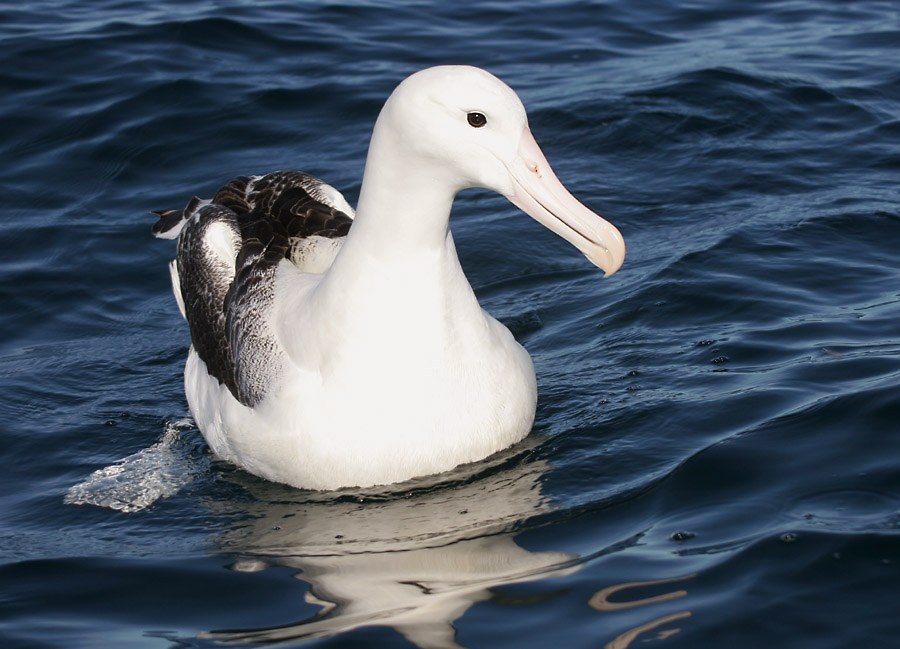
Key Field Marks
- Size & shape: An enormous albatross with a wingspan that can reach 3.05–3.5 m, among the largest wingspans of any living bird; long, narrow, stiffly held wings adapted for dynamic soaring over open ocean.
- Plumage: Predominantly white body; the upperwing is mostly white with a black trailing edge, and the amount of black decreases (the wing whitens further) as birds age — Southern Royal Albatross typically shows whiter upperwings than Northern Royal Albatross, which retains more black along the leading edge and forewing even in old adults.
- Bill: Large, pale pink, with a diagnostic black cutting edge (tomium) line running along the mandible — this thin black line is a key mark separating Royal Albatross from the closely related Wandering Albatross complex, which lacks it.
- Underwing: Mostly white with black wingtips and a narrow black trailing edge; a diagonal dark mark near the carpal (wrist) area is often present.
Separating It From Similar Species
- Wandering Albatross complex (Wandering, Antipodean, Amsterdam Albatross, etc.): Extremely similar in size and overall whiteness; the clearest structural difference is the black cutting edge on the bill of Royal Albatross, absent in Wandering-type albatrosses. Molt pattern of upperwing whitening also differs: Royal Albatrosses whiten from the front of the wing backward with age, while Wandering-type albatrosses whiten in a different sequence.
- Northern vs. Southern Royal Albatross: Northern retains more black on the upperwing leading edge throughout life; Southern becomes almost entirely white-winged in old adults. Definitive separation of the two Royal Albatross forms can require close study of wing pattern and, ideally, known breeding origin.
- Other smaller albatrosses (mollymawks): Much smaller with dark upperwings and often dark markings on the head/underwing margins, easily separated by size and pattern alone.
Where and When to Find One
- Range: Breeds exclusively on New Zealand's subantarctic and offshore islands — Northern Royal Albatross breeds mainly on the Chatham Islands (plus a small mainland colony at Taiaroa Head near Dunedin), while Southern Royal Albatross breeds on Campbell Island and the Auckland Islands.
- At sea: Ranges very widely over the Southern Ocean, regularly reaching the waters off South America, and is a classic sight on pelagic birding trips out of New Zealand and southern South America.
- Habitat: Fully pelagic outside the breeding season; breeding colonies are on open, grassy slopes of remote subantarctic islands.
Voice
- Silent at sea. At breeding colonies, adults perform elaborate courtship displays accompanied by bill-clapping and loud, braying or groaning calls.
Frequently asked questions
How do you tell a Royal Albatross from a Wandering Albatross?
The most reliable mark is a thin black line along the cutting edge of the otherwise pale pink bill in Royal Albatross, which Wandering Albatross lacks; the pattern and sequence of upperwing whitening with age also differs between the two groups.
Where does the Royal Albatross breed?
Exclusively on New Zealand's islands — Northern Royal Albatross mainly on the Chatham Islands (with a small colony at Taiaroa Head), and Southern Royal Albatross on Campbell Island and the Auckland Islands.
What is the wingspan of a Royal Albatross?
It can reach roughly 3.05 to 3.5 meters, making it one of the largest wingspans of any living bird.
Can you tell Northern and Southern Royal Albatross apart?
Southern Royal Albatross becomes almost entirely white-winged as it ages, while Northern Royal Albatross retains more black along the upperwing leading edge even as an old adult, though close study is often needed for certainty.