
Rough-legged Hawk Identification Guide
An Arctic-breeding buteo named for its feathered legs, best recognized in winter open country by its habit of hovering in place while hunting and its dark belly band and wrist patches.
Read the full Rough-legged Hawk encyclopedia entry →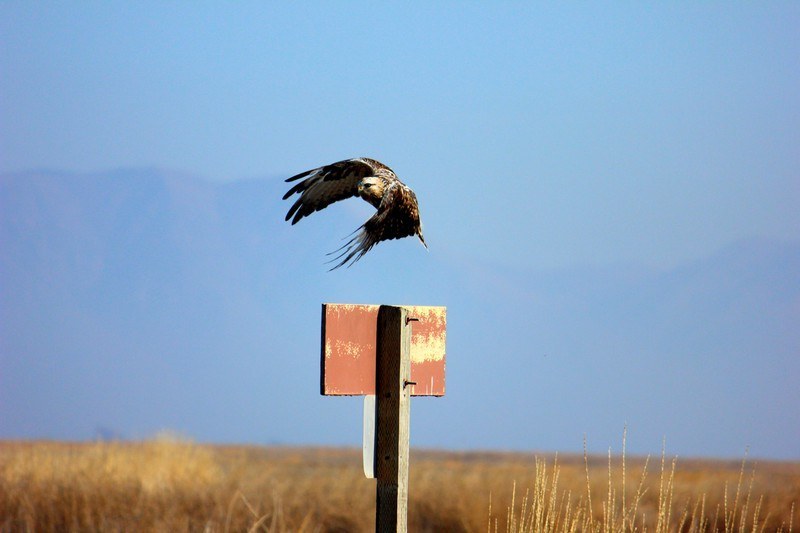
Key Field Marks
- Size & shape: A large buteo with long, fairly narrow wings and a relatively small bill and head compared to body size; legs are feathered all the way down to the toes, the source of its name (though this is hard to see in the field except at close range or in photos).
- Light morph: Pale head and breast, a dark belly band or blotchy patch across the lower breast/belly, prominent dark carpal (wrist) patches on the underwing, and a whitish tail with a dark terminal band (often with additional narrower dark bands).
- Dark morph: Overall blackish-brown body and underwing coverts, contrasting with paler flight feathers and a pale tail base — pattern varies individually.
- In flight: Often glides and soars with wings held in a slight dihedral (V-shape), somewhat like a Turkey Vulture or Northern Harrier, adding to identification at a distance.
Separating It From Similar Species
- Habit is a major clue: Rough-legged Hawk frequently hunts by hovering ("kiting") in place over open ground, flapping steadily to hold its position — a behavior far less commonly and less persistently shown by Red-tailed Hawk.
- Red-tailed Hawk: Broader wings, rufous tail in adults, unfeathered legs, and lacks the sustained hovering habit.
- Ferruginous Hawk: Larger overall, pale head, rufous "leggings" on the thighs, and a different underwing pattern lacking the bold dark carpal patches typical of Rough-legged.
- Golden Eagle: Much larger and bulkier with a proportionally bigger head/bill and different flight silhouette.
Where and When to Find One
- Range: A circumpolar Arctic breeder found across northern Canada, Alaska, Scandinavia, and Siberia; in winter it moves south into open country across the temperate United States, Europe, and Asia.
- Habitat: Tundra with rocky outcrops or cliffs for nesting in summer; open fields, prairies, marshes, and agricultural land in winter, where it is a classic bird of wide-open landscapes rather than forest.
- Season: Present in most of its winter range from roughly late fall through early spring; entirely absent from temperate latitudes during the breeding season.
Voice
- Largely silent away from the breeding grounds. On the tundra breeding territory, it gives a descending, mewing scream broadly similar to calls of other buteos.
Frequently asked questions
What is the most reliable behavioral clue for identifying a Rough-legged Hawk?
Its habit of hovering, or "kiting," in place over open fields while hunting — flapping steadily to hold position in the air — is shown far more persistently by Rough-legged Hawk than by other North American buteos.
Why is it called the Rough-legged Hawk?
It has feathers extending all the way down its legs to the toes, unlike most other hawks, which have bare lower legs; this feathering is an adaptation to its cold Arctic breeding habitat.
When and where can you see a Rough-legged Hawk?
It breeds on Arctic tundra in summer and is unavailable to most birders then; in winter it moves into open fields, prairies, and marshes across the temperate United States, Europe, and Asia, typically from late fall through early spring.
How do you tell a light-morph Rough-legged Hawk from a Red-tailed Hawk?
Look for a dark belly band, bold blackish carpal patches on the underwing, and a whitish tail with a dark terminal band, plus the hovering hunting behavior — Red-tailed Hawk instead shows a rufous tail and unfeathered legs and rarely hovers persistently.