
Roseate Tern Identification Guide
A pale, elegant tern known for its very long tail streamers, buoyant flight, and a faint rosy blush on fresh breeding plumage, breeding in dense colonies on offshore islands.
Read the full Roseate Tern encyclopedia entry →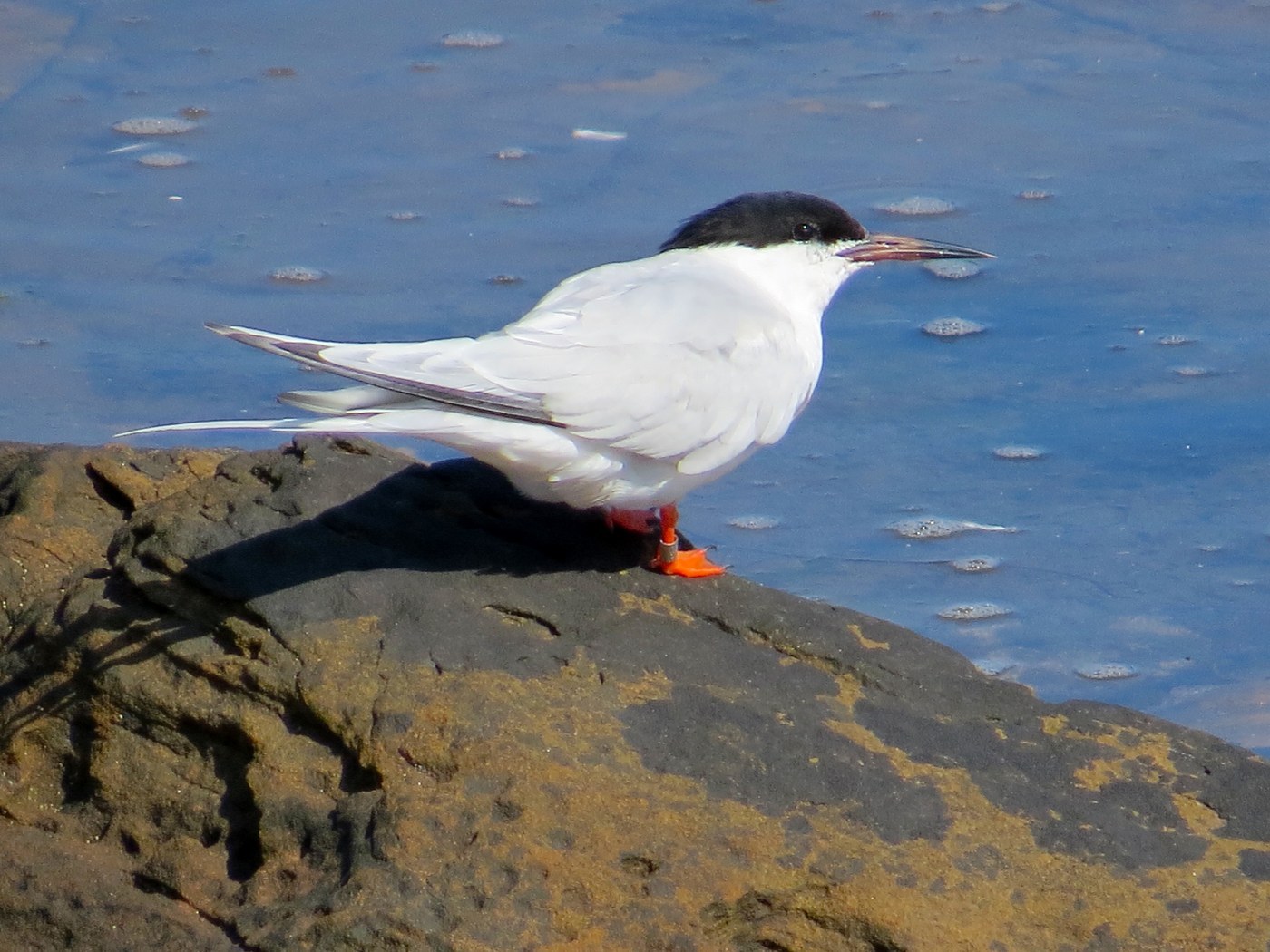
Key Field Marks
- Size & shape: A medium-sized tern, 33–41 cm including tail, that looks slender and long-tailed compared to relatives — the tail streamers often extend noticeably beyond the folded wingtips at rest, longer than in Common or Arctic Tern.
- Breeding plumage: Very pale grey upperparts (paler than Common Tern), whitish underparts that can show a faint pink flush in fresh plumage (the source of the name, though this fades quickly and is hard to see in the field), a full black cap, and long orange-red legs.
- Bill: Mostly black with a variable amount of red at the base, generally showing less red than Common Tern.
- Flight: Fast, buoyant, with quicker, stiffer wingbeats than Common Tern; often plunge-dives steeply for small fish.
Separating It From Similar Species
- Common Tern: Darker grey mantle, shorter tail streamers, more extensive red on the bill, and a dark wedge along the outer primaries visible in flight that Roseate lacks (Roseate's wings look more uniformly pale from below).
- Arctic Tern: Has translucent, more uniformly grey wings, an all blood-red bill, and shorter legs; Roseate looks paler-backed with a whiter overall appearance and longer tail streamers.
- Overall impression: Roseate looks paler, whiter, longer-tailed, and "sharper" in flight than either relative, with a call that is often the most reliable clue in mixed colonies.
Where and When to Find One
- Range: A colonial, patchily distributed breeder — northeastern United States and Atlantic Canada, the Caribbean, parts of Europe (notably Ireland and the UK), West Africa, the Indian Ocean, and Australia, with distinct regional populations.
- Habitat: Breeds on offshore islands and islets with sand, rock, or sparse vegetation, almost always nesting in mixed colonies alongside Common and/or Arctic Terns; forages over open water and tide rips near the colony and during migration.
- Season: Present at colonies during the breeding season (roughly May–August in the Northern Hemisphere); the Atlantic population winters well offshore West Africa.
- Conservation note: Populations are localized and considered threatened or endangered in several regions due to limited colony sites and predation pressure.
Voice
- A harsh, distinctive "chivik" or sharp "kip" call, quite different from the drawn-out "kee-arrr" of Common Tern — a useful way to pick out Roseates calling within a large mixed tern colony.
Frequently asked questions
What is the best field mark for a Roseate Tern in flight?
Very long tail streamers extending past the wingtips at rest, combined with pale grey upperparts lacking the dark outer-wing wedge shown by Common Tern, and a quick, buoyant flight style.
Does the Roseate Tern really have pink underparts?
Freshly molted breeding adults can show a faint rosy blush on the breast, but it fades quickly and is often difficult to see in the field, so it is not a reliable everyday field mark.
How do you separate a Roseate Tern from a Common Tern by call?
Roseate gives a harsh, sharp "chivik" or "kip" note, distinctly different from the longer, more drawn-out "kee-arrr" call typical of Common Tern.
Why are Roseate Terns considered threatened in some regions?
They breed in a limited number of dense colonies on offshore islands, making them vulnerable to habitat loss, predation, and disturbance, which has led to endangered or threatened status in parts of their range.