
Roseate Spoonbill Identification Guide
The only pink spoonbill in the Americas, this large wading bird combines a flat, spatula-shaped bill with brilliant pink plumage and a bare greenish head.
Read the full Roseate Spoonbill encyclopedia entry →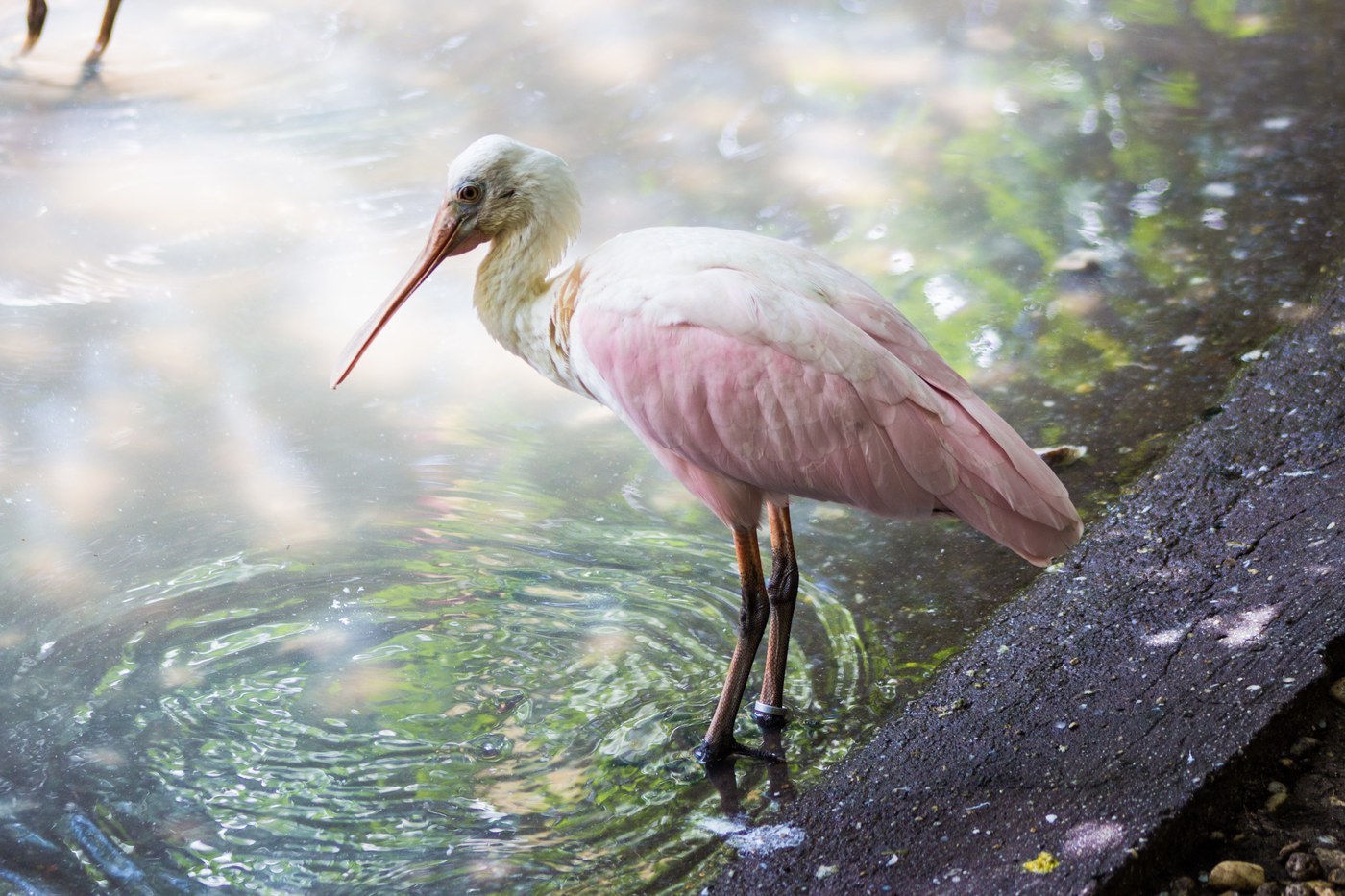
Key Field Marks
- Size & shape: A large wading bird, 71–86 cm long, with long legs, a long neck, and the unmistakable flat, spoon-shaped bill held level or angled down while feeding.
- Adult plumage: Overall pink body plumage, with a deeper carmine-red patch on the shoulder/wing coverts and a tuft of curled orange tail feathers; the neck and upper back are white; the head is bare and pale greenish-grey in breeding adults (sometimes with a darker crown patch).
- Juvenile: Much paler, whitish-pink, with a fully feathered white head (no bare skin) and a pale pinkish-grey bill that darkens with age.
- Bill: Long, flattened, and spatulate — grey and smooth in adults, a defining structural feature unique among American wading birds.
Separating It From Similar Species
- No other American bird combines pink plumage with a spoon-shaped bill, making adults essentially unmistakable at close or moderate range.
- Flamingos: Superficially pink but have a long, sharply down-curved bill and a much longer, more sinuous neck; spoonbills have a straight neck and flattened bill rather than a hooked one.
- Juveniles/immatures could suggest a pale ibis at a distance, but the flat spatulate bill (versus an ibis's down-curved slender bill) is diagnostic once seen clearly.
Where and When to Find One
- Range: Gulf Coast of the United States, Florida, the Caribbean, and Central and South America; post-breeding dispersal (mainly by juveniles) has been expanding the species' range farther north and inland along the U.S. Atlantic and Gulf coasts in recent decades.
- Habitat: Shallow coastal lagoons, mangrove swamps, brackish and freshwater marshes, and tidal mudflats.
- Season: Largely resident in core range with local and seasonal movements; more widespread post-breeding dispersal is most noticeable in late summer and fall.
Voice
- Generally quiet away from breeding colonies; at nesting colonies, adults give low, hoarse grunting and croaking notes. Most identification is visual rather than by voice.
Behavior
- Feeds by wading in shallow water and sweeping its partly open bill side to side, snapping it shut on small fish, crustaceans, and aquatic invertebrates detected by touch. Often forages and roosts alongside herons, egrets, and ibises in mixed wading-bird flocks.
Frequently asked questions
How do you tell a Roseate Spoonbill from a flamingo?
Spoonbills have a straight neck and a flat, spoon-shaped bill held level, while flamingos have a long, sharply down-curved bill and a longer, more curved neck. The two also differ in overall shape and typical posture while feeding.
Why do Roseate Spoonbills have a bare greenish head?
The bare, featherless head is a feature of breeding adults; it is greenish-grey and can show a darker crown patch, while juveniles have a fully feathered white head that has not yet molted to the adult bare-skin pattern.
Are juvenile Roseate Spoonbills pink?
Yes, but a much paler, washed-out pink than adults, and they lack the deep red shoulder patch and bare head of mature birds.
Where is the best place to see Roseate Spoonbills?
Shallow coastal lagoons, mangroves, and marshes along the Gulf Coast, Florida, the Caribbean, and Central/South America; post-breeding wanderers can also turn up on Atlantic coast wetlands farther north.