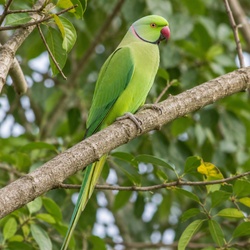
Rose-ringed Parakeet Identification Guide
A slender, bright green parakeet with a long tapering tail, native to Africa and South Asia and now a familiar, noisy feral resident of many cities worldwide.
Read the full Rose-ringed Parakeet encyclopedia entry →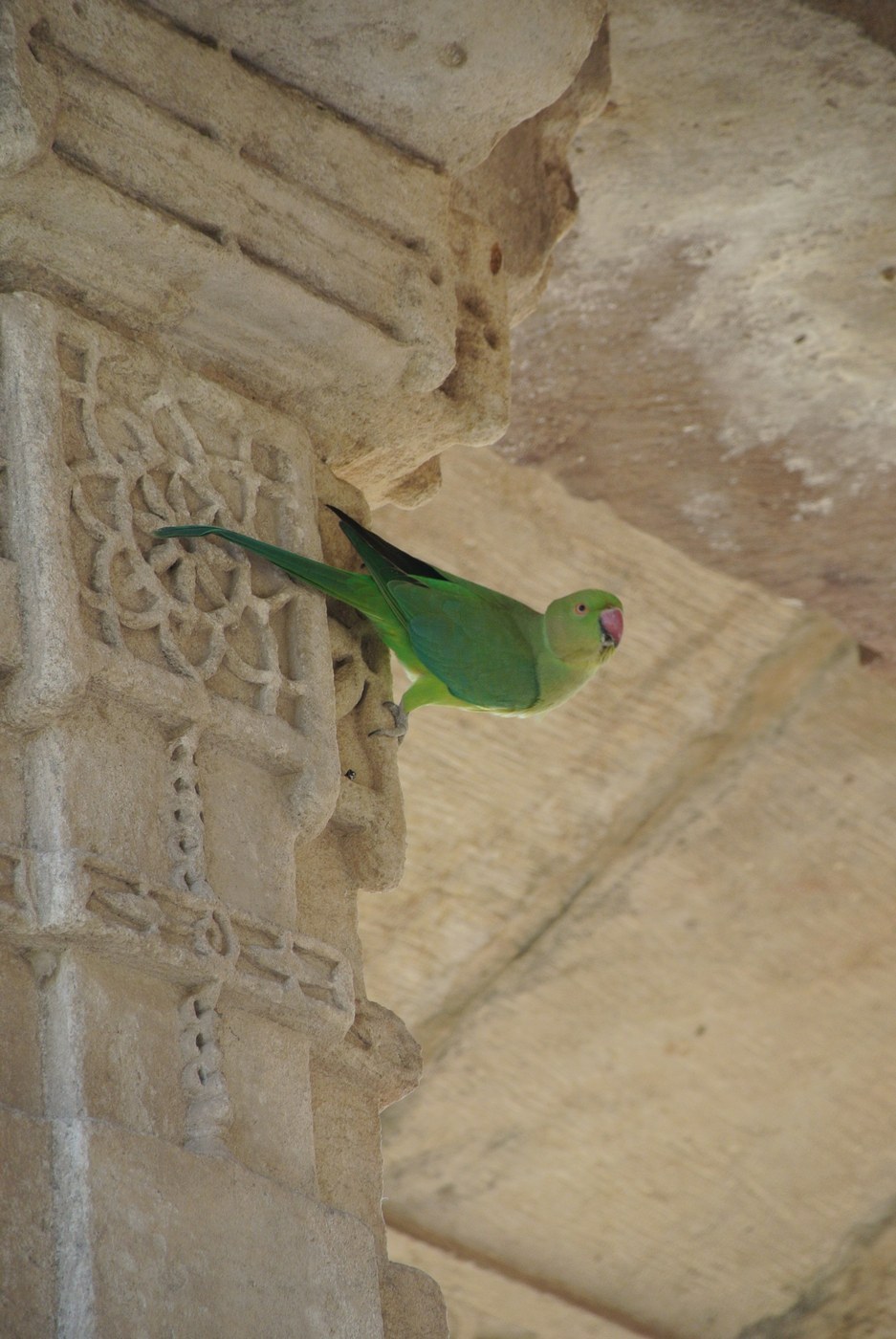
Key Field Marks
- Size & shape: About 40 cm including a long, pointed tail; slim-bodied with a fairly large head and hooked bill relative to overall size.
- Plumage: Bright grass-green overall, with slightly paler underparts and a bluish wash on the nape in some birds.
- Bill: Red upper mandible, black lower mandible.
- Adult male: Shows the namesake feature — a black chin stripe extending into a rose-pink and black neck ring (collar), with a blue-grey wash across the nape.
- Adult female and juvenile: Lack the neck ring entirely, or show only a very faint, incomplete pale ring; otherwise plain green.
Separating It From Similar Species
- Alexandrine Parakeet: Noticeably larger and heavier-headed with a much bigger, more powerful bill, plus a maroon-red shoulder patch that Rose-ringed lacks.
- Other Psittacula parakeets (e.g., Plum-headed Parakeet) differ in head color and range; Rose-ringed is best identified by its plain green head (aside from the male's collar) and its now-cosmopolitan feral distribution.
- Female/juvenile Rose-ringed can be confused with other all-green parakeets in a region where multiple feral species coexist — check overall size, bill color, and tail length/shape.
Where and When to Find One
- Native range: Sub-Saharan Africa (a broad belt south of the Sahara) and the Indian subcontinent.
- Introduced/feral range: Well-established, self-sustaining populations exist in numerous cities across Europe (e.g., London, Amsterdam, Brussels), the Middle East, and parts of the United States and elsewhere, typically originating from escaped or released cage birds.
- Habitat: Highly adaptable — urban parks, gardens, orchards, farmland, and open woodland; readily uses artificial nest sites and mature parkland trees.
- Season: Resident and non-migratory year-round wherever established.
Voice
- Very vocal and conspicuous: loud, screeching "kee-ak" or "kee-kee-kee" calls given constantly in flight and from communal roosts. Large numbers gather to roost together at dusk, creating a distinctive noisy spectacle in many cities where the species is established.
Frequently asked questions
How can I tell a male from a female Rose-ringed Parakeet?
Only the adult male shows the black-and-rose-pink neck ring with a blue-grey nape wash; females and juveniles are plain green around the neck, at most showing a faint pale trace of a ring.
Are the Rose-ringed Parakeets seen in European and American cities wild or escapees?
They descend from escaped or released cage birds, but many urban populations are now large, self-sustaining, and fully naturalized, breeding freely outside their native African and South Asian range.
How do you separate Rose-ringed from Alexandrine Parakeet?
Alexandrine Parakeet is distinctly larger and bigger-headed with a heavier bill, and shows a maroon shoulder patch that Rose-ringed Parakeet never has.
What habitat do Rose-ringed Parakeets prefer?
They are highly adaptable, using urban parks and gardens as readily as farmland and open woodland, and often nest in tree cavities in mature parkland trees.
Rose-ringed Parakeet identified by the community
Recent Rose-ringed Parakeet sightings identified with Bird Identifier.